
Lesson 2
Tracks and the hierarchy
The tree on the left looks like folders and files. It is not, and the difference is worth five minutes: there is one kind of thing in it, and what any row happens to be is decided entirely by what it is holding.
One kind of node
Most DAWs have a track type and a plugin type, and a plugin lives in a slot on a track. Phonon has neither. Every row in that tree is the same kind of object, and it can be any of three things depending on what it holds:
- It has children and no module, and it is a container: a track, or a bus.
- It has a module and no children, and it is one module sitting in a chain.
- It has both, which is legal and means the node runs its own module before its children.
So a track does not have a slot rack attached to it. The modules on a track are that track's children, in the tree, at the same level of the same structure as everything else. Once you have that, most of the panel explains itself.
Two directions, two meanings
Because there is one structure rather than two, the tree has to carry both of the things a mixer normally splits between a channel strip and a mix bus. It does that with direction.
Down is series. A node's children run in the order they are listed, and each hands what it produced to the next. Across is parallel. Nodes beside each other are summed.
That one rule has a practical edge. Reordering a track's children changes the sound, every time, because you are reordering a signal path. Reordering tracks changes nothing at all, so you are free to arrange them however you like to read.
A small project, read row by row
Here is the tree with something in it. A bass track that is a chain of three, a drum track beside it, an audio track, and a bus.
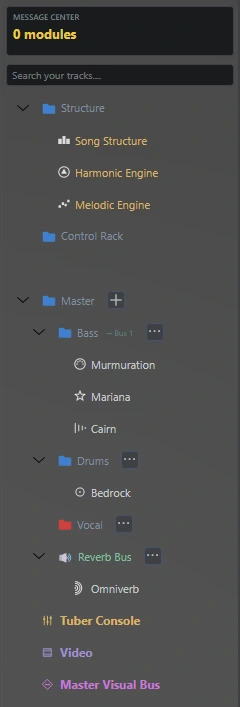
A container carrying MIDI and modules. Bass and Drums are ordinary tracks; Structure and Master are the same kind of object doing a different job.
An audio track. Vocal plays recorded audio regions rather than hosting instruments, and that is the only thing separating it from the blue ones.
A bus. Reverb Bus receives audio sent to it and runs it through the module inside, exactly the way a track runs its own chain.
A send, printed on the row it belongs to. The bass sits under Master but its audio goes to bus 1 instead.
Song Structure, the harmonic engine and the melodic engine get marks of their own rather than a category icon. They are the rows you go looking for in a large project.
The panel at the size it really is: 240 pixels wide, which is what it occupies on screen.
The colours are not decoration
Blue, red and green mean MIDI, audio and bus, and they are the same three colours the arrangement gives its lane headers, chosen by the same piece of code. That is deliberate: a track that read as one kind in the tree and another in the timeline would be worse than no colour at all.
It is worth knowing because most people navigate a long list by colour well before they read any of it.
Buses are in the tree because they are not special
A bus is a container with modules in it that other things feed. That is the same sentence as the one describing a track, which is why there is no separate mixer view holding a different set of objects: a bus goes in the same tree because it is the same thing.
What is not tree-shaped is the send. Where a track's audio goes is a number rather than a position, so the bass can sit under Master and still feed bus 1 without moving. The tree cannot express that with shape, so it prints it on the row instead.
There is one thing in the panel that this lesson has quietly simplified. The three rows at the bottom of the picture are the mixer console, the video track and the master visual bus, and the tree pulls them out and gives them their own place rather than leaving them where their wiring would put them. They are not exceptions to the model so much as fixtures of every project, and they get their own rows so that they are always in the same place.
What a new project starts with
Nothing above needed you to make anything, and neither does a new project. It arrives with a Structure folder holding the song structure, the harmonic engine and the melodic engine, plus a control rack and a master. The tracks are the part you add.
That is unusual and it is the point: harmony is running in Phonon before you have made a sound, which is why lesson 1 found a chord already lit in the lattice on an empty project. What the harmonic engine does with that, and which modules listen to it, is its own course.