Solved from its schematicAll Netlist Effects

A stereo lamp phaser

Guilt Complex 'A'

Guilt Complex 'A' Lamp Phaser

The phaser you leave on (because you couldn't live without it.)

A 1970s German lamp phaser, solved from a photograph of its schematic: eight all-pass stages whose resistors are light-dependent cells, two incandescent lamps that light them, a feedback loop and a blend. Nothing draws the sweep. The filaments heat and cool, and the cells follow them, slowly in the dark.

VST®3 effect · Windows 64-bit No activationmacOS VST3 and Audio Unit are in development.

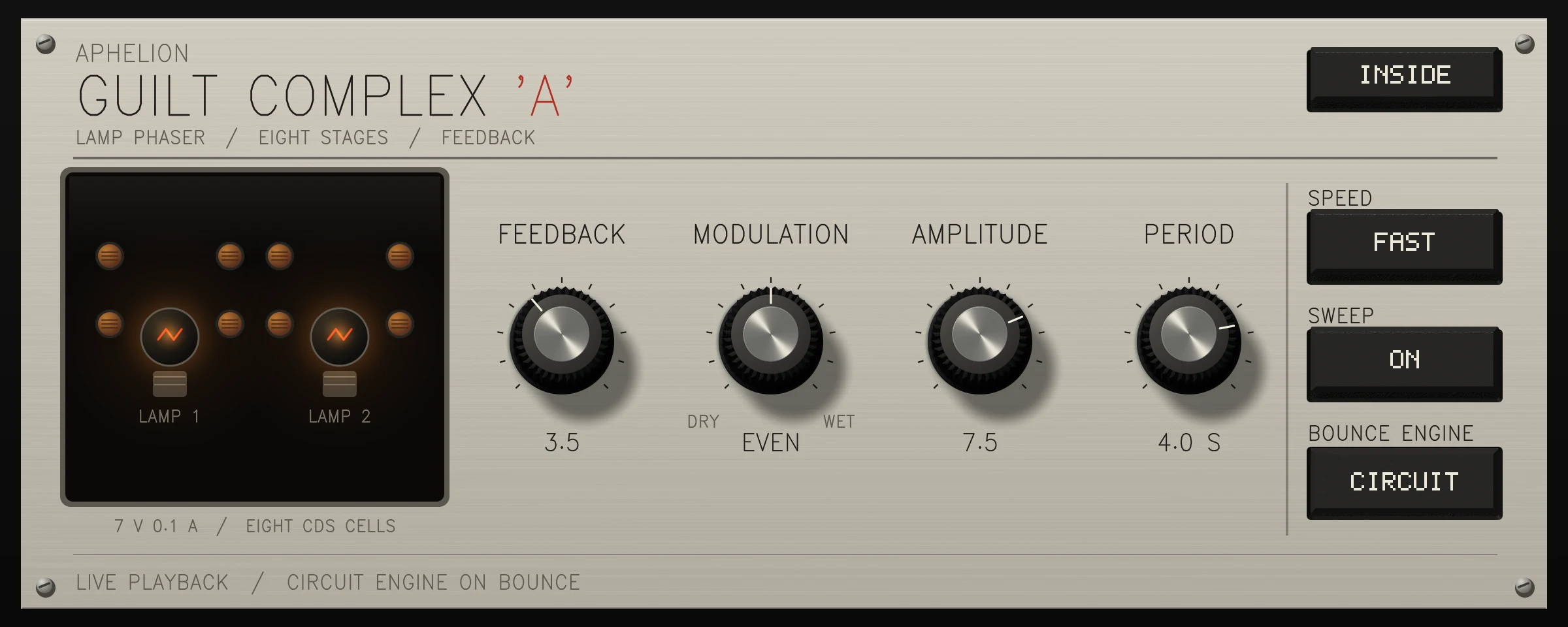
The FRONT face of the Guilt Complex 'A' panel in pale brushed metal: APHELION and GUILT COMPLEX 'A' at the top left, the 'A' in red, over LAMP PHASER / EIGHT STAGES / FEEDBACK; a dark window on the left where LAMP 1 and LAMP 2 glow orange among eight copper-colored cells, labeled 7 V 0.1 A / EIGHT CDS CELLS; the FEEDBACK, MODULATION, AMPLITUDE and PERIOD knobs, MODULATION on EVEN between DRY and WET and PERIOD at 4.0 S; on the right the SPEED key on FAST, SWEEP on ON and BOUNCE ENGINE on CIRCUIT; the INSIDE key at the top right; and along the foot the line LIVE PLAYBACK / CIRCUIT ENGINE ON BOUNCE.
  • Two lamps, eight cells
  • Eight stages
  • 50 Hz at the floor, as printed
  • One photograph of the sheet

Listen

Leave it on.

The same sixteen seconds, dry and twice through Guilt Complex 'A'. The three play together, so switching keeps your place: listen to WET 1 or WET 2 for a while, then press DRY.

Where it came from

A sweep made of heat.

Most phasers sweep along a shape: something draws a curve, and the notches follow it. A lamp phaser has no curve to follow. Its LFO swings the voltage on two small incandescent lamps, the lamps light eight cells whose resistance falls as the light rises, and the cells move the notches. So the sweep is a temperature. A filament heats in about 60 ms and cools over about 200, and a cell keeps darkening for 300 to 700 ms after its lamp has settled.

That is what makes it lean and breathe instead of wobble, and why you put it on a track and never take it off. Guilt Complex 'A' is a 1970s German lamp phaser solved from a photograph of its schematic: the eight stages, the feedback loop, the blend, the LFO, and the lamps and cells as the physics they are.

What is in the netlist

Light, not a control voltage.

Nothing in the signal path is told where to sweep. The LFO warms the lamps, the lamps light the cells, and the cells are the stages' resistors, all solved together with the feedback around them.

THE LAMPS AND THE CELLS Two small 7 V lamps in series, one lighting four of the cells and the other the other four. Each filament heats and cools by its own heat balance, and each cell answers its lamp's light, quickly as it brightens and slowly, over hundreds of milliseconds, as it fades.

Read from one photograph

Two figures on the sheet.

The source is a single photograph of the unit's schematic: no service notes, no parts list, no voltages. It prints two figures, the lamp line's top and the floor of its trim, and the sweep is calibrated to exactly those two.

  • 50 Hzthe sweep's floor, as the sheet prints it
  • 12.5 Vthe lamp line's top, where AMPLITUDE ends
  • 1 Hzbetween one notch solved on the netlist and by a separate calculation
  • 51 dBhow far that notch falls under the dry signal
THE SHEET AND THE NETLIST
WHATTHE SHEETTHE NETLIST
The sweep's floor50 HzF MIN solved to it: the lamp line at 3.95 V
The lamp line's top12.5 VAMPLITUDE at full: the lowest notch at 4.8 kHz
One notch, two waysthe lamp line at 7.124 V750 Hz solved, 751 Hz calculated

WHAT THE PHOTOGRAPH COULD NOT SETTLE

The lamp driver's front end is too faint to read, so the follower that is legible is fed the triangle mapped onto the sheet's range. The jacks' and the footswitch socket's switching are not modeled beyond the line path. One resistor in the LFO would, as read, stop it from running, so it is left out, and a third lamp is read as a panel light.

HOW THE NOTCH WAS CHECKED

With FEEDBACK off and the lamp line held at 7.124 V, the netlist's lowest notch lands at 750 Hz, 51 dB under the dry signal. A separate calculation from the filaments' heat balance, the cells' law and the stages' corners, with no circuit solved, puts it at 751 Hz.

Playback and bounce

Play it live. Bounce the circuit.

The circuit cannot promise real time on every kind of material, so Guilt Complex 'A' keeps two engines and tells you which one you are hearing. The panel prints it along its foot:

LIVE PLAYBACK / CIRCUIT ENGINE ON BOUNCE

LIVE PLAYBACK

The live engine.

While you play, the eight stages and the feedback loop are solved exactly each sample with ideal op-amps, the LFO is a triangle between the circuit's own turning points, and the lamps' heat and the cells' response are integrated as the circuit's are. It takes a few percent of one core. Through a sweep its lamps stay within 20 K of the circuit's and its cells within 5 to 10 percent. It leaves out the op-amps' finite bandwidth and the lamp follower's own law.

BOUNCE ENGINE: CIRCUIT

The netlist.

When your DAW renders offline, Guilt Complex 'A' solves the netlist in three blocks: the LFO, the lamps and their follower, and the eight stages, whose cells read the filaments' temperatures. The knobs move their parts as it goes, so the bounce follows your automation (CAP, the eight stage capacitors, from the next bounce), and both engines have the same delay, so a bounce lines up with playback to the sample.

What a bounce runs at each setting of BOUNCE ENGINE, and how long it takes
BOUNCE ENGINETHE PANEL SAYSA BOUNCE RUNSHOW LONG IT TAKES
LIVELIVE ENGINE / PLAYBACK + BOUNCEThe live engine, exactly as it plays.Faster than the song
CIRCUITLIVE PLAYBACK / CIRCUIT ENGINE ON BOUNCEThe netlist: the eight stages, the feedback, the LFO, and the lamps and cells as heat and light.From about the length of the song to a few times longer on bright, busy material

The panel

Two lamps, left on.

FRONT is the unit, with a window on LAMP 1 and LAMP 2 glowing at the engine's own filament temperature. INSIDE is what a technician would reach: the TRIMS, the SELECTED PARTS a unit was built with, and the LINE.

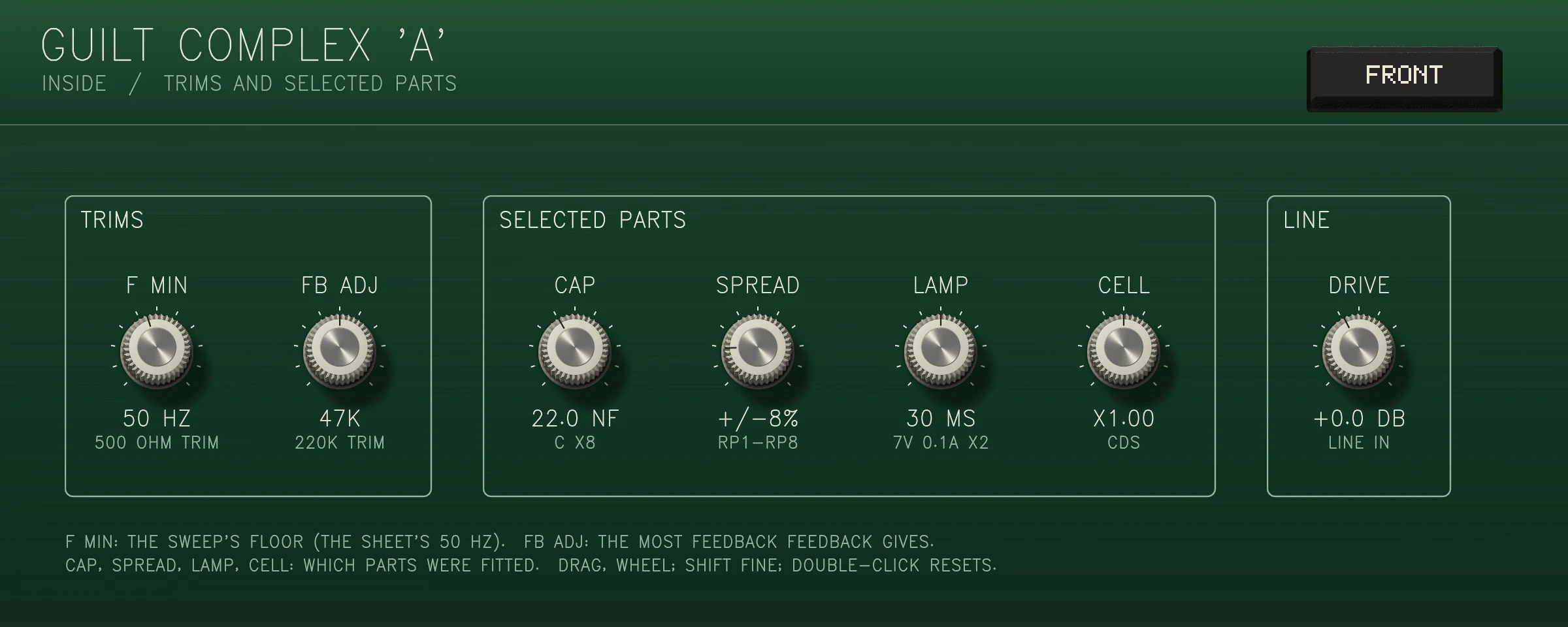
The INSIDE face of the Guilt Complex 'A' panel, a green board headed INSIDE / TRIMS AND SELECTED PARTS with a FRONT key: under TRIMS the F MIN knob at 50 HZ, a 500 ohm trim, and FB ADJ at 47K, a 220K trim; under SELECTED PARTS CAP at 22.0 NF, SPREAD at 8 percent across RP1 to RP8, LAMP at 30 MS for the two 7 V 0.1 A lamps, and CELL at x1.00; under LINE the DRIVE knob at +0.0 DB; and two lines of notes along the foot.
INSIDE The trims and the parts a unit was fitted with, each a part in the netlist. CAP takes effect live at once and in the bounce from the next one.

FEEDBACK

How much of the phased signal returns to the input: deeper, sharper notches, up to just short of oscillation.

MODULATION

The blend, from DRY through EVEN to WET. EVEN gives the deepest notches.

AMPLITUDE

How far the lamps swing above their floor, up to the sheet's 12.5 V at full.

PERIOD

The LFO's timing resistor; it shows the period, 4 seconds by default.

SPEED

FAST, or SLOW: the footswitch's slow contact.

SWEEP

ON, or HELD: the triangle stops where it is, and the lamps settle there.

BOUNCE ENGINE

CIRCUIT, an offline render solves the netlist; or LIVE, it renders the live engine, as fast as playback.

INSIDE / FRONT

The key at the top right turns the panel round: FRONT is the unit, INSIDE its trims and selected parts.

F MIN

TRIMS. The trim that sets the lamps' floor, so the sweep's lowest notch at its bottom, 10 to 400 Hz; the sheet's 50 Hz by default.

FB ADJ

TRIMS. The trimmer beside FEEDBACK, 10k to 220k: the most feedback FEEDBACK gives.

CAP

SELECTED PARTS. The eight stage capacitors, 15 to 33 nF, the range the sheet allows; in a bounce, from the next one.

SPREAD

SELECTED PARTS. How unevenly the eight cells answer their lamps, up to 50 percent.

LAMP

SELECTED PARTS. The filaments' thermal time, half to twice.

CELL

SELECTED PARTS. The cells' speed, a quarter to four times.

DRIVE

LINE. The level in, from -12 to +18 dB, and back out, so it changes how hard the circuit works rather than how loud it is.

What it is, and what it is not

Its own sound.

Guilt Complex 'A' is not a replica of any one unit, and we do not claim it sounds like one. It is what the circuit on that sheet does, with the parts the sheet left open chosen inside the ranges it gives and the rest estimated and marked.

SOLVED

The eight stages and their op-amps, the feedback loop, the blend, the LFO, the lamp follower, the two filaments by their heat balance and the eight cells by their own physics, quick to brighten and slow in the dark.

NOT MODELED

The power supply: the rails are ideal. The jacks' and the footswitch socket's switching, beyond the line path and the two footswitch contacts. In live playback, also the op-amps' finite bandwidth, which is why the circuit has the final word.

ESTIMATED

The cells' sensitivity, their slope and dark resistance, and their speed; the lamps' thermal time; one transistor's gain. Each is bracketed in the netlist. The cells' sensitivity sets the top of the sweep, so its 4.8 kHz at full AMPLITUDE is our best estimate.

The lamp phaser, solved

Guilt Complex 'A'

Guilt Complex 'A' Lamp Phaser

The phaser you leave on (because you couldn't live without it.)

VST®3 effect · Windows 64-bit No activationmacOS VST3 and Audio Unit are in development.

At a glance

Guilt Complex 'A' specifications

Technical specifications for Guilt Complex 'A', Lamp Phaser
FormatVST®3 effect · Windows 64-bit
In developmentmacOS VST3 and Audio Unit
Requires64-bit Windows 11, in any version Microsoft still supports. When the Mac version ships: macOS 15 or later, on Apple silicon or Intel.
ChannelsStereo
The netlistEight all-pass stages, the feedback loop, the blend, the LFO, the lamp follower and the two lamps
Read fromOne photograph of the schematic sheet · its 12.5 V lamp line and 50 Hz floor
PlaybackThe live engine, from the same parts · a few percent of one core
BounceBOUNCE ENGINE CIRCUIT: the netlist · LIVE: the live engine
Bounce timeFrom about the length of the song to a few times longer
FRONTFEEDBACK, MODULATION, AMPLITUDE, PERIOD · SPEED FAST or SLOW · SWEEP ON or OFF · BOUNCE ENGINE
INSIDEF MIN and FB ADJ · CAP, SPREAD, LAMP and CELL · DRIVE
LatencyThe same in playback and the bounce, so a bounce lines up to the sample
The panel1200 by 480 · two faces
Validation47 of 47 validator tests · host-tested
ActivationNone. No license server, no phone-home
Security updatesUntil November 2031
LicenseLicense agreement · Facts sheet
VST Compatible

VST is a registered trademark of Steinberg Media Technologies GmbH.