
THE CLONE
Every voice is the whole voice circuit, oscillators to VCA, with one board of shared modules beside the four. Turn the new controls down and each voice is the stock circuit.
Four-Voice Netlist Synthesizer
Four voices, screaming into the void, forever.
Four voices of a 1978 Japanese semi-modular, solved from its service manual part by part. Then two circuits it never had: a wave wrapper before the filters, and a folder that folds nothing but the resonance.
VST®3 instrument · Windows 64-bit No activationmacOS VST3 and Audio Unit are in development.
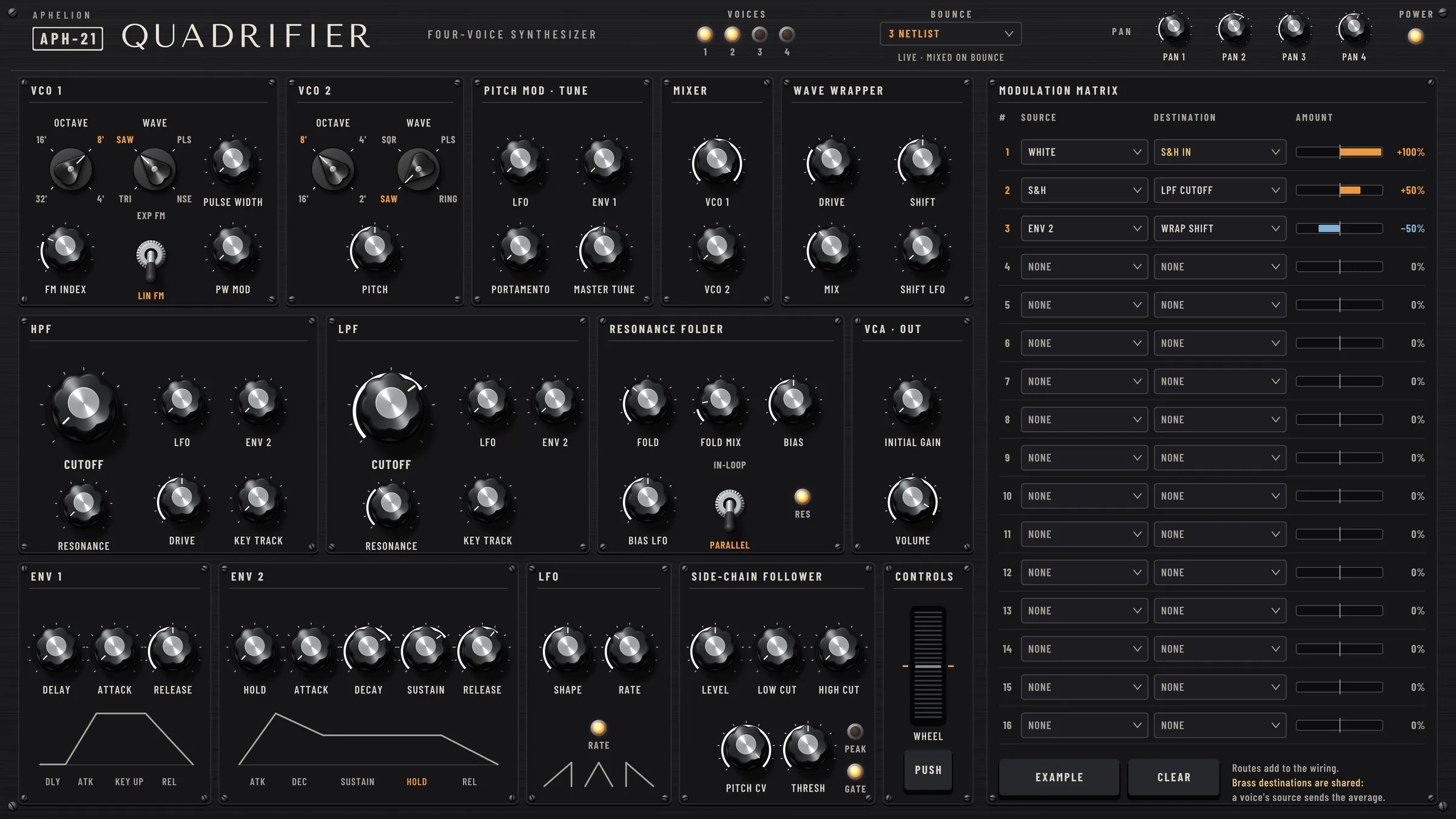
THE CLONE
Every voice is the whole voice circuit, oscillators to VCA, with one board of shared modules beside the four. Turn the new controls down and each voice is the stock circuit.
THE NEW CIRCUITS
A WAVE WRAPPER before the filters, and a RESONANCE FOLDER that folds the low-pass's ring and nothing else. Both are in the netlist, solved with the rest of the voice.
THE BOUNCE
Play it through a live model of the same voice. When your DAW renders, it solves the circuit, block by block, as much of it as you choose.
Listen
Six takes from the Quadrifier, thirty-two seconds each, in stereo. They are here as they were given, at the levels they came at, so the last one plays quieter than the rest.
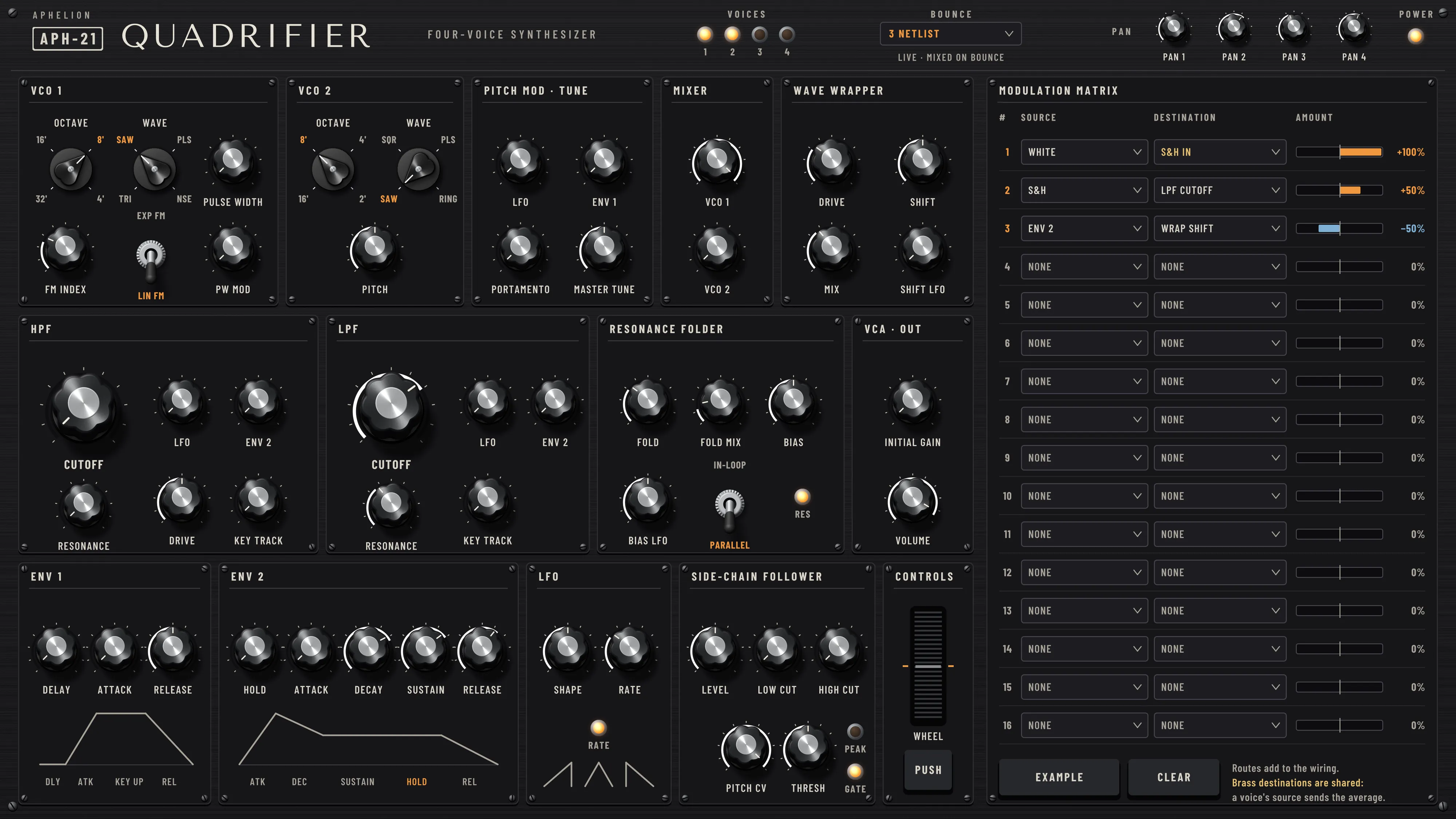
THE PANEL
Fifteen modules in blackened steel: the voice's path across the top two rows, the envelopes and the shared modules along the foot, and the matrix down the right side.
Then we made it gnarly
Both are built into the voice and solved with it, not effects after it: the wrapper feeds the filters, and the folder lives on the low-pass's resonance. Turn both down and each voice is the stock circuit again.
NEW · BETWEEN THE MIXER AND THE FILTERS
A wavefolder turns a wave back at its limit. A wrapper carries it over to the other side: six transistor pairs step it back into a 5 V window every time it would leave, so a wave driven past the window comes out in pieces. DRIVE pushes the mix into it from one to six times, SHIFT moves the window off centre, SHIFT LFO lets the LFO move it, and MIX sets how much of the wrapped wave the filters hear.
NEW · ON THE LOW-PASS'S RESONANCE
It folds the resonance and nothing else. A twin of the low-pass runs beside it with no resonance; the difference between the two is the ring alone, with no bass in it, and that is what goes through the six folding pairs. FOLD drives it, BIAS makes the folds lopsided, and FOLD MIX blends it in. PARALLEL puts the folded ring back on top of the clean twin. IN-LOOP feeds it back into the filter as its resonance, and the filter screams through the folds.
2590
spectral lines in the low-pass's ring, PARALLEL
1088
spectral lines, IN-LOOP
Counted in SPICE on the netlist, before the fold and after it.
First, the clone
Every voice is the original's voice circuit, read part by part from its service manual and written out as a netlist, and one more board of it holds the shared modules. In SPICE, the netlist's oscillators track within 0.6 percent across four octaves. Then the plug-in solves the same netlist with a solver of its own, and here is that solver against SPICE, block by block.
| BLOCK | THE PANEL | HERE | SPICE | |
|---|---|---|---|---|
| LPF | CUTOFF centre, RESONANCE full | 497.5 Hz | 500 Hz | sings on its own |
| HPF | CUTOFF centre, RESONANCE full | 496.9 Hz | 500 Hz | sings on its own |
| LFO | RATE full, then half | 19.14 Hz, 9.03 Hz | 19.2 Hz, 9.0 Hz | the rate |
| LFO | the triangle and the pulse | 5.53 V, 5.11 V | 5.5 V, 5.1 V | peak to peak, and high |
| NOISE | white, after six seconds | 4.59 V | 4.7 V | peak to peak |
The 500 Hz is where the service manual's own adjustment procedure trims the filters, and each voice's oscillators are trimmed to their own circuit the same way.
The side-chain
Route a drum loop, a vocal or a guitar into the side-chain input, and the SIDE-CHAIN FOLLOWER turns it into control: its envelope, a gate whenever it passes THRESH, its pitch as a voltage, and its preamp and band-pass outputs. All five are sources in the matrix, so the track can open the filter, fold the resonance or fire the envelopes.
The patch bay's place
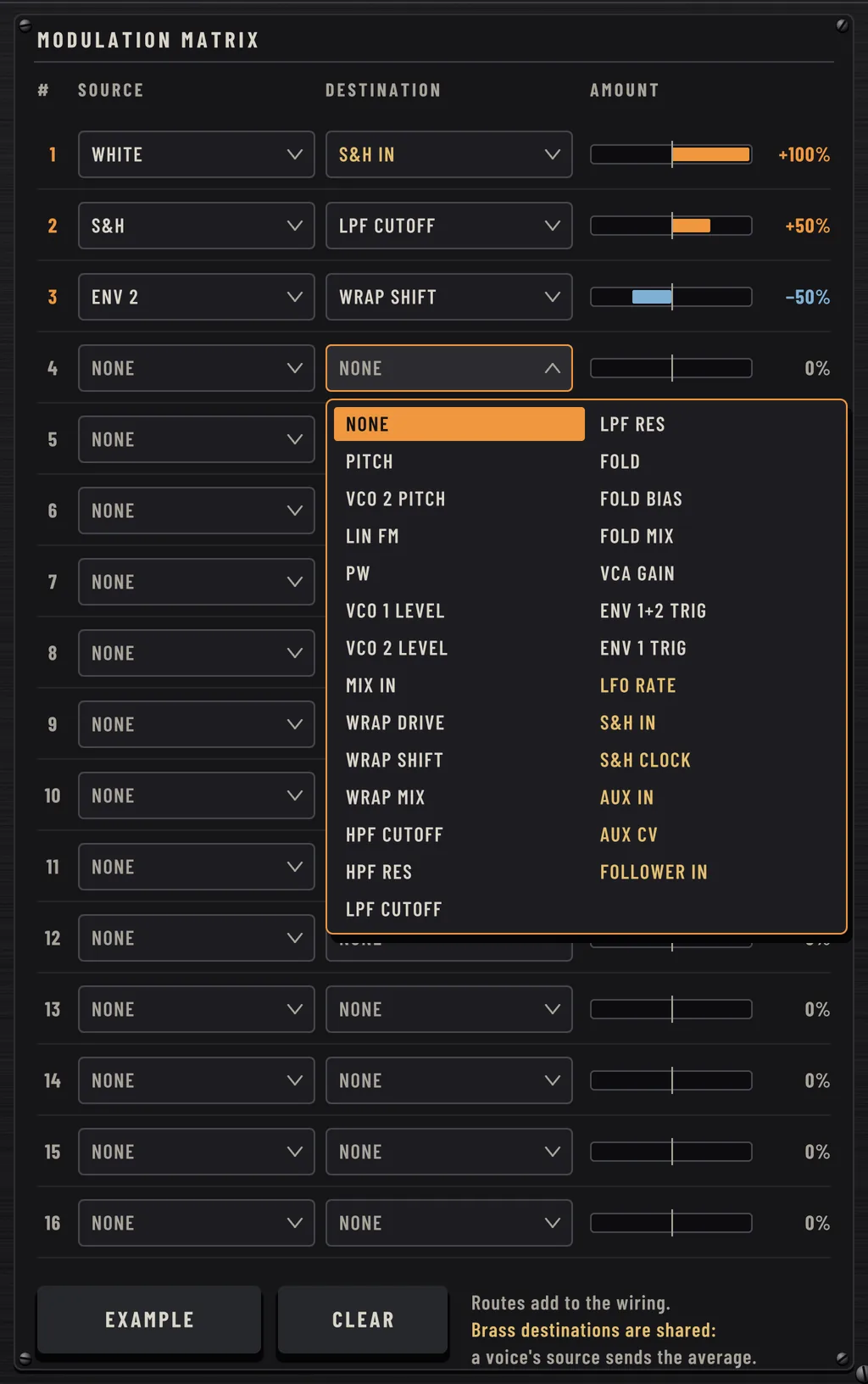
Sixteen slots, each a SOURCE, a DESTINATION and an AMOUNT either way: 24 sources, 26 destinations. The original's own wiring stays exactly where it was, VCO 2 into the FM, the LFO into the pitch and the filters, ENV 2 into both cutoffs, and every route adds to it. So no route can unplug the keys. EXAMPLE sets three routes and the knobs they need, and CLEAR empties the slots.
SOURCES
DESTINATIONS (brass: shared) (amber: new)
The six brass destinations are on the shared board, so a voice's source sent there arrives as the four voices' average. A route to a knob turns the knob's own part in the circuit.
Playback and bounce
Four solved circuits cannot keep up with your hands, so the Quadrifier plays a live model of the same voice, each stage's law worked from the netlist's own parts. When your DAW renders offline, with ENGINE on CIRCUIT, it solves the netlist for the blocks you choose and the live model plays the rest.
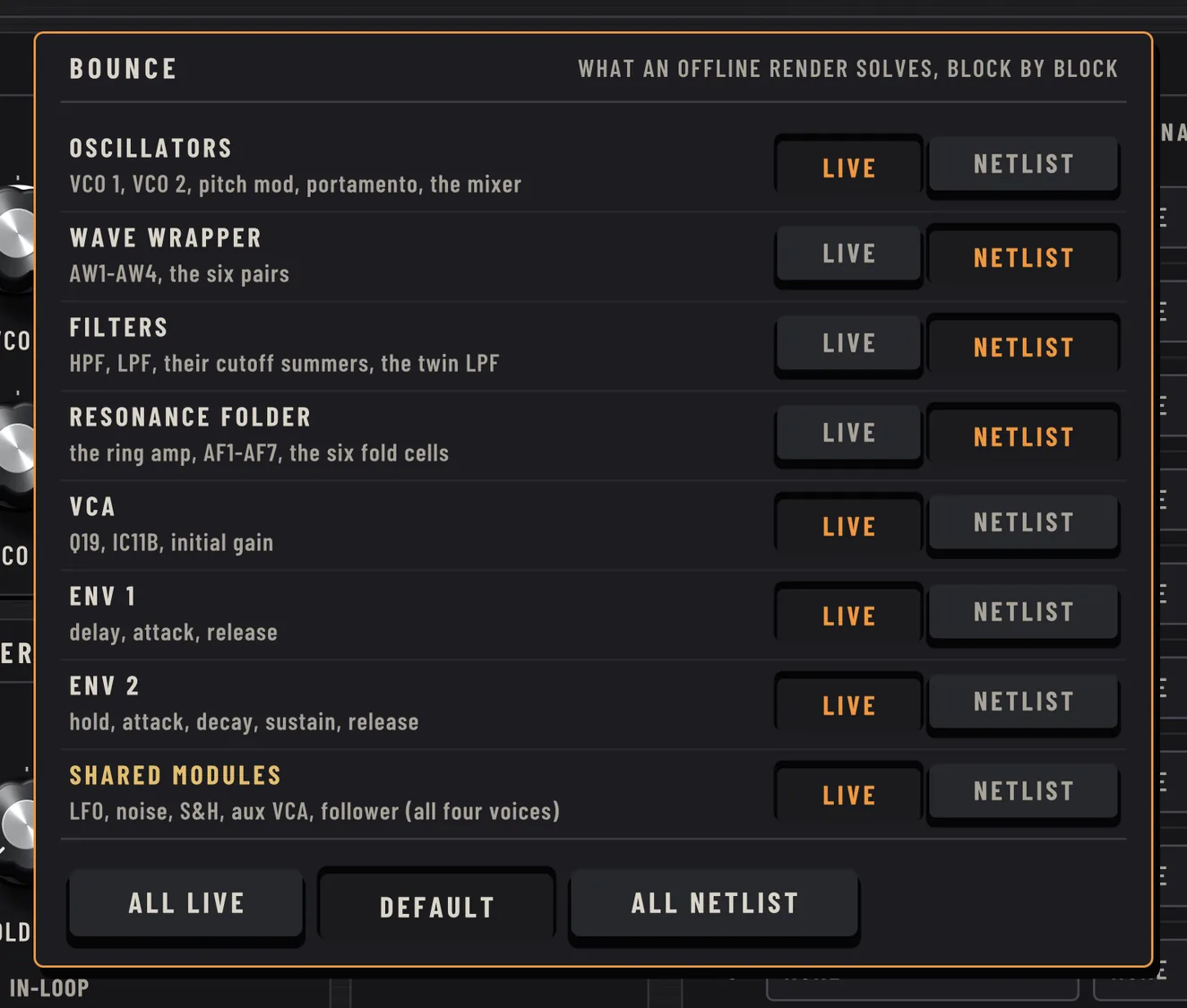
THE DEFAULT
The wrapper, the filters and the folder are solved; the oscillators, the envelopes, the VCA and the shared modules are live. The filters and the low-pass's twin are one block, because the folder's ring is the difference between the two and only cancels when both come from the same engine.
WHAT IT COSTS
On our bench, over a four-second phrase with its warm-up, the default blocks took from about 4 times to about 21 times as long as the audio, the plainest patch to one full of noise. Every block solved took about 65 times as long. ALL LIVE renders faster than the song.
HOW CLOSE
On the default patch the live engine sits 0.38 dB from the whole netlist, and its third-octave bands 1.74 dB from it on average. Its VCA is the simplest part of it, so on loud patches set VCA to NETLIST and hear the circuit's own. If the circuit ever faults, the panel says so, the fault is logged, and the live voices carry on.
Every control
The panel is 1600 by 900, and it uses the words any synth player already knows: LFO, ENV 1, RESONANCE, KEY TRACK. The voice modes, the unison detune, the bend range and the sustain pedal are in your host's parameter list, and four voices can play as POLY, UNISON or MONO, with LEGATO.
VCO 1
OCTAVE, 32' to 4'; WAVE, TRI, SAW, PLS or NSE; PULSE WIDTH and PW MOD; FM INDEX, and the LIN FM or EXP FM switch.
VCO 2
OCTAVE, 16' to 2'; WAVE, SAW, SQR, PLS or RING; and its own PITCH.
PITCH MOD · TUNE
How far the LFO and ENV 1 move both oscillators, PORTAMENTO, and MASTER TUNE.
MIXER
VCO 1 and VCO 2, each its own level.
WAVE WRAPPERNEW
DRIVE, SHIFT and MIX, and SHIFT LFO, how far the LFO moves the window.
HPF
CUTOFF and RESONANCE, LFO and ENV 2, DRIVE into it, and KEY TRACK.
LPF
CUTOFF and RESONANCE, LFO and ENV 2, and KEY TRACK.
RESONANCE FOLDERNEW
FOLD, FOLD MIX and BIAS, BIAS LFO, PARALLEL or IN-LOOP, and the RES lamp.
VCA · OUT
INITIAL GAIN, to hold the VCA open, and VOLUME.
ENV 1 · ENV 2
DELAY, ATTACK and RELEASE; HOLD, ATTACK, DECAY, SUSTAIN and RELEASE, each drawn as you set it.
LFO
SHAPE, from a rising ramp through a triangle to a falling one, RATE, and a lamp that blinks at it.
SIDE-CHAIN FOLLOWER
LEVEL, LOW CUT and HIGH CUT, PITCH CV and THRESH, with PEAK and GATE lamps.
CONTROLS
WHEEL and PUSH, a wheel and a button, both of them sources in the matrix.
VOICES · BOUNCE · PAN
Along the top: a lamp for each voice, the BOUNCE field and its menu, and PAN 1 to PAN 4.
What it is, and what it is not
SOLVED
Every voice's circuit and the shared board, with the wrapper and the folder in the same netlist, on the blocks the BOUNCE menu names. The power supply is left out, its rails ideal, and so are the lamps and the headphone amplifier. The keyboard is your host's.
READ, AND ESTIMATED
The manual draws the filter chip as a sealed box, so its insides come from published descriptions of it. Where a value on the page was unclear we read it and wrote the reading down. The transistors and diodes use close stand-in models of parts of their class, not measurements of the originals, the op-amps are behavioural models, and the live model is a model.
NOT YET
The Mac: it is Windows only for now, with the Mac VST3 and Audio Unit in development. Nothing on this page is for sale yet.
Four voices, screaming into the void, forever.
VST®3 instrument · Windows 64-bit No activationmacOS VST3 and Audio Unit are in development.
At a glance
| Format | VST®3 instrument · Windows 64-bit |
|---|---|
| In development | macOS VST3 and Audio Unit |
| Requires | 64-bit Windows 11, in any version Microsoft still supports. When the Mac version ships: macOS 15 or later, on Apple silicon or Intel. |
| Voices | 4 · poly, unison or mono · legato · the sustain pedal |
| The circuit | Each voice the whole voice circuit of a 1978 Japanese semi-modular · one board of shared modules |
| Filters | HPF, 6 dB an octave · LPF, 12 dB an octave · both self-oscillating |
| New circuits | WAVE WRAPPER before the filters · RESONANCE FOLDER on the low-pass's ring, PARALLEL or IN-LOOP |
| Shared modules | LFO · white and pink noise · S&H · AUX VCA · WHEEL and PUSH · SIDE-CHAIN FOLLOWER |
| Matrix | 16 slots · 24 sources · 26 destinations, 6 of them shared · an amount either way |
| Side-chain | One auxiliary stereo input, into the follower |
| Playback | The live model, its laws worked from the netlist's own parts |
| Bounce | ENGINE CIRCUIT: eight blocks, each LIVE or NETLIST · the wrapper, the filters and the folder solved by default |
| Bounce time | About 4 to 21 times slower than real time with the default blocks · about 65 with all eight |
| The panel | 1600 by 900 · blackened steel |
| Validation | 47 of 47 validator tests · host-tested |
| Activation | None. No license server, no phone-home |
| Security updates | Until November 2031 |
| License | License agreement · Facts sheet |

VST is a registered trademark of Steinberg Media Technologies GmbH.