Audio path solved from its schematicAll Netlist Effects

Bucket-Brigade Chorus/Flanger

Madge Mustard Fluster

ANALOG BUCKET-BRIGADE CHORUS AND FLANGER / TWO BBDS / BIPOLAR FEEDBACK

Go from thick chorus to jet flange.

Set RANGE to CHORUS for the thick end. Set it to FLANGER and push FEEDBACK until it howls. The audio path comes from a 2011 analog chorus/flanger, solved from its schematic. Play on the live engine. Bounce on the circuit, and give it time.

VST®3 effect · Windows 64-bit No activationmacOS VST3 and Audio Unit are in development.

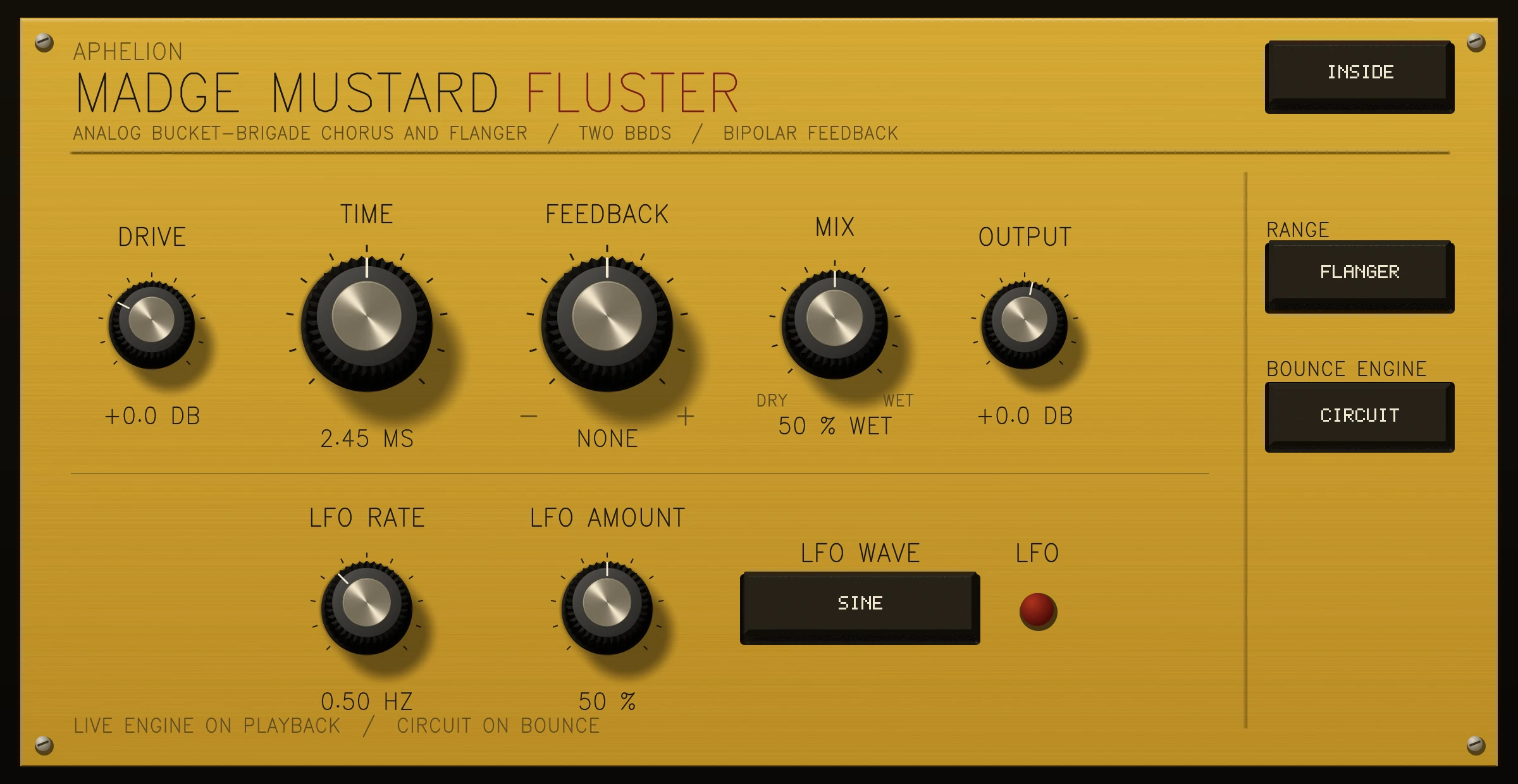
The FRONT face of the Madge Mustard Fluster panel, in brushed mustard enamel: APHELION and the name at the top left with FLUSTER in red, the line ANALOG BUCKET-BRIGADE CHORUS AND FLANGER / TWO BBDS / BIPOLAR FEEDBACK under it, and the INSIDE key at the top right. Across the middle, knobs for DRIVE, TIME, FEEDBACK, MIX and OUTPUT, FEEDBACK reading NONE between its minus and plus. Below them LFO RATE, LFO AMOUNT, the LFO WAVE key on SINE and the LFO lamp. On the right, the RANGE key on FLANGER and the BOUNCE ENGINE key on CIRCUIT, and along the foot the line LIVE ENGINE ON PLAYBACK / CIRCUIT ON BOUNCE.
  • Two bucket brigades
  • 0.6 to 50 ms of delay
  • Both signs of feedback
  • One input, two jacks

Listen

Dry, then flustered.

The same sixteen seconds, dry and five times through the Madge Mustard Fluster. The six play together, so switching keeps your place: listen to a WET for a while, then press DRY.

How it works

One chain to flange. Two to chorus.

Start with RANGE. FLANGER sends the signal through one bucket brigade of 256 stages, for 0.6 to 10 ms of delay. CHORUS sends it on through a second of 1024 stages, for 5 to 50 ms.

Set the delay with TIME. Sweep it with LFO RATE and LFO AMOUNT, and pick the sweep's shape on LFO WAVE. As LFO AMOUNT goes up, TIME gets less travel, so the sweep stays inside the range. Blend the delay with the dry signal on MIX.

Then push FEEDBACK. NONE is at the center. Turn right for positive feedback, left for negative. Over the last 12 percent of either side the loop feeds itself and howls. A limiter in the loop holds it.

It takes one input, the host's two channels summed, and has two jacks out. Left is MIX. Right is DELAY. The left jack is always dry plus wet. The right jack follows the switches on the INSIDE face.

What is in the netlist

The whole audio path. One loop.

A bounce solves the analog audio path part by part, input jack to output jacks, with the feedback closed through the brigades. Point at a block to read it.

THE BRIGADES Two chains of capacitors on one clock. Each clock edge moves every charge one step along. FLANGER takes the 256-stage chain alone. CHORUS feeds it on into the 1024-stage chain.

Playback and bounce

Two engines. The panel says which.

Full simulation takes far longer than the music does. So playback runs a live engine, and an offline render can solve the circuit. The panel prints the split along its foot:

LIVE ENGINE ON PLAYBACK / CIRCUIT ON BOUNCE

LIVE ENGINE

The same parts, as equations.

The live engine runs sample by sample round the loop, at twice the host's rate, or at the host's rate from 80 kHz up. It takes about four percent of one core. It leaves out the brigades' sampling, so you hear no aliasing and no clock residue. It also leaves out their noise and leak. The op-amps get no speed limit of their own, and the transconductance amplifiers no distortion below their limit.

Against the netlist, the dry path lands within 0.07 dB, the flanger's wet within 0.3 dB to 7 kHz, and the chorus's wet at 50 ms within 0.6 dB. Over ten test takes through both, levels land within 0.21 dB. High feedback and the SQUARE wave are where the two differ most. At full positive feedback the howl turns chaotic and they part ways: the bands stay within 1.7 dB, and live runs 0.9 dB hotter.

BOUNCE ENGINE: CIRCUIT

The netlist, solved.

Render offline with BOUNCE ENGINE on CIRCUIT and the plug-in solves the netlist in five blocks, with the feedback loop closed through the brigades. Their sampling is in: a transfer at every clock edge. Both engines have the same latency, 56 samples.

Put BOUNCE ENGINE on LIVE and a render runs the live engine instead, faster than the song.

The panel

Two faces. Turn it round.

FRONT has the controls you play. INSIDE has what the unit keeps on its board or behind MIDI. Press the key at the top right to turn the panel round.

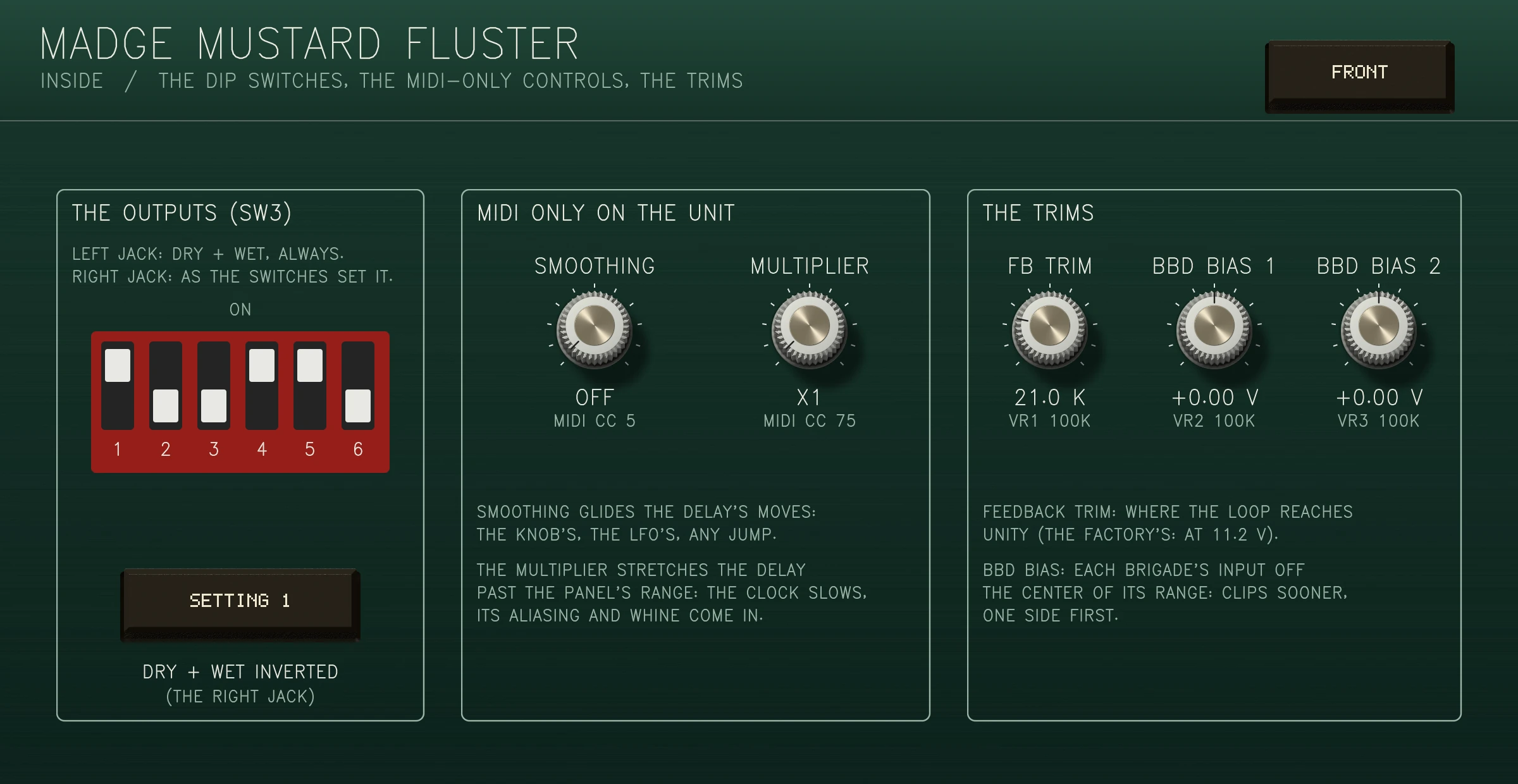
The INSIDE face of the Madge Mustard Fluster panel, in dark green: the name and the line INSIDE / THE DIP SWITCHES, THE MIDI-ONLY CONTROLS, THE TRIMS across the top with the FRONT key, and three boxes below. THE OUTPUTS (SW3) draws six DIP switches on a red block over the SETTING 1 key, which reads DRY + WET INVERTED (THE RIGHT JACK). MIDI ONLY ON THE UNIT holds SMOOTHING on OFF and MULTIPLIER on X1, marked MIDI CC 5 and MIDI CC 75. THE TRIMS holds FB TRIM on 21.0 K and BBD BIAS 1 and BBD BIAS 2 on +0.00 V, marked VR1, VR2 and VR3.
INSIDE Set the right jack with the switches. SMOOTHING and MULTIPLIER are MIDI ONLY ON THE UNIT. Here they are knobs. THE TRIMS are the board's.

DRIVE

The level going in, -6.9 to +27.25 dB. The pot is the schematic's own and its taper is an estimate.

TIME

The delay within RANGE. Its taper is an estimate. LFO AMOUNT takes some of its travel, so the sweep stays inside the range.

FEEDBACK

NONE at the center, + to the right, - to the left. The last 12 percent of either side howls.

MIX

From DRY to WET.

OUTPUT

The level coming out, up to +5.11 dB.

LFO RATE

How fast the delay sweeps, 0.05 to 50 Hz. The taper is an estimate.

LFO AMOUNT

How wide it sweeps.

LFO WAVE

The sweep's shape: SINE, TRIANGLE, SQUARE, SAW (falling), RAMP (rising), RANDOM (a new level each cycle) or SMOOTH RANDOM.

RANGE

FLANGER or CHORUS. It picks the path and the delay's span.

BOUNCE ENGINE

CIRCUIT: an offline render solves the netlist. LIVE: it renders the live engine.

INSIDE / FRONT

The key at the top right turns the panel round.

THE OUTPUTS (SW3)

The DIP switches' four settings, drawn as the switches. The left jack stays dry plus wet. The right jack follows the key: SETTING 1 is DRY + WET INVERTED.

SMOOTHING

Glides the delay's moves: the knob's, the LFO's, any jump. OFF, or 5 ms to 2 s on an estimated scale.

MULTIPLIER

Stretches the delay past the panel's range: X2, X4 or X8. The clock slows, and its aliasing and whine come in on a CIRCUIT bounce. The live engine leaves those out.

FB TRIM

VR1. Where the loop reaches unity. 21.0 K puts it where the schematic prints it.

BBD BIAS 1 BBD BIAS 2

VR2 and VR3. Each brigade's input off the center of its range: it clips sooner, one side first.

What it is, and what it is not

Solved where it can be. Estimated where it can't.

Madge Mustard Fluster is not a replica of any one unit, and we do not claim it sounds like one. Where the schematic gives a part, we used it. Where it stops, we estimated and marked the estimate in the netlist.

SOLVED

On a bounce, the whole audio path of a 2011 analog chorus/flanger: the input and DRIVE, the feedback loop and its limiter, both filters, both brigades, the mix and both jacks. The three filters on the control voltages too. Each part is the schematic's, or marked where it is not.

ESTIMATED

The original's firmware is unpublished, so the DSP here is an estimate. The unit's manual gives the delay ranges, the span of LFO RATE, the waves and MULTIPLIER's steps. We estimated the tapers on DRIVE, TIME and LFO RATE, the linear laws on MIX, OUTPUT and FEEDBACK, the LFO's sign and SMOOTHING's scale. None of it is measured. Some parts are estimates too, such as the zeners' knee and the short brigade's law.

NOT MODELED

Tap tempo, MIDI clock sync and note control of the delay. Spillover. The CV jacks. The unit's bypass: your host has its own. The FB INSERT jack stays normalled, so it is no insert here. The rails are ideal.

CHECKED

Against the schematic: every audio node's operating point, and the levels it prints. With 2 V peak to peak in and DRIVE at unity, the level after it solves 1.971 V against a printed 2.00 V. OUTPUT fully up solves +5.11 dB against about +4.9. The widest miss is OUTPUT fully down: -25.7 dB against a printed -31.3 to -31.7. The brigades' gains are calibrated to the printed levels, each about +2.2 dB, inside their datasheet's spread. By impulse, TIME at 0.6 ms arrives at 0.833 ms and TIME at 10 ms at 10.29 ms. The two filters add the rest.

The audio path, solved

Madge Mustard Fluster

Bucket-Brigade Chorus/Flanger

Go from thick chorus to jet flange.

VST®3 effect · Windows 64-bit No activationmacOS VST3 and Audio Unit are in development.

At a glance

Madge Mustard Fluster specifications

Technical specifications for Madge Mustard Fluster, Bucket-Brigade Chorus/Flanger
FormatVST®3 effect · Windows 64-bit
In developmentmacOS VST3 and Audio Unit
Requires64-bit Windows 11, in any version Microsoft still supports. When the Mac version ships: macOS 15 or later, on Apple silicon or Intel.
ChannelsOne input, the host's two summed · two jacks out, left MIX and right DELAY
The netlistThe whole analog audio path and the three control-voltage filters · not the supplies, the DSP, the lamps, the CV jacks' mixers or the level meter
The DSPEstimated: the original's firmware is unpublished · the unit's manual where it gives a law
Checked againstThe schematic's printed levels and every audio node's operating point
RangeFLANGER 0.6 to 10 ms, 256 stages · CHORUS 5 to 50 ms, 1280 stages
LFOSINE, TRIANGLE, SQUARE, SAW, RAMP or RANDOM · 0.05 to 50 Hz
PlaybackThe live engine, the same parts as equations · about four percent of one core
BounceBOUNCE ENGINE CIRCUIT: the netlist · LIVE: the live engine
Bounce timeThe circuit about seven times slower than real time on chords, more at the shortest delay
FRONTDRIVE, TIME, FEEDBACK, MIX, OUTPUT · LFO RATE, LFO AMOUNT, LFO WAVE · RANGE · BOUNCE ENGINE
INSIDETHE OUTPUTS (SW3), four settings · SMOOTHING and MULTIPLIER · FB TRIM, BBD BIAS 1 and BBD BIAS 2
Latency56 samples, the same in playback and the bounce
The panel1200 by 620 · two faces
Validation47 of 47 validator tests · host-tested
ActivationNone. No license server, no phone-home
Security updatesUntil November 2031
LicenseLicense agreement · Facts sheet
VST Compatible

VST is a registered trademark of Steinberg Media Technologies GmbH.