
KBD
The teeth follow the key.
With KBD lit, the comb's frequency follows the note you play, so its first ten teeth sit on that note's first ten harmonics. FIXED leaves them where FREQ puts them.
Monophonic Netlist Synthesizer
As subtle as a cinderblock to the face.
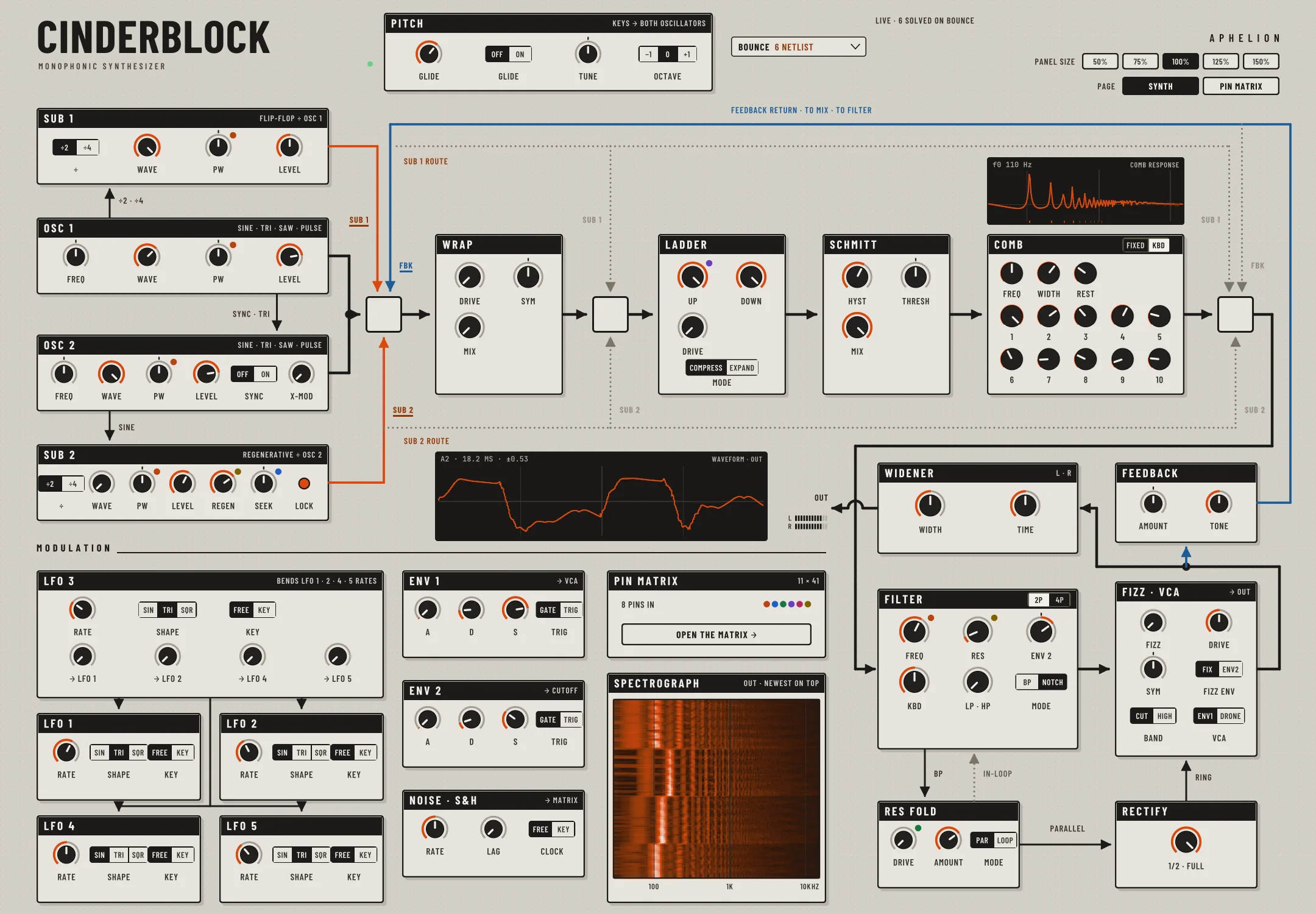
One voice, and a wall of circuits in its way: two oscillators and two subs, then three shapers and a comb with ten teeth before the filter ever hears the note. Every stage has its own knobs, and every part of it is written out.
VST®3 instrument · Windows 64-bit No activationmacOS VST3 and Audio Unit are in development.
The idea
Cinderblock is a monophonic synthesizer whose note passes through three shapers and a ten-tooth comb on its way to the filter, and every one of them is a circuit, written out part by part, with its own knobs on the panel.
FEEDBACK returns the output to the mix, or to the filter alone.
Two saw cores start it, and two subs under them: one divided down by flip-flops, one grown by a loop that has to be kept going.
A wrapper, a diode ladder and a Schmitt trigger, one after another. At rest each passes the wave as it came; turn one and it bends the wave its own way.
The comb lifts whichever of the note's first ten harmonics you choose. The filter, its folder and the rectifier finish it, and FEEDBACK can send it round again.
Hear it
Nine takes of Cinderblock, half a minute each. Nothing has been done to them on the way here but the encoding, so some are a good deal louder than others.
0:32
0:32
0:32
0:32
0:32
0:32
0:32
0:32
0:32
The tracking comb
A comb filter is a delay fed back into itself: it lifts every frequency whose period fits the delay a whole number of times, and its peaks stand in a row like teeth. In a plain comb every tooth is the same height. Cinderblock's delay is a bucket brigade of 512 stages, and inside its loop a band-pass sits on each of the first ten teeth, through a level of its own. So each of those ten teeth is a knob.
KBD
With KBD lit, the comb's frequency follows the note you play, so its first ten teeth sit on that note's first ten harmonics. FIXED leaves them where FREQ puts them.
TOOTH 1 TO 10
Each of the first ten teeth has its own height, read in decibels, from off to about 20 dB. Measured: TOOTH 2 at the top of its travel lifts the second harmonic of A2 12.6 dB against the fundamental, and of A4 13.4 dB.
REST
One knob for all of them at once. The ten below are left exactly where their own knobs put them.
WIDTH
Narrow, and a tooth touches only its own harmonic. Wide, and it catches a detuned OSC 2, the subs and the cross-modulated partials near it, and neighbouring teeth blend.
FREQ
FREQ moves the whole comb two octaves either side of OSC 1's unison, and on KBD it sets the comb's interval from the note.
IN THE MATRIX
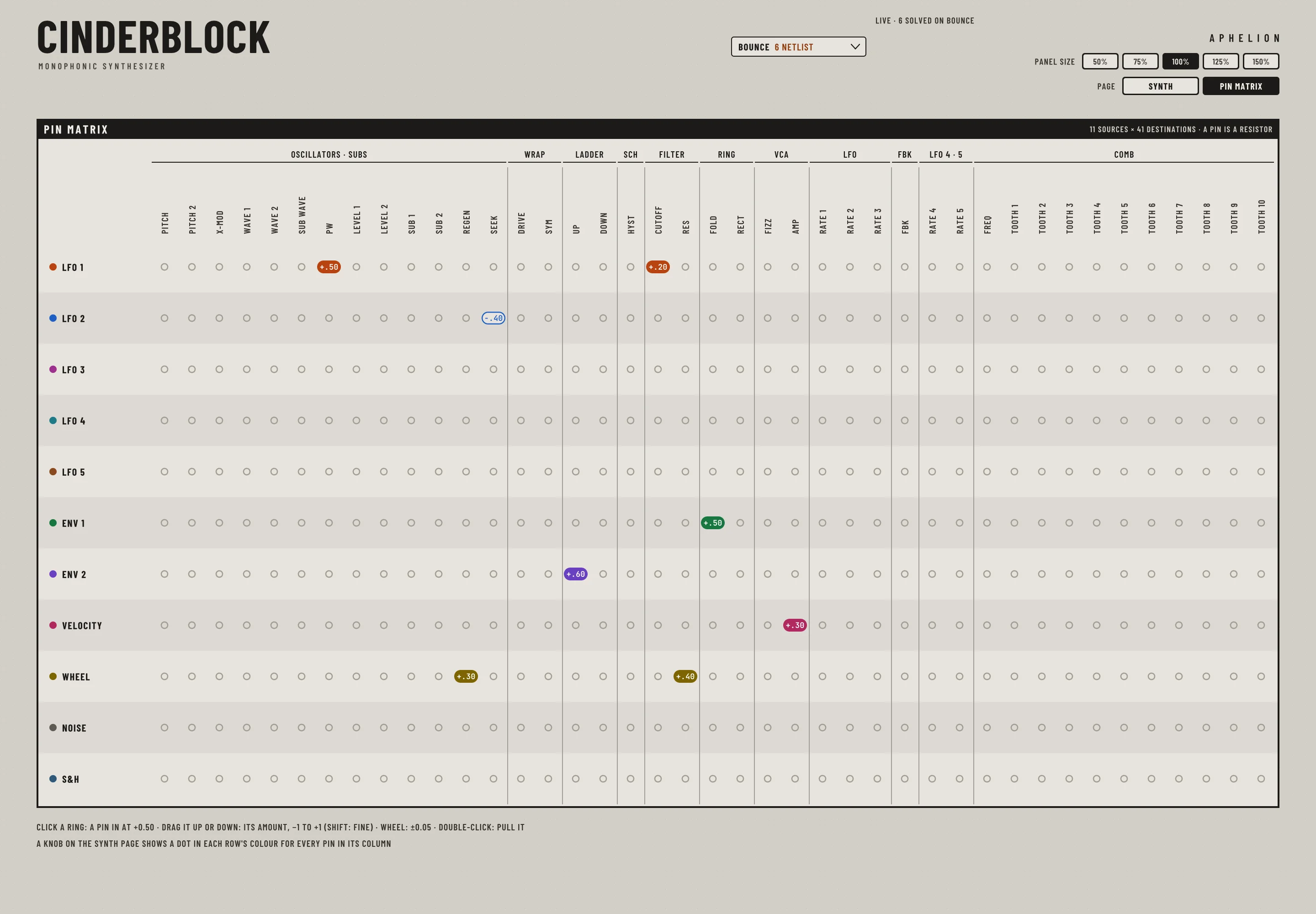
FREQ and all ten teeth are columns of the PIN MATRIX, so any of the eleven sources can move the comb's tuning, or play its teeth up and down one by one.
TWO FILTERS, ONE MODULATION
The comb stands just ahead of the filter, and both answer to the pin matrix: the comb's FREQ and its teeth, the filter's CUTOFF and RES. Put pins on both and the two filters move against each other, the teeth sliding through the filter's sweep, and the spectrum fills with patterns neither makes alone. Here are three of them, frequency up the side and time across.
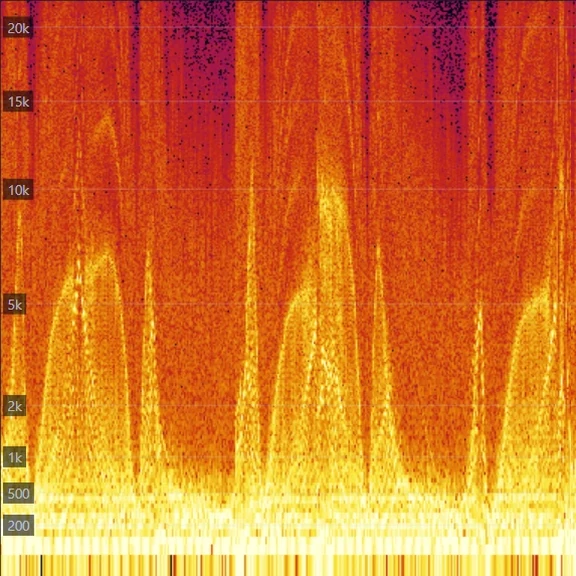
Slow arches, ruled through with fine lines.
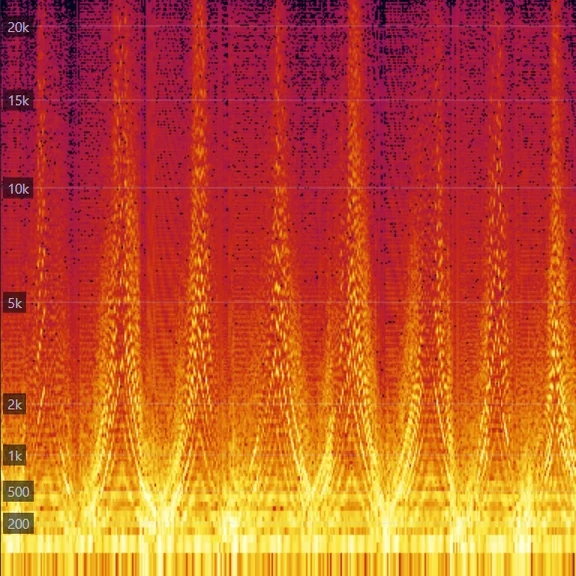
A lattice: lines that bend and cross.
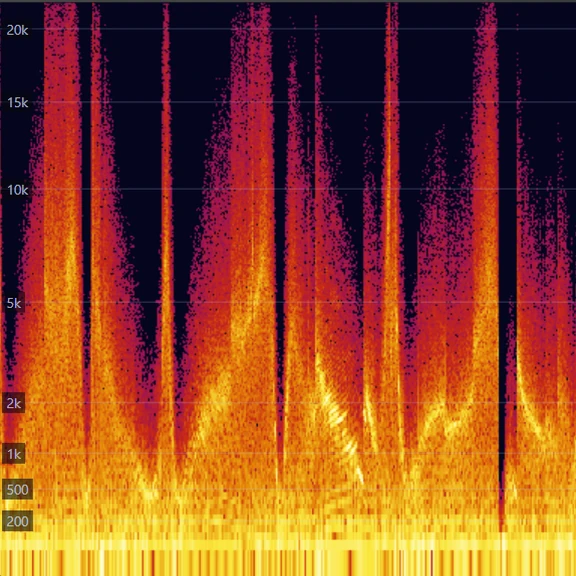
Sweeps that strike and fall away.
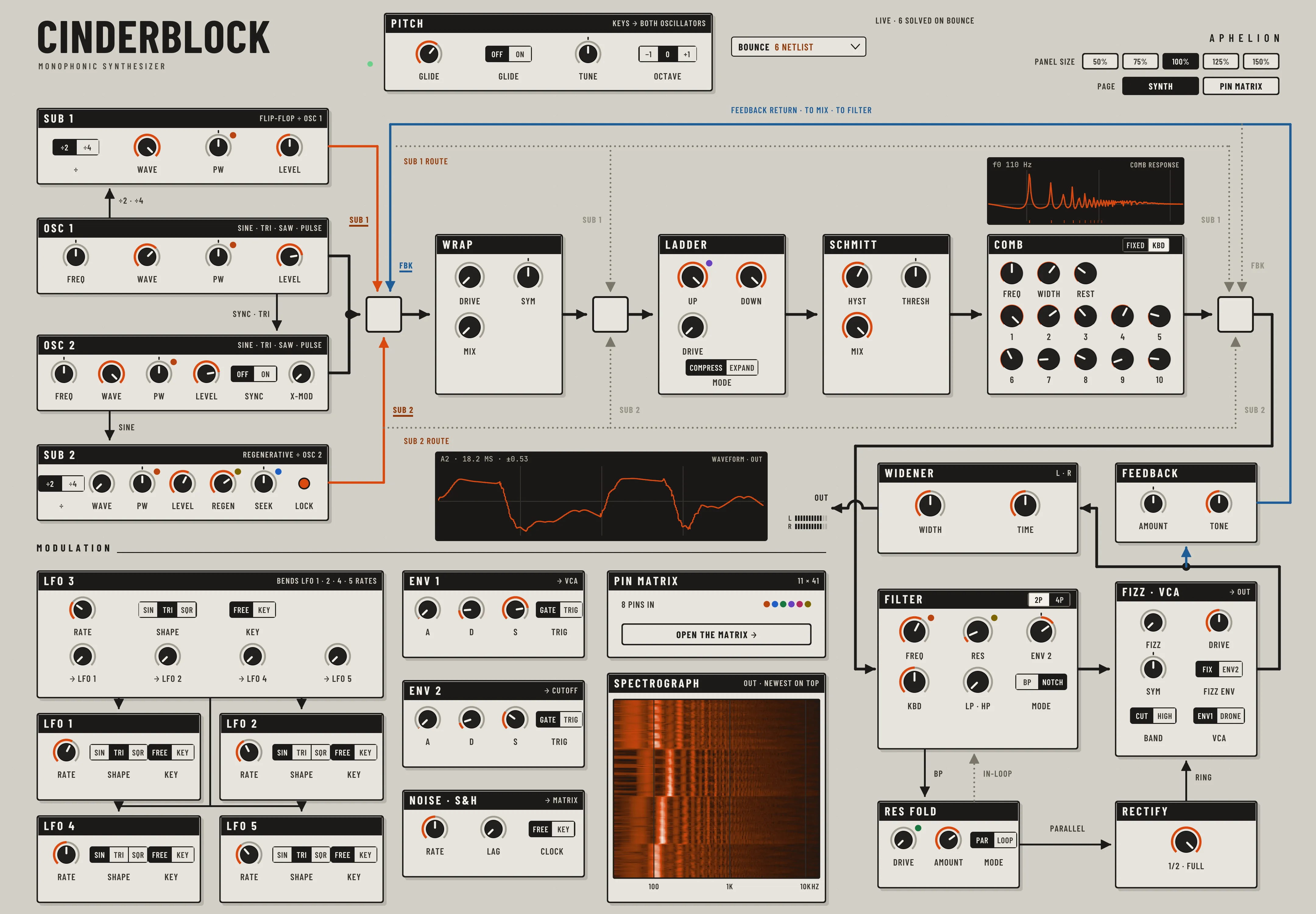
THE PANEL
The signal's line runs along the top, left to right, from the oscillators through the shapers and the comb, then drops to the filter section under it and out. The modulation lies along the foot.
The wall, card by card
From the wrapper to FEEDBACK, each card on the panel is a circuit, and each of its knobs is a part of that circuit.
WRAP A wave wrapper. Driven past its window, the wave carries over to the opposite edge and comes out in pieces. SYM makes the wraps lopsided, and MIX sets how much of the wrapped wave you hear.
The arithmetic
11sources41destinations
Every pin is a resistor from a source's row into a destination's column, with an amount either way, and every column is a real place in the circuit: a pitch, a knee, a window, a tooth. Click a ring and a pin goes in at +0.50; drag it for its amount, from -1 to +1; double-click pulls it.
And the rest of it
SUB 2
SUB 2 is a regenerative divider: a multiplier whose output, band-passed at half OSC 2's pitch, is fed back into itself. Nothing in it counts. Below REGEN's threshold there is no sub at all; just above it the sub grows out of nothing over tens of milliseconds. SEEK tunes where it listens, and LOCK lights while it holds.
BOUNCE
Playback runs the same parts as equations. When your DAW renders offline, the BOUNCE menu's seventeen blocks are each LIVE or NETLIST, and by default six are solved: the wrapper, the ladder, the Schmitt, the filter, the folder and the rectifier.
ROUTE
Each sub comes in ahead of the wrapper, ahead of the ladder, or straight into the filter. On the panel, the route is the label you click at the junction.
NOISE · S&H
A junction's noise, and the same noise held on each tick of its own clock, or at each note you play. LAG turns the steps into a wander.
YOURS
No license server, and no phone-home.
A monophonic netlist synthesizer
As subtle as a cinderblock to the face.
Its oscillators, its FEEDBACK and its LFOs are the circuits inside Profundus, the oscillators on a smaller capacitor, up out of the bass register. The diode ladder, the Schmitt trigger, SUB 2's divider and the rectifier were drawn for this one, the tracking comb was rebuilt for it on the same parts as the rest, and every part of it is written out in its netlist.
VST®3 instrument · Windows 64-bit No activationmacOS VST3 and Audio Unit are in development.
At a glance
| Format | VST®3 instrument · Windows 64-bit |
|---|---|
| In development | macOS VST3 and Audio Unit |
| Requires | 64-bit Windows 11, in any version Microsoft still supports. When the Mac version ships: macOS 15 or later, on Apple silicon or Intel. |
| Voice | Monophonic · last, low or high note priority · legato · glide |
| Oscillators | OSC 1 and OSC 2 · WAVE sine to triangle to saw to pulse · PW · SYNC · X-MOD |
| Subs | SUB 1 by flip-flops under OSC 1 · SUB 2 a regenerative divider under OSC 2, REGEN and SEEK · each down two or four times, into the wrapper, the ladder or the filter |
| Shapers | WRAP · LADDER, three knees each way, COMPRESS or EXPAND · SCHMITT, a saturator to a snap |
| Comb | A 512-stage bucket brigade in a feedback loop · TOOTH 1 to 10, REST, WIDTH, FREQ · KBD puts the teeth on the note's harmonics |
| Filter | Two-pole state-variable, a four-pole twin · LP · HP blend or band-pass · RES into self-oscillation |
| Ring | RES FOLD on the filter's ring, PARALLEL or IN-LOOP · RECTIFY straight, half-wave or full-wave |
| Feedback | The output TO MIX or TO FILTER · AMOUNT either way · TONE |
| Modulation | Five analog LFOs, LFO 3 bending the other four · two envelopes · NOISE · S&H |
| Matrix | 11 sources by 41 destinations · 451 pins, every pin a resistor |
| Playback | The same parts as equations |
| Bounce | Seventeen blocks, each LIVE or NETLIST · six solved by default |
| Bounce time | About three times slower than real time with the default blocks · about twenty with all seventeen (the host test) |
| Latency | 29 samples at 48 kHz, the same in playback and the bounce |
| The panel | 1440 by 1000 · two pages, SYNTH and PIN MATRIX |
| Validation | 47 of 47 validator tests · host-tested |
| Activation | None. No license server, no phone-home |
| Security updates | Until November 2031 |
| License | License agreement · Facts sheet |

VST is a registered trademark of Steinberg Media Technologies GmbH.