An original circuit, solved part by partAll Netlist Effects

Tidal Stereo Disruptor

Sphinxographic Quartzalizer

TIDAL STEREO DISRUPTOR · TWO VOLTAGE-CONTROLLED BUCKET BRIGADES · MID AND SIDE REGENERATION

An original circuit for a sound that didn't exist - yet.

Two delay lines run on clocks that the music itself pushes, pulls and swings around each other. The beat stays where you put it. The air around it is what moves.

VST®3 effect · Windows 64-bit No activationmacOS VST3 and Audio Unit are in development.

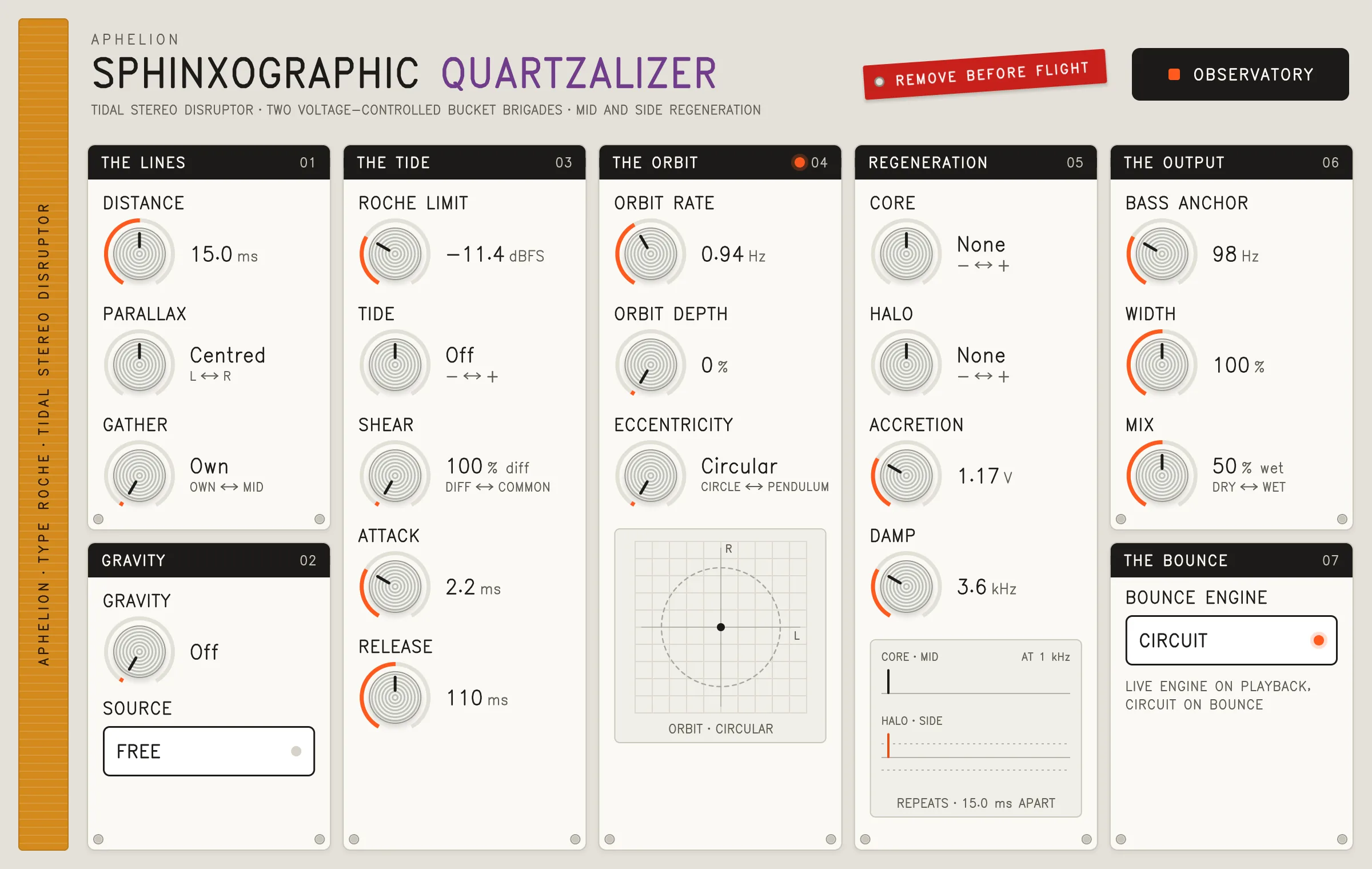
THE PANEL page of the Sphinxographic Quartzalizer at its defaults: a warm grey face with an orange spine down its left edge, APHELION and the name at the top with QUARTZALIZER in amethyst, the line TIDAL STEREO DISRUPTOR · TWO VOLTAGE-CONTROLLED BUCKET BRIGADES · MID AND SIDE REGENERATION under it, a red REMOVE BEFORE FLIGHT tag, and the black OBSERVATORY key at the top right. Seven white modules under black numbered tabs, every knob a ringed dial with an orange arc and its reading beside it: THE LINES with DISTANCE on 15.0 ms, PARALLAX Centred and GATHER Own; GRAVITY with its knob Off and the SOURCE key on FREE; THE TIDE with ROCHE LIMIT on -11.4 dBFS, TIDE Off, SHEAR on 100 % diff, ATTACK on 2.2 ms and RELEASE on 110 ms; THE ORBIT, its lamp in the tab, with ORBIT RATE on 0.94 Hz, ORBIT DEPTH on 0 %, ECCENTRICITY Circular, and a screen showing the dashed circle the knobs set; REGENERATION with CORE and HALO on None, ACCRETION on 1.17 V, DAMP on 3.6 kHz, and a screen of the repeats, 15.0 ms apart; THE OUTPUT with BASS ANCHOR on 98 Hz, WIDTH on 100 % and MIX on 50 % wet; and THE BOUNCE with the BOUNCE ENGINE key on CIRCUIT over the line LIVE ENGINE ON PLAYBACK, CIRCUIT ON BOUNCE.
  • Two delay lines on moving clocks
  • 227 parts, solved together
  • Mono bass, restless air
  • Two pages: panel and observatory

Listen

Dry, then quartzalized.

The same sixteen seconds, dry and seven times through the Sphinxographic Quartzalizer. The eight play together, so switching keeps your place. Listen to a WET for a while, then press DRY, and keep an ear on the middle of the stereo field: the beat never leaves it.

Measured on these takes

Mono bass. Anti-correlated treble.

Frequency-dependent correlation gradient from mono bass to anti-correlated treble. That is the long way of saying what this shows: how alike the left and right channels are, band by band, in each take above. +1 is the same signal on both sides, 0 is unrelated, and -1 is the same signal turned upside down.

Left-right correlation of each take on this page, by frequency band, from +1 to -1
Take20 to 80 Hz80 to 160 Hz160 to 320 Hz320 to 640 Hz640 Hz to 1.3 kHz1.3 to 2.6 kHz2.6 to 5.1 kHz5.1 to 10 kHz10 to 20 kHz
DRY+1.00+0.98+0.96+0.96+0.95+0.99+0.99+1.00+1.00
WET 1+1.00+0.96+0.76+0.40+0.34+0.46+0.65+0.90+1.00
WET 2+1.00+0.93+0.39−0.32−0.57−0.60−0.61−0.68−0.92
WET 3+1.00+0.92+0.80−0.03−0.29−0.16−0.47−0.53−0.53
WET 4+1.00+0.98−0.01−0.34−0.60−0.53−0.54−0.51−0.51
WET 5+1.00+1.00+0.19+0.23−0.42−0.56−0.56−0.55−0.56
WET 6+1.00+0.94+0.37−0.34−0.55−0.55−0.54−0.39+0.74
WET 7+1.00+0.95+0.48−0.34−0.57−0.30−0.51−0.18+0.89

WET 2 10 to 20 kHz−0.92

The dry take is all but mono: +0.95 or more in every band. Below 80 Hz every wet take stays at +1.00, because BASS ANCHOR high-passes the wet side and leaves the low end in the middle. Between 640 Hz and 10 kHz, six of the seven run negative in every band. WET 2 reaches -0.92 in its top octave.

What it does

Audio had no words for it. So the panel borrowed astronomy's.

TIDE, ORBIT, GRAVITY, ACCRETION, the ROCHE LIMIT. Each names a real part of the circuit, and each does to the two delay lines roughly what it does to two bodies in space.

The rhythm remains solid while the air around the rhythm becomes unstable.

With MIX anywhere short of WET, the dry signal goes straight through, so the hits land where you played them. The tide only moves when a hit crosses the ROCHE LIMIT, so even the movement keeps time. What drifts, swings and tears is the delayed copy around the hits, and BASS ANCHOR keeps the low end out of the sides, so the kick and the bass stay put.

THE TIDE

Dynamic Doppler Bloom

A peak detector follows the mid. When a hit crosses the ROCHE LIMIT, the excess drags the delay lines' clocks, and a delay that moves is a pitch that moves. Each transient blooms and then settles as RELEASE lets go. TIDE sets how far and which way. SHEAR decides whether the two lines are pulled apart or together. Anything quieter than the limit passes under it untouched.

REGENERATION

Holographic halo

HALO feeds the side back through ACCRETION, a clipper that only the side passes through. In the last few percent of its travel the side starts to ring on its own and settles into a bounded drone, while the mid stays clean: the halo hangs around the sound, not inside it. On the bench the side held at -19 dBFS with the mid more than 45 dB under it. CORE feeds the mid back, either sign.

GRAVITY

Metallic gravity flutter

GRAVITY feeds each channel's low end into the other line's clock, in opposite directions. The left side's bass wobbles the right line's delay and the right side's wobbles the left's, at the speed of the music rather than of a slow oscillator, so the flutter turns metallic. With SOURCE on FREE the pull comes from what goes into the lines. On BOUND it comes from what comes out of them, and the lines start bending their own clocks.

THE ORBIT

Two bodies, one center

A quadrature oscillator swings the two clocks around each other, 0.16 to 23 Hz, as far as ORBIT DEPTH lets it. With ECCENTRICITY at CIRCLE the two lines move a quarter-cycle apart, and the image circles the middle. At PENDULUM they move in opposite directions, and it swings from side to side. PARALLAX sets how far apart the two bodies sit to begin with.

What is in the netlist

227 parts. Clocks the music moves.

A bounce solves the whole circuit part by part, input to output, with the regeneration loop closed through both lines and every clock driven by what the music is doing. Point at a block to read it.

THE LINES Two voltage-controlled bucket brigades of 1024 stages, one per side, each on its own clock between 15 and 150 kHz. Every edge of a clock moves every charge one step along, and a reconstruction filter smooths what each line hands on.

The second page

The Observatory. See what you're hearing.

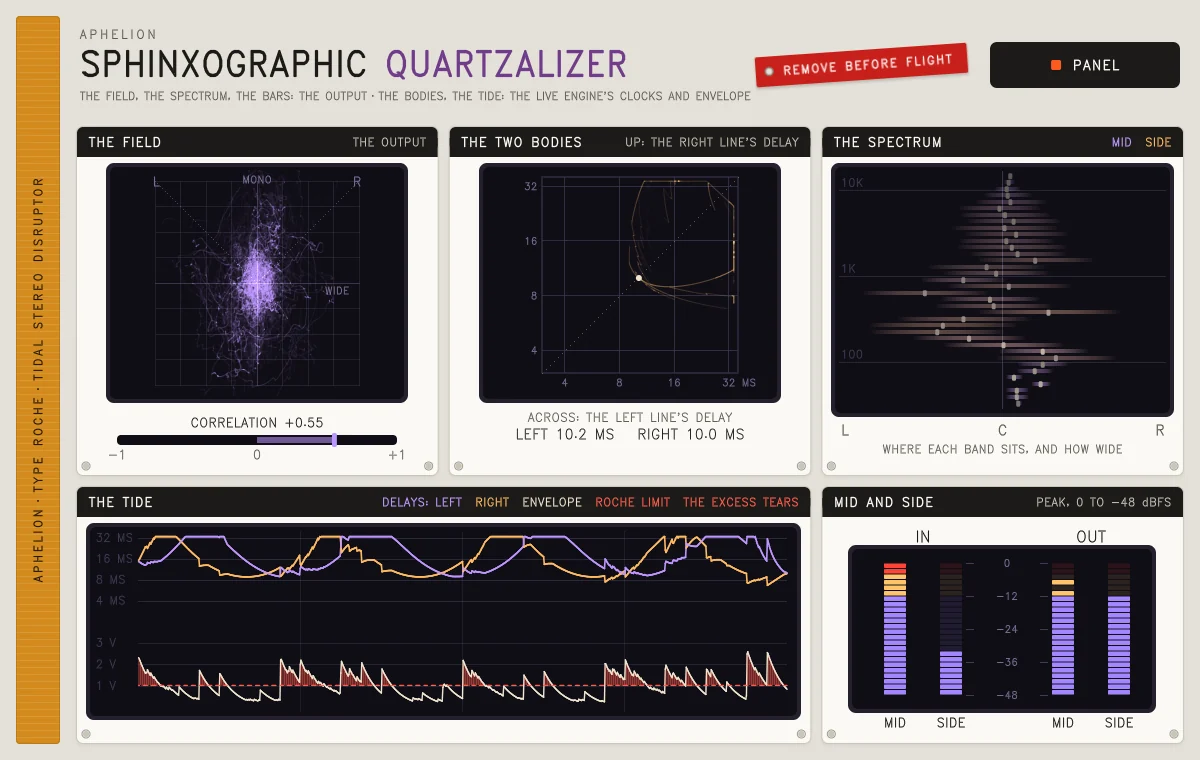
The key at the top right turns THE PANEL into THE OBSERVATORY: five live displays of what the circuit is doing to your signal. The plug-in painted this one with the dry take from Listen playing through it, TIDE, ORBIT DEPTH and HALO turned up.

THE OBSERVATORY page of the Sphinxographic Quartzalizer, painted by the plug-in with the dry take from Listen playing through it: five flat dark screens in white modules under black tabs, on the same warm grey face as the panel, under the name, the REMOVE BEFORE FLIGHT tag and the PANEL key. THE FIELD shows a violet cloud standing upright between the dotted diagonals, MONO above and WIDE to the side, with CORRELATION +0.55 under it. THE TWO BODIES draws the left line's delay against the right's on scales of 4 to 32 ms, an amber trail off the dotted diagonal, LEFT 10.2 MS and RIGHT 10.0 MS. THE SPECTRUM stacks bands from under 100 Hz to over 10 kHz, each a dot for its pan and a bar for its width. THE TIDE runs four seconds of the two delays, violet and amber, swinging between about 8 and 32 ms above an envelope that spikes on every hit over the dashed ROCHE LIMIT, the excess shaded red. MID AND SIDE stands four bars on a scale of 0 to -48 dBFS, the side's bar far higher coming out than going in.
THE OBSERVATORY THE FIELD, THE SPECTRUM and MID AND SIDE read the audio. THE TWO BODIES and THE TIDE read the live engine's clocks and envelope, so during a CIRCUIT bounce those two say they are not running.

THE FIELD

A goniometer of the output. Mono stands up, width lies down, one side leans to its dotted diagonal, and the correlation reads under it, -1 to +1.

THE TWO BODIES

The left line's delay across, the right's up, 4 to 32 ms on both, with a trail that fades over 1.4 s. DISTANCE slides the point along the dotted diagonal, PARALLAX and the tide throw it off, the orbit circles it or swings it across, and gravity smears it.

THE SPECTRUM

36 bands from 30 Hz to 16 kHz. Each band's pan is a dot and its width a bar, violet while it is narrow and amber as it widens.

THE TIDE

Four seconds of both delays above the envelope and the ROCHE LIMIT, the excess that tears shaded. The hits keep time underneath while the delays swing above them.

MID AND SIDE

Four peak bars, the mid and side going in and coming out, 0 to -48 dBFS: violet to -12, amber to -3, red above. The width the circuit adds, at a glance.

Playback and bounce

Two engines. The panel says which.

Solving every part takes far longer than the music does. So playback runs a live engine, and an offline render can solve the circuit. THE BOUNCE prints the split under its key:

LIVE ENGINE ON PLAYBACK, CIRCUIT ON BOUNCE

LIVE ENGINE

The same parts, as equations.

The live engine runs the circuit sample by sample at twice the host's rate, or at the host's rate from 80 kHz up, for about seven percent of one core. Every filter is its own parts' response and every knob its pot's own law. The peak detector keeps the op-amp that drives it, because the tide depends on how that op-amp recovers after a hit. It leaves out the bucket brigades' sampling, so you hear no aliasing and no clock residue, and it leaves out their noise.

Against the netlist, a sine at the defaults differs by -41 and -47 dB, at zero lag, with levels within 0.06 dB. Over ten test takes rendered through both, every take lands at zero lag, with levels within 0.04 dB and 25 ms envelopes within 1.0 dB.

BOUNCE ENGINE: CIRCUIT

The netlist, solved.

Render offline with BOUNCE ENGINE on CIRCUIT and the plug-in solves all 227 parts in eight blocks, with the regeneration loop closed through both delay lines. Each clock is integrated from the circuit's own control voltage, edge by edge, and the bucket brigades' sampling is in: a transfer at every edge. Both engines have the same latency, 56 samples.

Put BOUNCE ENGINE on LIVE and a render runs the live engine instead, faster than the song.

The panel

Seven sections. Twenty-one controls.

Every knob is a potentiometer in the netlist, turning on the netlist's own taper. Every readout is worked out from the circuit, in its own units: milliseconds, hertz, volts, and the ROCHE LIMIT as the peak level that reaches it.

DISTANCE

The delay of both lines, about 3.4 ms to 24 ms, 15 ms at noon.

PARALLAX

Offsets one line against the other, L to R, Centred at noon: up to about 27.6 ms between them with DISTANCE at noon.

GATHER

What the lines are fed: each its own channel at OWN, both the mid at MID.

GRAVITY

How hard each channel's low end pulls the other line's clock, from Off up.

SOURCE

FREE: the pull comes from what goes into the lines. BOUND: from what comes out of them, so the lines bend their own clocks.

ROCHE LIMIT

How loud a hit must be to move the tide. The readout gives the limit as the peak level that reaches it, in dBFS.

TIDE

How far, and which way, the excess drags the clocks. Off at noon, minus and plus either side.

SHEAR

How the two lines share the tide. DIFF pulls them apart, COMMON moves them together, and noon moves one.

ATTACK RELEASE

How fast the tide's envelope rises, 0.5 to 50 ms, and falls, 10 ms to 1 s.

ORBIT RATE

The orbit's speed, 0.16 to 23 Hz. The lamp in THE ORBIT's tab keeps its time.

ORBIT DEPTH

How far the two clocks orbit each other.

ECCENTRICITY

CIRCLE: the two lines a quarter-cycle apart. PENDULUM: opposite. THE ORBIT's screen draws the figure: dashed, as the knobs set it, or, with audio running, the two clocks' own orbit over its last turn.

CORE

The mid fed back, None at noon, minus and plus either side.

HALO

The side fed back through ACCRETION, None at noon. In its last few percent the side rings on its own.

ACCRETION

Where the side's clipper bites, read as its clip point in volts.

DAMP

The regeneration loop's low-pass, 16 kHz down to 160 Hz. REGENERATION's screen sketches the loop from its parts: a click and its repeats, the mid's through CORE and the side's through HALO, under ACCRETION's dashed ceiling.

BASS ANCHOR

The wet side's high-pass, 30 to 410 Hz. Below it, the wet signal is mono.

WIDTH

The wet side's level, 0 to 200 percent, 100 at noon.

MIX

From DRY to WET.

BOUNCE ENGINE

CIRCUIT: an offline render solves the netlist. LIVE: it renders the live engine. The note under the key says which engine plays and which bounces, how far a circuit render has got, or where one stopped.

OBSERVATORY PANEL

The key at the top right turns the page.

What it is, and what it is not

Drawn from nothing. Solved part by part.

A netlist effect usually starts from a machine that already existed, and is judged by how faithful it is. This one had nothing to be faithful to. The circuit was designed here, as a netlist, and the plug-in solves that netlist.

SOLVED

On a bounce, every part of the netlist: 227 of them, 56 op-amps among them, cut into eight blocks and solved together, with the regeneration loop closed through both delay lines. Every part is the netlist's own, unchanged.

ESTIMATED

The netlist leaves the inside of each delay line to the host. We filled it with our bucket-brigade model, and its transfer loss, its noise and its clock residue are estimates. So are each line's clip point and where 0 dBFS sits, at 2 V peak. The range of each clock's control voltage is inferred from the delays the netlist states. Two 1 pF strays were added where the solver needed them, and nothing audible moves.

THE LIVE ENGINE LEAVES OUT

The bucket brigades' sampling: no images, no aliasing, no clock residue. Their noise. The op-amps' own speed, except the one that drives the peak detector. The rectifiers' switching glitches. Its orbit runs 17 samples off the netlist's, 3 degrees at the orbit's fastest.

CHECKED

Against the netlist's own comments, every figure lands. DISTANCE solves 3.413, 14.992 and 24.224 ms against about 3.4, 15 and 24. The ROCHE LIMIT tops out at 3.488 V against 3.5. ORBIT RATE spans 0.158 to 23.40 Hz against 0.16 to 23, DAMP 15.9 kHz to 158 Hz, BASS ANCHOR 30.6 to 413.8 Hz. By impulse, DISTANCE at noon arrives at 15.083 ms. The filters add the rest.

An original circuit, solved

Sphinxographic Quartzalizer

Tidal Stereo Disruptor

An original circuit for a sound that didn't exist - yet.

VST®3 effect · Windows 64-bit No activationmacOS VST3 and Audio Unit are in development.

At a glance

Sphinxographic Quartzalizer specifications

Technical specifications for Sphinxographic Quartzalizer, Tidal Stereo Disruptor
FormatVST®3 effect · Windows 64-bit
In developmentmacOS VST3 and Audio Unit
Requires64-bit Windows 11, in any version Microsoft still supports. When the Mac version ships: macOS 15 or later, on Apple silicon or Intel.
ChannelsStereo in, stereo out
The circuitOriginal, designed at Aphelion · 227 parts, 56 op-amps, 30 potentiometers, two voltage-controlled bucket brigades
The netlistEvery part solved together on a bounce · the delay lines' insides, which the netlist leaves open, are our bucket-brigade model
The linesTwo bucket brigades of 1024 stages · clocks 15 to 150 kHz · DISTANCE about 3.4 to 24 ms
The tideROCHE LIMIT 0 to 3.5 V · ATTACK 0.5 to 50 ms · RELEASE 10 ms to 1 s
The orbit0.16 to 23 Hz · CIRCLE to PENDULUM
RegenerationCORE on the mid, HALO on the side through ACCRETION · DAMP 16 kHz to 160 Hz
The outputBASS ANCHOR 30 to 410 Hz · WIDTH 0 to 200 percent · MIX
PlaybackThe live engine, the same parts as equations · about seven percent of one core
BounceBOUNCE ENGINE CIRCUIT: the netlist · LIVE: the live engine
Bounce timeThe circuit five to nine times slower than real time on music, more on dense noise
Latency56 samples, the same in playback and the bounce
The panel1200 by 760 · two pages, THE PANEL and THE OBSERVATORY
Validation47 of 47 validator tests · host-tested
ActivationNone. No license server, no phone-home
LicenseLicense agreement · Facts sheet
VST Compatible

VST is a registered trademark of Steinberg Media Technologies GmbH.