Solved from its schematicAll Synths

A polyphonic synthesizer

OvertimeEight-Tone

We took a beloved classic and threw it into a shredder.

We cloned a legend down to the exact circuit: eight voices, each one the whole of a 1974 American expander module, solved part by part from its schematic. Then we added a bunch of weird stuff that made it better, and over all eight voices a peak-trough cascade filter, five notches and five peaks in stereo.

VST®3 instrument · Windows 64-bit No activationmacOS VST3 and Audio Unit are in development.

  • 8 voices, eight circuits
  • 74 transistors in each
  • 4 new stages inside
  • 10 peaks and troughs over them all
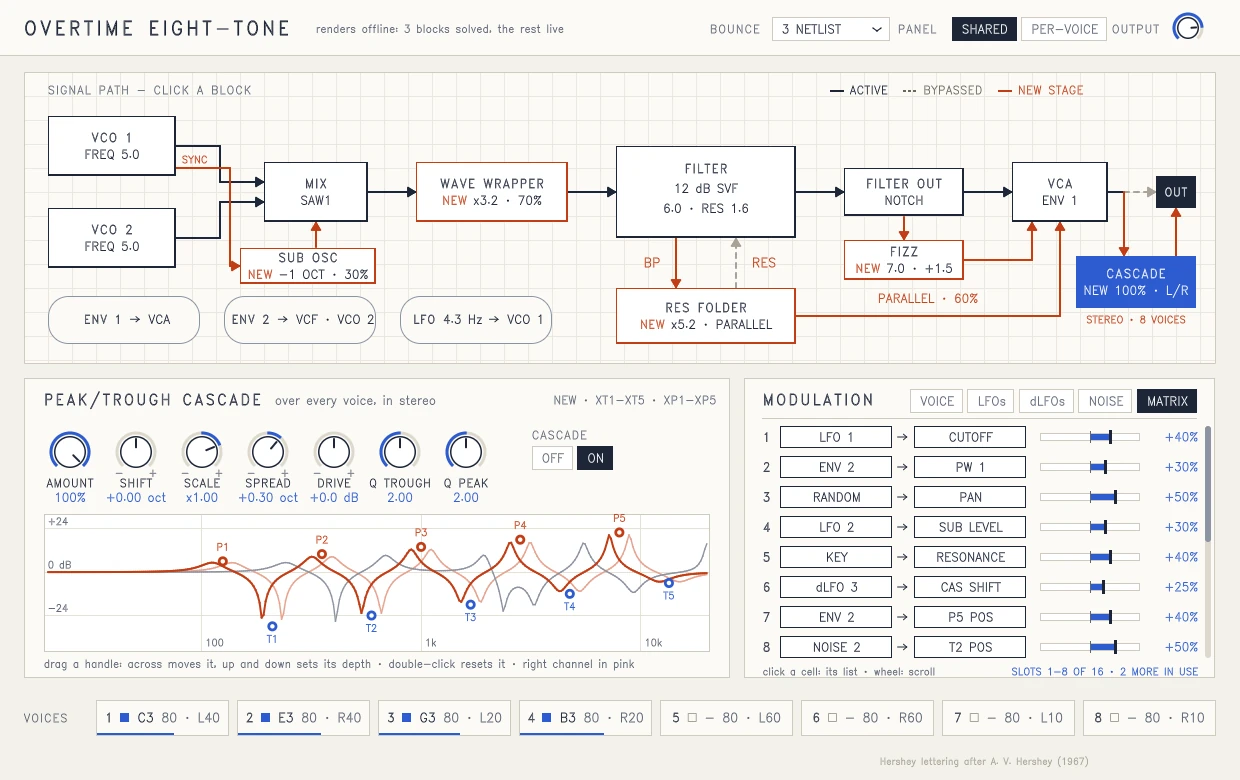
The Overtime Eight-Tone panel on cream drafting paper with the CASCADE selected in blue on the signal path, at 100%, L/R, STEREO · 8 VOICES, between the VCA and OUT, and the four new stages lit in red. Below, the PEAK/TROUGH CASCADE card, over every voice, in stereo: AMOUNT 100%, SHIFT +0.00 oct, SCALE x1.00, SPREAD +0.30 oct, DRIVE +0.0 dB, Q TROUGH 2.00 and Q PEAK 2.00, CASCADE ON, over the cluster's response from 20 Hz to 20 kHz: five blue handles, T1 to T5, at the bottoms of its notches and five red ones, P1 to P5, on its peaks, the right channel in pink and the response the matrix is moving in grey. To the right, MODULATION on its MATRIX tab, slots 1 to 8 of the sixteen in view and all eight set, the last three dLFO 3 to CAS SHIFT, ENV 2 to P5 POS and NOISE 2 to T2 POS, and under them SLOTS 1-8 OF 16 · 2 MORE IN USE; along the bottom, the eight VOICES, the first four playing.
ACTIVEBYPASSEDNEW STAGEThe panel's own key. Everything in red is ours.

From the schematic set

We modeled every component in every voice. Yes, all of them.

Every part from the original schematics is in the circuit, under its own reference designator. The only things left out are the power supply, whose rails are ideal here, and a gate lamp.

Listen

Seven takes. Press play.

Seven takes from the Eight-Tone, thirty-two seconds each, in stereo. They are here as they were given, at the levels they came at, so some play quieter than others.

  1. TAKE 10:00 / 0:32
  2. TAKE 20:00 / 0:32
  3. TAKE 30:00 / 0:32
  4. TAKE 40:00 / 0:32
  5. TAKE 50:00 / 0:32
  6. TAKE 60:00 / 0:32
  7. TAKE 70:00 / 0:32

And with the cascade

Four takes through the peaks and troughs.

Four takes with the peak-trough cascade on over the voices, thirty-two seconds each. They came in hotter than the seven above, and they are here as they came too.

  1. CASCADE 10:00 / 0:32
  2. CASCADE 20:00 / 0:32
  3. CASCADE 30:00 / 0:32
  4. CASCADE 40:00 / 0:32

Stock, and then us

Drag the line. The red is new.

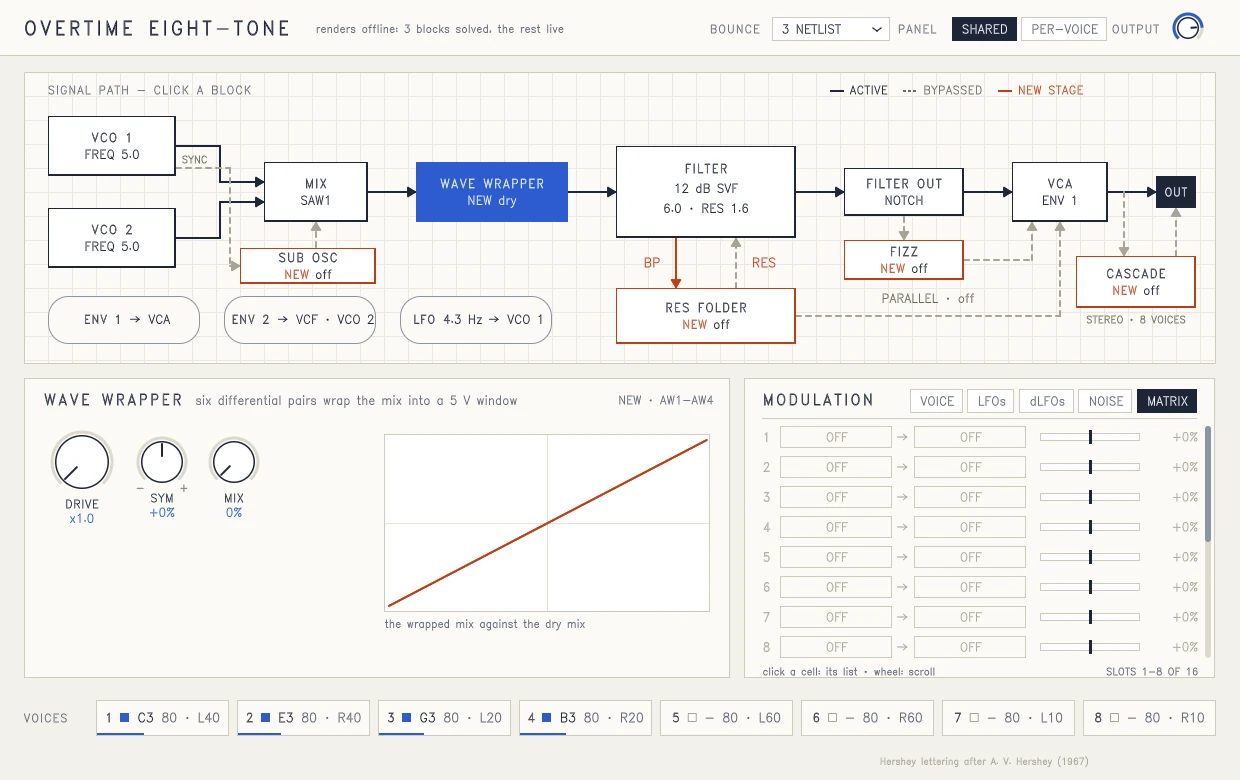
Left of the line, the panel as the circuit came: the new stages dashed, bypassed, and the cascade off. Right of it, all four turned up, the cascade on and five matrix slots set. Turn the four down and each voice is the stock circuit, but for a shift of a percent or two at the very top of the filter's range, where FIZZ copies its current.

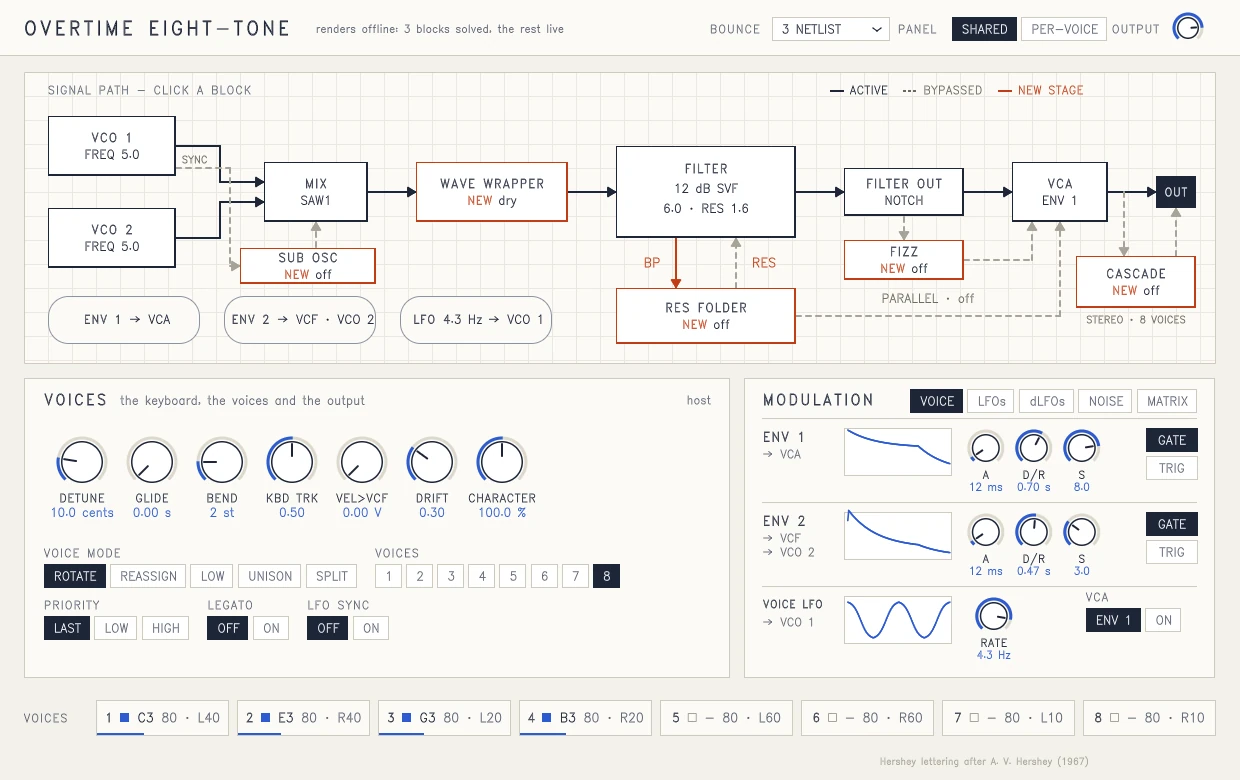
The stock Overtime Eight-Tone panel: on the signal path, VCO 1 and VCO 2 into MIX, the FILTER, FILTER OUT, the VCA and OUT in black, and the new stages, SUB OSC, WAVE WRAPPER, RES FOLDER, FIZZ and the CASCADE, outlined in red with their paths dashed, each reading off or dry. Below, the WAVE WRAPPER card at DRIVE x1.0 and MIX 0%, and MODULATION on its MATRIX tab with every slot OFF.

First, the clone

Down to the exact circuit.

The source is the module's full schematic set, 8 sheets of it, and every original part keeps its reference designator from those sheets. Nothing was drawn as a curve and fitted. Each voice is the circuit, solved.

One voice holds two oscillators with their exponential converters and reset comparators, two envelopes, an LFO, the 12 dB state-variable filter on its transconductance integrators, the notch blend and the VCA: 74 transistors and 310 unknowns, all of them solved together at every step, so the filter hears the oscillators exactly as they are and the VCA hears the filter the same way.

There are eight of them. Every voice draws its own part tolerances: seed 1977 is the netlist's own set, any other seed draws a fresh one, and CHARACTER sets how far the parts stray. Each oscillator is tuned to its own circuit, measured off it, and DRIFT lets the tuning and the filters wander a little. Hold a chord and you are hearing eight instruments that nearly agree.

The power supply and its regulator are left out (the rails are ideal), and so is the pot board's gate lamp. The keyboard and the case mixer were never on these sheets, so the notes, the voice allocation and the mix are ours, in code.

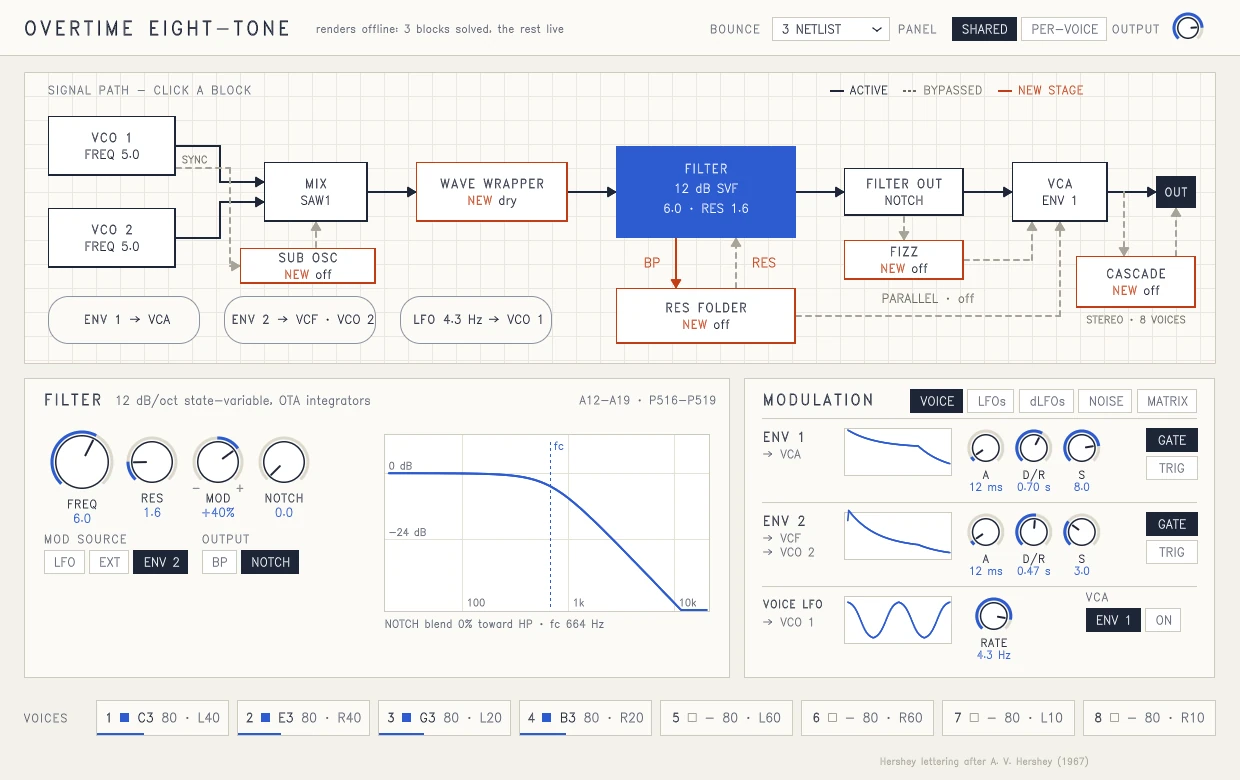
The stock Overtime Eight-Tone panel, the new stages and the CASCADE outlined in red with their paths dashed, each off or dry, and the FILTER selected in blue on the signal path, 12 dB SVF, 6.0, RES 1.6. Its card reads 12 dB/oct state-variable, OTA integrators, with FREQ 6.0, RES 1.6, MOD +40% and NOTCH 0.0, MOD SOURCE on ENV 2 and OUTPUT on NOTCH, beside the filter's response, a lowpass falling from about 660 Hz. To the right, MODULATION on its VOICE tab: ENV 1 to the VCA, ENV 2 to the VCF and VCO 2, and the VOICE LFO at 4.3 Hz to VCO 1.
The panel as the circuit came, the new stages dashed and off. The FILTER card: the circuit's own controls, and its response drawn from the circuit's own laws.
BLOCK BY BLOCK, AGAINST THE SAME NETLIST IN SPICE
BLOCKTHE PANELHERETHE REFERENCE 
VCO 1 and VCO 2FREQ centred, the key voltage from -1 to +5 V62.68 to 4013.1 Hz62.6 to 4007.8 Hzevery point within 0.53 percent
FILTERFREQ 4.0 to 10.0, RES 072.0, 253.1, 937.3, 3689 Hz72, 253, 936, 3700 Hzthe cutoff, four settings
FILTERFREQ 6.0, RES 10.0+11.9 dB near 643 Hz+11.7 dB near 650 Hzthe resonant peak
ENV 1 and ENV 210 and 30 ms into the attack2.539 V, 6.404 V2.54 V, 6.40 Vafter two seconds at rest
VOICE LFOtwo settings of RATE14.18 Hz, 4.338 Hz14.2 Hz, 4.34 Hzboth swinging 3.89 V either way
WAVE WRAPPERthe window it wraps into2.44 V either way2.44 V either wayNEW
RES FOLDERthe folded resonance-1.574 to 1.498 V-1.57 to 1.50 VNEW

Then

We added the weird stuff.

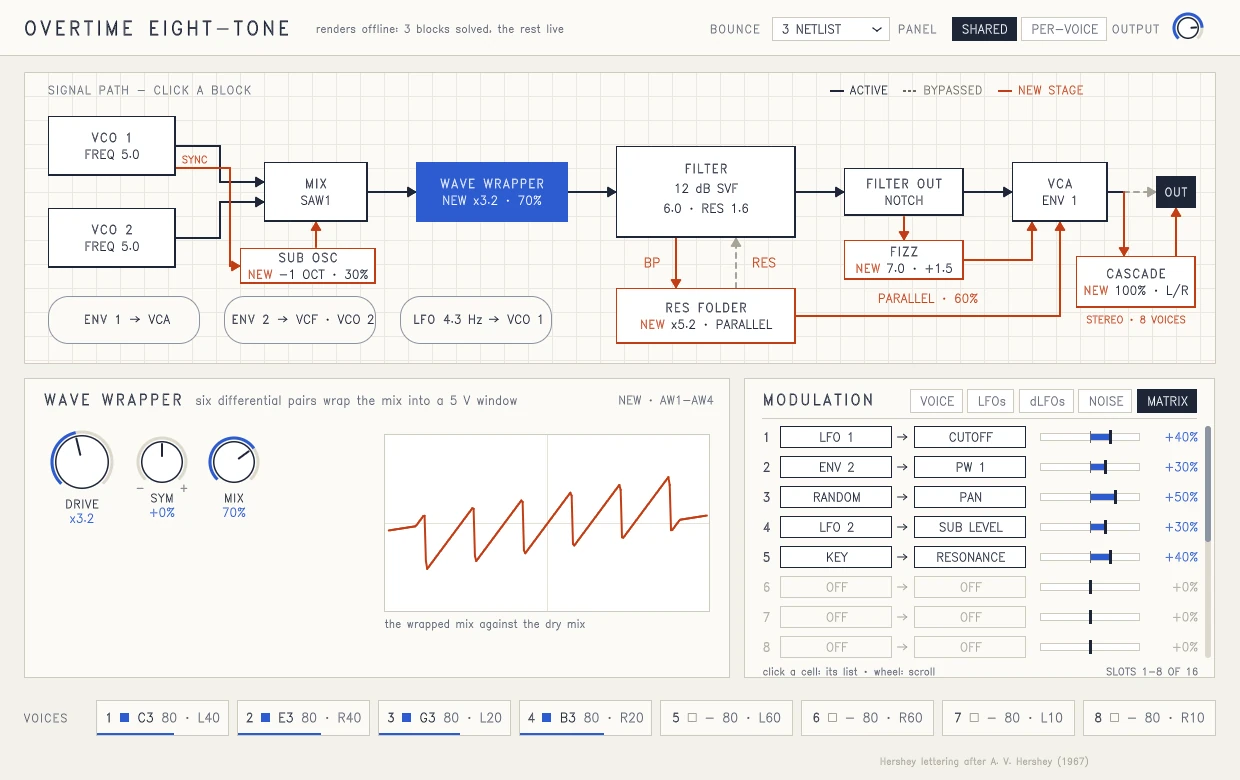
Four new stages, built as circuits, placed inside the voice and solved with the rest of it. They are not effects after the synth: the wrapper feeds the filter, the folder lives on the filter's resonance, the sub divides an oscillator and the fizz rides into the VCA.

The Overtime Eight-Tone panel on cream drafting paper, its new stages lit in red on the signal path: SUB OSC at -1 OCT and 30%, WAVE WRAPPER selected in blue at x3.2 and 70%, RES FOLDER at x5.2, PARALLEL, FIZZ at 7.0 and +1.5, and the CASCADE at 100%, L/R, between the VCA and OUT. Below, the WAVE WRAPPER card with DRIVE x3.2, SYM +0% and MIX 70% and its picture, a red sawtooth wrapped back into its window; to the right, MODULATION on its MATRIX tab with five slots set, LFO 1 to CUTOFF, ENV 2 to PW 1, RANDOM to PAN, LFO 2 to SUB LEVEL and KEY to RESONANCE; and along the bottom, the eight VOICES, the first four playing C3, E3, G3 and B3.

On the oscillators' mix, before the filter

The mix, wrapped back into a window.

Six differential pairs fold the oscillators' mix back on itself whenever it leaves a 5 V window, so a plain saw comes out with a new edge every time it would have run off the end. DRIVE pushes it from ×1 to ×6, SYM tilts the window, and MIX sets how much of the wrapped wave reaches the filter.

DRIVE · SYM · MIX

And over every voice

The Peak-Trough Cascade Filter.

After the eight voices are mixed and before OUTPUT, the signal runs through ten filter sections in series, one cascade for each side of the stereo: five troughs that cut a notch, then five peaks that ring. Every one has its own position and its own depth, and the whole cluster moves together: SHIFT slides it up or down the spectrum, SCALE spreads it out, gathers it to one point or turns it over, and AMOUNT takes it from flat to full depth.

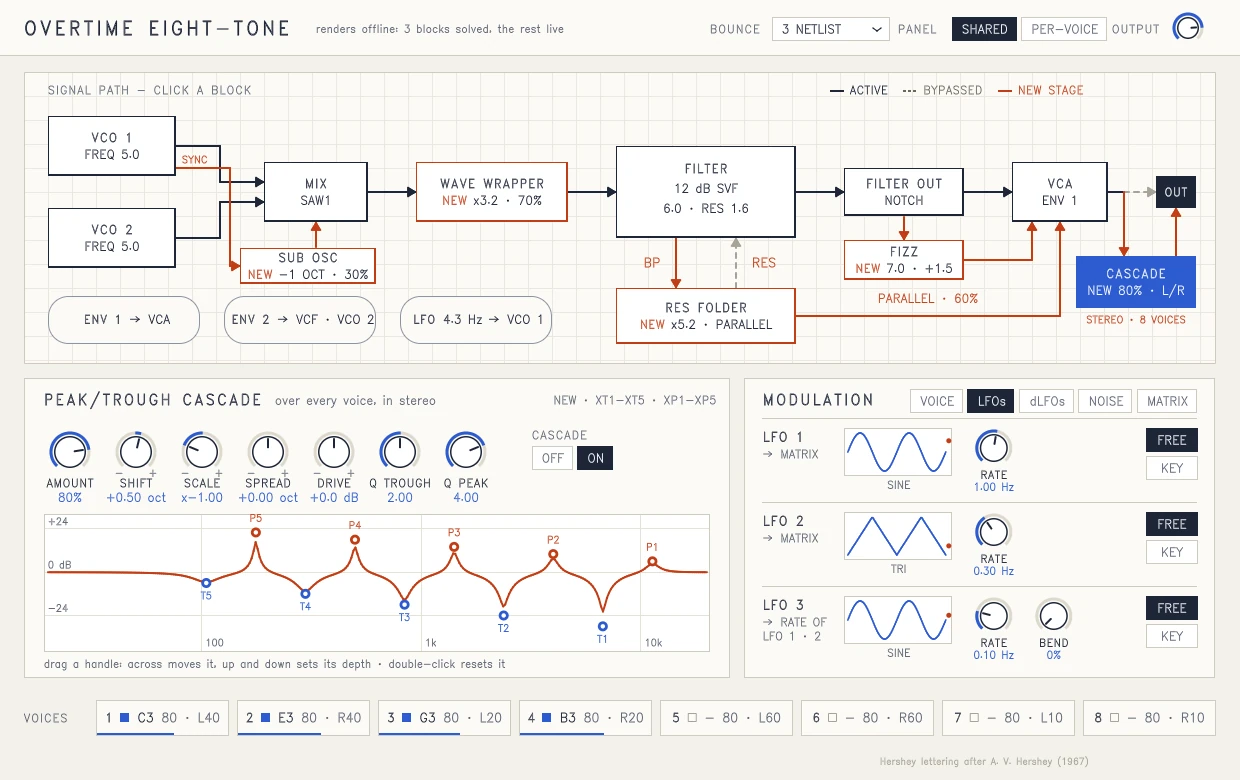
The Overtime Eight-Tone panel with the CASCADE selected in blue at 80%, L/R. Its card reads AMOUNT 80%, SHIFT +0.50 oct, SCALE x-1.00, SPREAD +0.00 oct, DRIVE +0.0 dB, Q TROUGH 2.00 and Q PEAK 4.00, CASCADE ON, and its response is the cluster turned over: from the left T5, P5, T4, P4, T3, P3, T2, P2, T1 and P1, the peaks narrower. To the right, MODULATION on its LFOs tab: LFO 1 SINE at 1.00 Hz, LFO 2 TRI at 0.30 Hz, and LFO 3 SINE at 0.10 Hz, which bends the other two's rates.
SCALE at -1 turns the cluster over: the fifth trough becomes the lowest feature and the first peak the highest. Q PEAK at 4 narrows the peaks.

A handle on every feature

Drag it where you want it.

On the card, T1 to T5 are blue and P1 to P5 red. Drag one across to move it, up and down for its depth, up to 40 dB for a trough and 24 for a peak; the wheel moves it half a decibel, and a double-click puts it back. Q TROUGH and Q PEAK set how narrow they are, every feature stays between 20 Hz and 20 kHz, and SPREAD sets the two sides up to an octave apart, the right one drawn in pink.

AMOUNT · SHIFT · SCALE · SPREAD · DRIVE · Q TROUGH · Q PEAK · OFF or ON

IN THE MATRIX

14 of the matrix's 34 destinations.

CAS SHIFT, CAS SCALE, CAS AMOUNT and CAS SPREAD, and every feature's own position, T1 POS to P5 POS. The cascade is one for the whole instrument, so a voice's own sources, its envelopes, its LFO, velocity and the key, reach it from the newest note.

DRIVE

Push it, and it pushes back.

DRIVE sets the level into the cascade and takes the same back out after it. Quiet, the features are as deep as they are drawn. Driven, each section's gain cell starts to compress its peak and fill its notch, as the circuit does.

SOLVED ON A BOUNCE

Its own row in BOUNCE.

Set it to NETLIST and an offline render solves the cascade's circuit, 251 unknowns a side. Played live, a model of the same circuit runs within 0.09 dB of the solved one at every feature. Turned off, it leaves the voices exactly as they were.

And around the circuit

More to move it with.

The circuit keeps its own LFO and both envelopes, wired as they were. Around it we put three more LFOs, ten digital ones, four noise sources with a sample-and-hold each, a sixteen-slot matrix and a panel for every voice.

LFO 1 to 3, dLFO 1 to 10

Thirteen more LFOs.

Six shapes, SINE, TRI, SAW UP, SAW DN, SQUARE and S&H, from 0.02 to 30 Hz, each FREE or KEY, restarted with every note, and all thirteen shared by the eight voices. LFO 3 does nothing but bend the rates of LFO 1 and LFO 2, three octaves either way at full BEND. The ten dLFOs, digital, each have a PHASE as well, so ten can be set apart, and they start at rates spread from 0.25 to 9.6 Hz. A bounce starts every one of them afresh, so it renders the same every time.

NOISE 1 to 4

Four noises, each held.

Digital white noise, a fresh draw at every tick of its own clock and held until the next: RATE runs the clock from 0.05 Hz to 5 kHz. SLEW glides from one draw to the next instead of stepping, and KEY draws afresh and restarts the clock with every note. The four are separate streams, and a bounce starts them afresh too, so even the noise renders the same every time.

MATRIX

Sixteen slots, 26 sources, 34 places to go.

Eight slots show at once; the box scrolls to the rest, and a line under it counts the ones in use out of view. Each destination enters the circuit where a hand or a patch cable would: PITCH and CUTOFF as voltages into the circuit's own control inputs, the rest by moving a pot along its track, and LEVEL and PAN in the mixer. In a bounce the pots' resistors move inside the solved circuit.

PANEL: SHARED OR PER-VOICE

A panel for every voice.

SHARED plays all eight voices from one panel. PER-VOICE gives each voice a full panel of its own, kept in the preset either way: click a voice in the VOICES strip and the panel edits that one. Eight voices can be eight patches.

SOURCES

  • LFO 1
  • LFO 2
  • LFO 3
  • ENV 1
  • ENV 2
  • VOICE LFO
  • VELOCITY
  • KEY
  • MOD WHEEL
  • AFTERTOUCH
  • CC74
  • RANDOM
  • dLFO 1
  • dLFO 2
  • dLFO 3
  • dLFO 4
  • dLFO 5
  • dLFO 6
  • dLFO 7
  • dLFO 8
  • dLFO 9
  • dLFO 10
  • NOISE 1
  • NOISE 2
  • NOISE 3
  • NOISE 4

DESTINATIONS (red: a new stage's)

  • PITCH
  • PITCH 1
  • PITCH 2
  • PW 1
  • PW 2
  • VCO 1 MIX
  • VCO 2 MIX
  • SUB LEVEL
  • WRAP DRIVE
  • WRAP SYM
  • WRAP MIX
  • CUTOFF
  • RESONANCE
  • NOTCH
  • FOLD DRIVE
  • FOLD MIX
  • LEVEL
  • PAN
  • FIZZ
  • FIZZ DRIVE
  • CAS SHIFT
  • CAS SCALE
  • CAS AMOUNT
  • CAS SPREAD
  • T1 POS
  • T2 POS
  • T3 POS
  • T4 POS
  • T5 POS
  • P1 POS
  • P2 POS
  • P3 POS
  • P4 POS
  • P5 POS

The keyboard

Eight voices, played like one.

The Overtime Eight-Tone panel with its VOICES card open: DETUNE 10.0 cents, GLIDE 0.00 s, BEND 2 st, KBD TRK 0.50, VEL>VCF 0.00 V, DRIFT 0.30 and CHARACTER 100.0 %; the VOICE MODE keys ROTATE, REASSIGN, LOW, UNISON and SPLIT, with ROTATE lit; VOICES 1 to 8; PRIORITY LAST, LOW or HIGH; LEGATO and LFO SYNC, both OFF. Along the bottom, the eight voices with their notes, levels and pans, the first four playing.
The VOICES card, opened from OUT on the signal path, and the eight voices along the bottom, each with its note, level, pan and a lamp while it sounds.

VOICE MODE deals notes five ways. ROTATE goes round the free voices in turn; REASSIGN sends a repeated note back to the voice that played it; LOW takes the lowest-numbered voice that is free; UNISON stacks every voice in play on one note, DETUNE spreading them, with PRIORITY LAST, LOW or HIGH and LEGATO if you like; SPLIT puts voices 1 to 4 below a key and 5 to 8 above it. When every voice is busy, the quietest released one is taken first, and if all are held, the oldest note. VOICES sets how many of the eight are in play.

It answers the pitch bend, the sustain pedal, the mod wheel (vibrato), channel pressure and CC74, and velocity, aftertouch and CC74 can each open the filter. KBD TRK sets how far the filter follows the keyboard, and VEL>VCF how far velocity pushes it.

Along the bottom of the panel, each voice shows its note, its level and its pan, with a lamp while it sounds. Click one to edit it in PER-VOICE; the wheel sets its level, and shift with the wheel its pan.

Playback and bounce

Play it live. Bounce the circuit.

Eight solved circuits cannot keep up with your hands, so the Eight-Tone keeps two engines and tells you which one you are hearing. BOUNCE, in the header, opens a menu of the voice's 9 blocks and the cascade, each LIVE or NETLIST, and under its name the panel says what an offline render will be:

renders offline: 3 blocks solved, the rest live

PLAYBACK

The live model.

While you play, each voice runs a real-time model of the same circuit, every stage's law worked from the netlist's own resistors and measured levels, with the four new stages modeled from their circuits too. Against the circuit on one voice it is a little brighter, by 0.31 dB.

BOUNCE: NETLIST

The netlist, block by block.

When your DAW renders offline, the Eight-Tone solves the blocks the BOUNCE menu sets to NETLIST in every voice that sounds, the voices in parallel, and runs the rest as the live model beside them, with your automation moving their parts as it goes. By default the wave wrapper, the filter and the resonance folder are solved. Both engines have the same delay, 29 samples at 44.1 and 48 kHz, so a bounce lines up with playback to the sample.

What a bounce runs at each setting of the BOUNCE menu, and how long it takes
BOUNCEA BOUNCE RUNSHOW LONG IT TAKES
ALL LIVEThe live model, exactly as it plays.Faster than the song
DEFAULT, 3 NETLISTThe wave wrapper, the filter and the resonance folder solved, the rest live.3.1 to 9.0 times slower than real time
ALL NETLISTThe netlist of every voice that sounds, new stages and all, and the cascade.11.2 to 19.9 times slower than real time

The panel

Click a block, get its card.

The panel is the signal path. Click a block and its card opens below it, with its controls and a picture of what it is doing; MODULATION sits beside it, with VOICE, LFOs, dLFOs, NOISE and MATRIX tabs. Blocks in red are the new stages, dashed while they are bypassed.

VCO 1, VCO 2

FREQ, two octaves either way in semitones; MOD and its SOURCE, LFO, EXT or an envelope; PW, the pulse's width. SYNC locks VCO 2 to VCO 1.

MIX

VCO 1 and VCO 2 each from pulse through off to saw, and EXT, the external input's level.

WAVE WRAPPERNEW

DRIVE, ×1 to ×6; SYM; MIX, dry to fully wrapped.

SUB OSCNEW

LEVEL, and the OCTAVE keys, -1 OCT or -2 OCT, under VCO 1.

FILTER

FREQ, RES, MOD and its SOURCE, LFO, EXT or ENV 2; OUTPUT, BP or NOTCH; and NOTCH, which blends the lowpass into the highpass.

RES FOLDERNEW

DRIVE, ×1 to ×9.3; MIX; PARALLEL beside the main path, or IN-LOOP inside the filter's damping.

FIZZNEW

FIZZ, DRIVE and SYM; DRIVE CURRENT, FIXED or ENV 2; BAND, CUTOFF or +1.5 OCT.

VCA

ENV 1, or ON for a drone.

CASCADENEW

OFF or ON; AMOUNT, SHIFT, SCALE, SPREAD, DRIVE, Q TROUGH and Q PEAK; a handle for each of T1 to T5 and P1 to P5 on its response.

ENV 1, ENV 2

A, D/R and S, and GATE or TRIG. ENV 1 opens the VCA; ENV 2 sweeps the filter and VCO 2.

VOICE LFO

The circuit's own LFO and its RATE, one in every voice.

LFO 1, LFO 2, LFO 3NEW

SINE, TRI, SAW UP, SAW DN, SQUARE or S&H, a RATE from 0.02 to 30 Hz, FREE or KEY. LFO 3 has BEND, which moves the other two's rates.

dLFO 1 to dLFO 10NEW

Digital LFOs: SHAPE, the same six as LFO 1 to LFO 3; RATE, 0.02 to 30 Hz; PHASE, 0 to 360 degrees; FREE or KEY.

NOISE 1 to NOISE 4NEW

White noise, a fresh draw at every tick of RATE, 0.05 Hz to 5 kHz, held until the next; SLEW, from steps to a glide; FREE or KEY.

MATRIXNEW

Sixteen slots, eight in view and a scroll bar for the rest, each a source, a destination and an amount either way: click a source or a destination for its list, drag an amount, double-click for zero.

VOICES

VOICE MODE, PRIORITY, LEGATO and how many VOICES; DETUNE, GLIDE, BEND, KBD TRK, VEL>VCF, DRIFT and CHARACTER.

BOUNCE, PANEL, OUTPUT

In the header: BOUNCE, a menu that sets each block LIVE or NETLIST for an offline render; PANEL, SHARED or PER-VOICE; and the OUTPUT level.

What it is, and what it is not

Solved, estimated, and not yet.

SOLVED

Each voice's whole schematic: both oscillators and their converters, the envelopes, the LFO, the filter and its integrators, the notch and the VCA, with the four new stages in the same circuit, and the cascade's own deck. On a bounce the blocks set to NETLIST are solved oversampled, four times over at 44.1 and 48 kHz.

ESTIMATED

The discrete transistors and diodes use close stand-in models from published data for parts of their class, not measurements of the originals; the op-amps and transconductance amplifiers are behavioral models carrying their datasheets' figures. The live model is a model, and says so.

NOT YET

MPE. SPLIT with a separate panel for each half of the keyboard. And the Mac: it is Windows only for now, with the Mac VST3 and Audio Unit in development.

No activation, no license server, no phone-home

We took a beloved classic and threw it into a shredder.

A legend, cloned down to the exact circuit, a bunch of weird stuff that made it better, and a cascade of peaks and troughs over all of it. Its sibling, the Overtime State-Variable Filter, brings the fizz to anything else.

All Synths

VST®3 instrument · Windows 64-bit No activationmacOS VST3 and Audio Unit are in development.

At a glance

Overtime Eight-Tone specifications

Technical specifications for Overtime Eight-Tone, Polyphonic Netlist Synthesizer
FormatVST®3 instrument · Windows 64-bit
In developmentmacOS VST3 and Audio Unit
Requires64-bit Windows 11, in any version Microsoft still supports. When the Mac version ships: macOS 15 or later, on Apple silicon or Intel.
Voices8 · ROTATE, REASSIGN, LOW, UNISON or SPLIT
The circuitEach voice a 1974 American expander module, every original part kept · 74 transistors
New stagesWAVE WRAPPER · RES FOLDER · SUB OSC · FIZZ, all four in the circuit
ModulationThe circuit's own LFO and two envelopes · thirteen more LFOs, 0.02 to 30 Hz · four noise S&H sources, 0.05 Hz to 5 kHz · a sixteen-slot matrix, 26 sources, 34 destinations
CascadeStereo, after the voices · 5 troughs and 5 peaks, each a position and a depth · AMOUNT, SHIFT, SCALE, SPREAD, DRIVE, Q TROUGH, Q PEAK
PanelsSHARED, or PER-VOICE: a full panel for each voice
CharacterThe netlist's own part tolerances, or a fresh draw · CHARACTER spread · DRIFT
PlaybackThe live model, its laws worked from the netlist's own parts
BounceThe BOUNCE menu: nine blocks and the cascade, each LIVE or NETLIST · the wrapper, the filter and the folder solved by default
Bounce time3.1 to 9.0 times slower than real time with the default blocks · 11.2 to 19.9 with every block (eight voices)
Latency29 samples at 44.1 and 48 kHz, the same in playback and the bounce
The panel1240 by 780
Validation47 of 47 validator tests · host-tested
ActivationNone. No license server, no phone-home
Security updatesUntil November 2031
LicenseLicense agreement · Facts sheet
VST Compatible

VST is a registered trademark of Steinberg Media Technologies GmbH.