
Effects
Trouble.
Put one of these on a finished track and the track stops being finished. A supply that browns out while you hold the note. A photocell eleven times slower to forget than it was to notice. Two cells that never matched at the factory. A filter whose cutoff is a lamp, and answers late. None of it is a curve applied to a signal - a curve sees one sample at a time and remembers nothing that came before it. These have parts, and parts have history. All of it runs on the engine inside Phonon, compiling the same source files the DAW does.
What does this knob do? - why we build them this way
Can't afford our synths? Don't expose yourself to viruses. Email us instead. 🎶
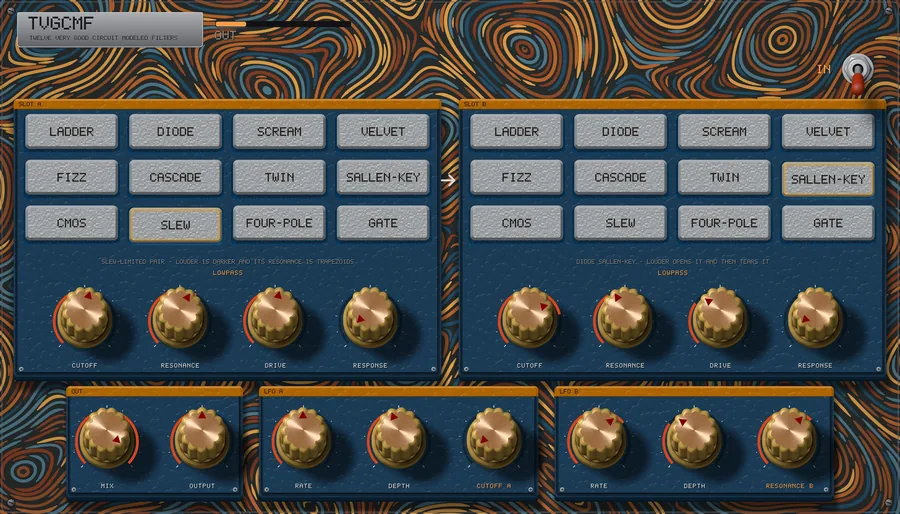
TVGCMF
Coming soonComponent-Modeled Filter Bank
Twelve very good filters. Twice. In a row.
- Every one solved from its parts, not approximated: transistor pairs, diodes, OTAs and a photocell, with every feedback loop solved inside the sample it happens in
- A second slot of the same twelve, in series behind the first
- Staged so the twelve arrive within 3.7 dB of each other: you hear the circuit, not the gain
VST3 · Windows 64-bit · macOS is in development.
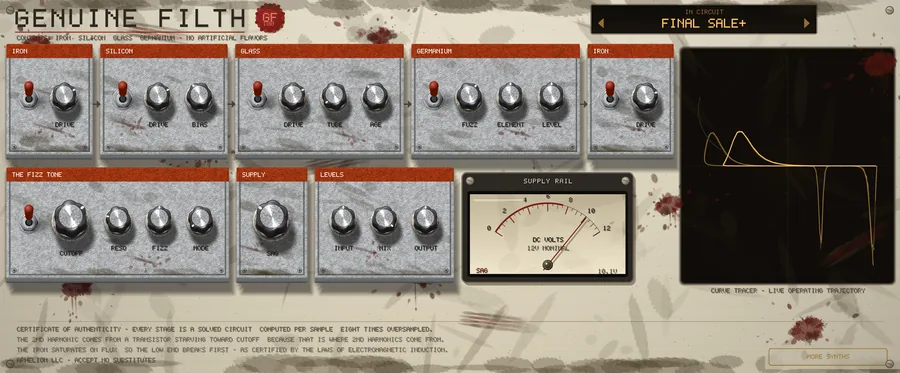
Genuine Filth
Coming soonComponent-Modeled Distortion
Accept no substitutes.
- 68.8% distortion at 60 Hz and 0.02% at 5 kHz, same knob setting
- One shared supply with real source impedance, so it sags and pumps
- Germanium, silicon and LED clipping elements, not three curves
VST3 effect · Windows 64-bit · macOS VST3 and Audio Unit are in development.
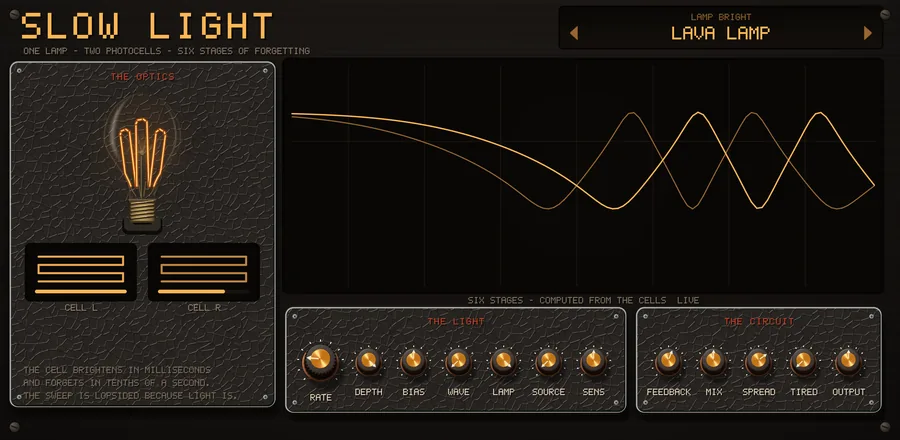
Slow Light
Coming soonComponent-Modeled Vactrol Phaser
Ooey. Gooey. Oh so analog.
- A cell that rises in 10 ms and falls in 107, eleven times slower
- A lamp you can swap for an incandescent filament with thermal lag
- A second, deliberately mismatched cell for the right channel
VST3 effect · Windows 64-bit · macOS VST3 and Audio Unit are in development.
Why a circuit rather than a curve
Because the parts have state, and a curve does not. A transformer core integrates voltage over time, so it saturates differently on a low note than a high one - the frequency is in the answer because the time is in the equation. A photocell has a chemistry that takes a tenth of a second to relax, so the sweep it drives is lopsided whatever shape you feed it. A shared supply droops under load, so the sound changes while you hold it and the other channel hears about it.
None of those can be drawn as a curve and then looked up, which is the whole reason to solve the circuit instead. It costs more to run and it is the only way to get behaviour that depends on what you just did.
The same library builds the synths and the drum machines, and the DAW they all came out of.