Checked against the service notesAll Netlist Effects

A stereo field processor

Chicagoland

Chicagoland SDS-230 Bucket-Brigade Chorus

The "gooey" chorus you notice when it's gone.

A 1979 stereo bucket-brigade chorus, solved from its netlist: both channels, the compander around each delay, the chains of capacitors that are the delays and the clocks that sweep them, and the mix that sets each channel against the other. Every mode's sweep lands within 0.27 ms of the range the unit's service notes print.

VST®3 effect · Windows 64-bit No activationmacOS VST3 and Audio Unit are in development.

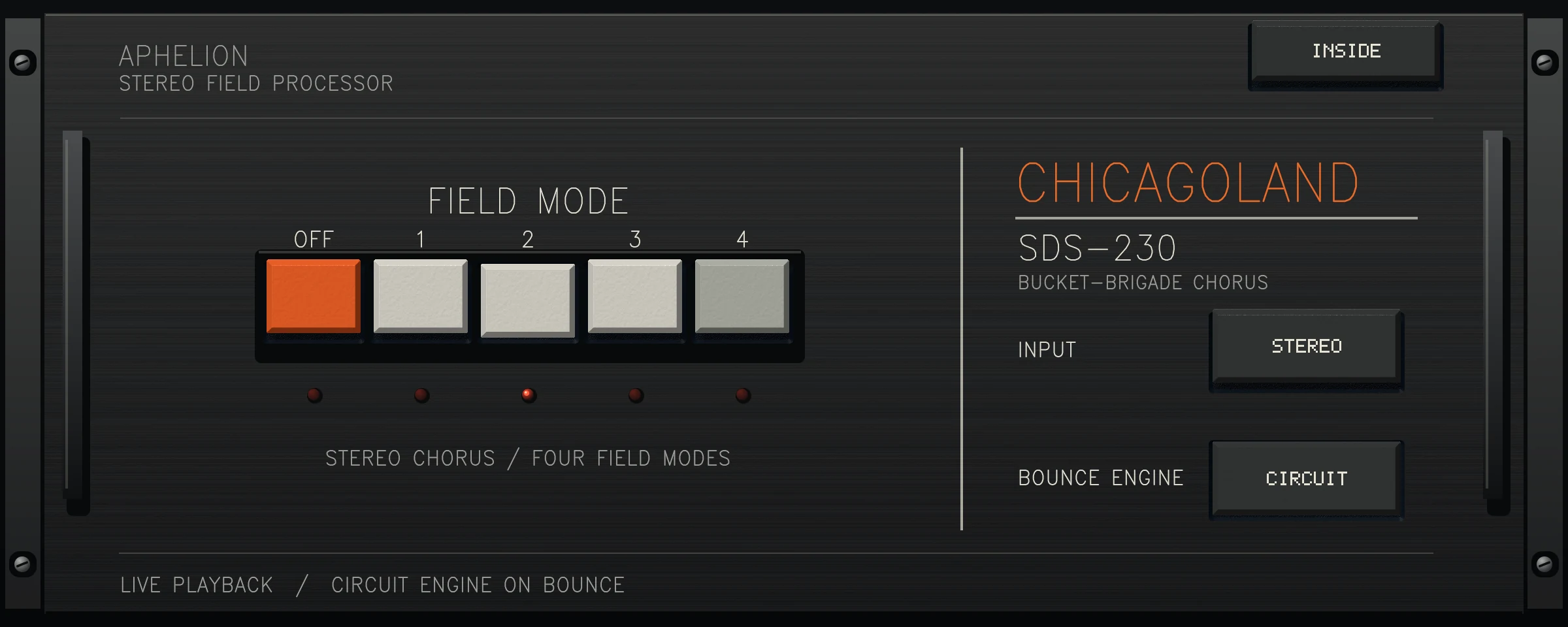
The FRONT face of the Chicagoland panel, a rack unit in black brushed metal: APHELION and STEREO FIELD PROCESSOR at the top left, the FIELD MODE buttons OFF in orange and 1 to 4 in cream with button 2 pressed and its red lamp lit, the line STEREO CHORUS / FOUR FIELD MODES beneath them, and on the right the name CHICAGOLAND in orange over SDS-230 and BUCKET-BRIGADE CHORUS, the INPUT key on STEREO and the BOUNCE ENGINE key on CIRCUIT; the INSIDE key at the top right, and along the foot the line LIVE PLAYBACK / CIRCUIT ENGINE ON BOUNCE.
  • Both channels solved
  • 1024 stages a delay
  • 0.27 ms from the service notes
  • Four field modes

Listen

Now take it away.

The same sixteen seconds, dry and through Chicagoland. The two play together, so switching keeps your place: listen to WET for a while, then press DRY.

Where it came from

You hear it leave.

Some choruses announce themselves: a wobble you can point at. This one is the other kind. Two short delays sweep in opposite directions, each channel heard against the other, and what comes out is not a wobble but a wider, thicker, warmer version of what went in. You stop noticing it, until you press OFF and the mix goes flat.

That is the sound of a 1979 stereo bucket-brigade chorus, and Chicagoland is that circuit solved from its netlist: both channels, the compander around each delay, the chains of capacitors that are the delays and the clocks that drive them, and the mix that sets the channels against each other. The four FIELD MODE buttons are the hardware's, and they can be held down together, as players of the hardware hold them.

What is in the netlist

Two delays, one circuit.

Not a delay line with a wobble on it, but the circuit around one: the compander that keeps the chain's noise down, the filters either side of it, the clock that sets its length, and the mix that sets the two channels against each other, all solved together.

THE BUCKET BRIGADE A chain of 1024 capacitors, each handing its charge to the next on every clock edge: that chain is the delay. Each transfer leaves a little behind, the outputs follow their own curve, and the clock steps through them, which a trimmer nulls.

Checked against the service notes

The sweeps it printed.

The unit's service notes print the delay sweep of every mode, read off a scope, and the LFO's swing and period. A netlist that is transcribed right should land on them without being tuned to them. One thing was calibrated: where the clock oscillator's inverters switch, set inside the spread their datasheet allows. With that one setting, every mode's sweep lands on its printed range, or within 0.27 ms of it.

  • 0.27 msthe farthest any sweep runs past its printed range, at the top of modes 3 and 4
  • 3.76 sthe slow LFO, printed as 4 s
  • 1.79 sthe fast LFO, printed as 2 s
  • 1calibration, within the datasheet's spread
THE DELAY SWEEP BY FIELD MODE, MS
FIELD MODETHE SERVICE NOTESTHE NETLIST
18 to 128.58 to 11.84
25 to 105.30 to 10.13
36 to 96.23 to 9.27
46 to 96.23 to 9.27
THE LFO
FIELD MODESPRINTED SWINGSOLVED SWINGPRINTED PERIODSOLVED PERIOD
1 and 26.8 V7.08 V4 s3.76 s
3 and 44.4 V4.45 V2 s1.79 s

HOW IT WAS READ

Page 4 of the service notes feeds a 40 Hz square wave into the right input in MONO and reads the delay off a scope at each mode. The netlist runs the LFO block at each mode and reads the delay its clock gives at the sweep's two ends. The left channel lands within 0.07 ms of the right.

WHAT ELSE WAS CHECKED

Stage by stage, the levels and the DC points the schematic prints: the compressor's output resting at 7.47 V against the printed 7, and the chain's input at -7.50 V against -7.5. The live engine was checked against the netlist the same way: its delay within 0.07 ms of the netlist's at the turns.

FIELD MODE

Four buttons. Press two.

The modes are the circuit's own: each button closes contacts that pick the LFO's tap, switch the depth transistors and change the mix. Because they are contacts rather than a code, two held down together close both, and the circuit does whatever those contacts do. SHIFT-click holds a button in.

OFF

The effect out: the dry signal at unity, through the same input and output stages.

1

The slow LFO with the depth transistors switched off: the gentlest sweep, around the longest delay, 8 to 12 ms.

2

The same slow LFO with the depth transistors in: a deeper sweep, 5 to 10 ms.

3

The faster tap, two seconds a cycle, with a narrower swing: 6 to 9 ms.

4

Mode 3's sweep with the mix changed: each channel's own delayed signal turned down to a third, so the other channel's carries more of it.

Playback and bounce

Play it live. Bounce the circuit.

Solving a bucket brigade edge by edge takes far longer than the music does, so Chicagoland keeps two engines and tells you which one you are hearing. The panel prints it along its foot:

LIVE PLAYBACK / CIRCUIT ENGINE ON BOUNCE

LIVE PLAYBACK

The live engine.

While you play, every stage runs as the analog response the netlist's own component values give it: the emphasis curves, the filters, the compander's two halves by their law, the bucket brigade as a delay line through its output curve, the clocks by the circuit's solved law, and the LFO turning where the netlist's turns. It takes a few percent of one core. It leaves out the bucket brigade's sampling, its images, aliasing and clock residue, along with the op-amps and the compander's offsets, and mode 4 follows the circuit less closely than the others.

BOUNCE ENGINE: CIRCUIT

The netlist.

When your DAW renders offline, Chicagoland solves the netlist instead: both channels, block by block, the chain sampled at every clock edge and the clocks integrated through the oscillator's solved law. Every knob moves its part between buffers, so the bounce follows your automation. Both engines have the same delay, so a bounce lines up with playback to the sample.

What a bounce runs at each setting of BOUNCE ENGINE, and how long it takes
BOUNCE ENGINETHE PANEL SAYSA BOUNCE RUNSHOW LONG IT TAKES
LIVELIVE ENGINE / PLAYBACK + BOUNCEThe live engine, exactly as it plays.Faster than the song
CIRCUITLIVE PLAYBACK / CIRCUIT ENGINE ON BOUNCEThe netlist: every part, both channels, the bucket brigades transfer by transfer and the clocks edge by edge.About twenty times slower than real time: a three-minute mix can take an hour

The panel

Two faces. Every trim a part.

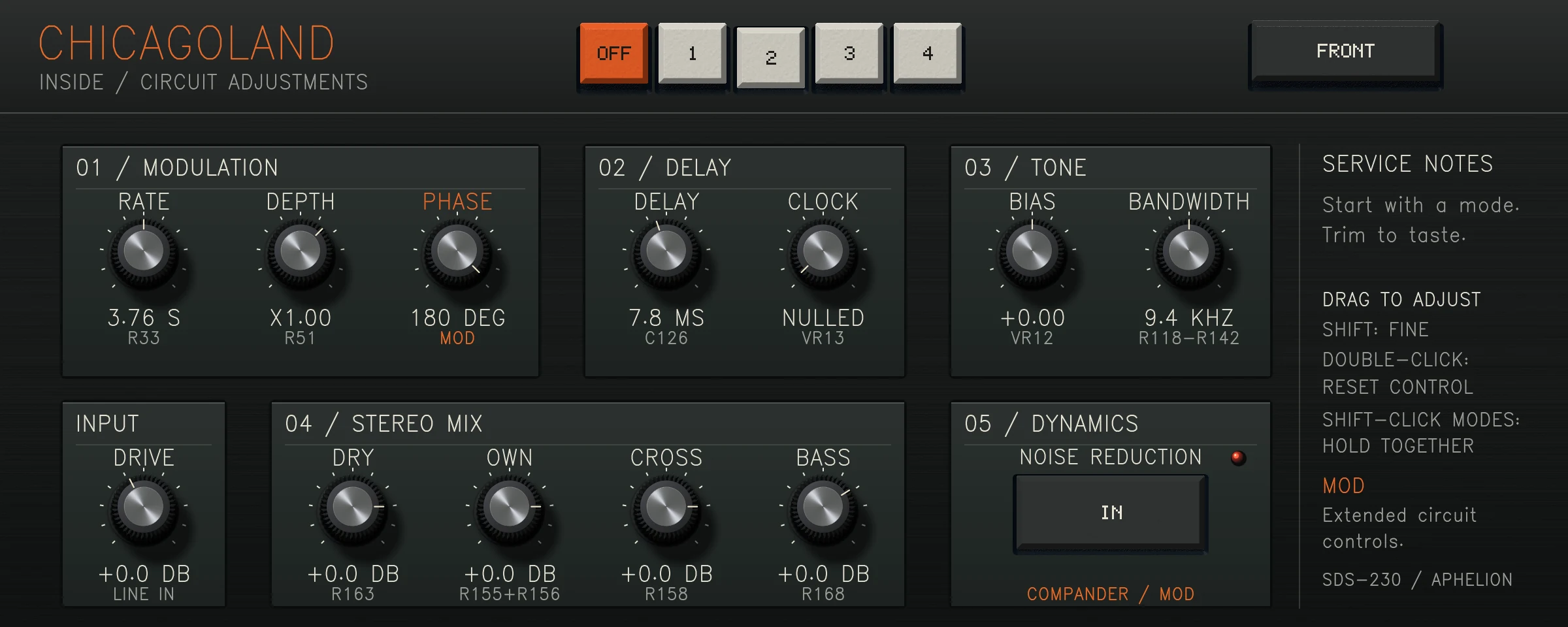
FRONT is the rack unit, the hardware's buttons and nothing else. INSIDE is the board: thirteen trims around the selected mode, each a part on the schematic with its designator printed under the knob, and two controls beyond the circuit, PHASE and NOISE REDUCTION, marked MOD.

The INSIDE face of the Chicagoland panel, in dark brushed metal: the FIELD MODE buttons OFF and 1 to 4 across the top with 2 pressed, and below them knobs in labeled groups, MODULATION with RATE, DEPTH and PHASE, DELAY with DELAY and CLOCK, TONE with BIAS and BANDWIDTH, INPUT with DRIVE, STEREO MIX with DRY, OWN, CROSS and BASS, and DYNAMICS with the NOISE REDUCTION button, each knob showing its value and its part's designator, PHASE and the compander marked MOD in orange.
INSIDE Start with a mode, then trim it: each knob moves its part in the netlist, between buffers, in the bounce as well as live.

FIELD MODE

OFF and 1 to 4, interlocked as the hardware's buttons are. SHIFT-click holds a button in with the ones already down; a plain click is one mode again.

INPUT

STEREO, each channel its own input; or MONO, the right input into both.

BOUNCE ENGINE

CIRCUIT, an offline render solves the netlist; or LIVE, it renders the live engine, as fast as playback.

INSIDE / FRONT

The key at the top right turns the panel round: FRONT is the rack unit, INSIDE the board's trims.

RATE

The LFO's timing resistor, two octaves either way; it shows the period.

DEPTH

How far the LFO moves the clocks, a quarter to twice the mode's; the period holds.

PHASE

MOD. How far apart the two channels' sweeps run, up to the circuit's own half a cycle.

DELAY

The clock oscillator's timing capacitor: the delay's center, half to two and a half times the mode's.

CLOCK

The clock-cancel trimmer, off its null: the clock's residue let back through. Circuit only.

BIAS

The bucket brigade's bias trimmer: where the signal sits on the chain's curve.

BANDWIDTH

The filters' resistors, together: it shows the anti-alias corner.

DRIVE

The line in, from -12 to +18 dB, and back out, so it changes how hard the circuit works rather than how loud it is.

DRY, OWN, CROSS, BASS

The mix's four resistors: the dry signal, the channel's own delayed signal, the other channel's, and the dry's bass.

NOISE REDUCTION

MOD. The compander IN, as the circuit has it, or OUT, both halves held at unity.

What it is, and what it is not

Its own sound.

Chicagoland is not a replica of any one unit, and we do not claim it sounds like one. Where the schematic was legible we used its values, where the parts list or the circuit board settled a doubt we followed them, and where nothing survives we estimated, and marked the estimate in the netlist.

SOLVED

Both channels, part by part: the op-amp stages, the compander's two halves, the filters, the bucket brigades transfer by transfer, the clock oscillators and the LFO, with the FIELD MODE contacts as the resistors they are.

NOT MODELED

The power supply and the meter's driver: the rails are ideal. In live playback, also the bucket brigade's sampling, the op-amps and the compander's offsets, which is why the circuit has the final word.

ESTIMATED

A few transistors and one op-amp have no surviving data, so stand-ins carry their values. The bucket brigade's charge loss is fitted to its published response, and its noise and leakage are estimates. Each one is marked in the netlist.

The stereo chorus, solved

Chicagoland

Chicagoland SDS-230 Bucket-Brigade Chorus

The "gooey" chorus you notice when it's gone.

VST®3 effect · Windows 64-bit No activationmacOS VST3 and Audio Unit are in development.

At a glance

Chicagoland specifications

Technical specifications for Chicagoland, SDS-230 Bucket-Brigade Chorus
FormatVST®3 effect · Windows 64-bit
In developmentmacOS VST3 and Audio Unit
Requires64-bit Windows 11, in any version Microsoft still supports. When the Mac version ships: macOS 15 or later, on Apple silicon or Intel.
The netlistBoth channels, the LFO and both clocks · every part on the schematic but the supply and the meter's driver
Checked againstThe service notes' delay sweeps and LFO, mode by mode
PlaybackThe live engine, built from the circuit's component values · a few percent of one core
BounceBOUNCE ENGINE CIRCUIT: the netlist · LIVE: the live engine
Bounce timeThe circuit about twenty times slower than real time
FRONTFIELD MODE OFF and 1 to 4, held together with SHIFT · INPUT STEREO or MONO · BOUNCE ENGINE
INSIDERATE, DEPTH, DELAY, CLOCK, BIAS, BANDWIDTH, DRIVE, DRY, OWN, CROSS and BASS · PHASE and NOISE REDUCTION, marked MOD
LatencyThe same in playback and the bounce, so a bounce lines up to the sample
The panel1200 by 480 · two faces
Validation47 of 47 validator tests · host-tested
ActivationNone. No license server, no phone-home
Security updatesUntil November 2031
LicenseLicense agreement · Facts sheet
VST Compatible

VST is a registered trademark of Steinberg Media Technologies GmbH.