It takes a while because the tape is doing things. Lo-Fi things.
A tape recorder solved three ways at once: its tube electronics from their netlist, its tape by the physics of magnetic recording, and its transport by its mechanics. Live, it plays a fitted machine measured from the full one; a bounce runs the whole machine, and takes its time.
VST®3 effect · Windows 64-bit· No activationmacOS VST3 and Audio Unit are in development.
Tubes from the netlist
Ten layers of tape
Three heads a track
Slow on purpose
Listen
Let the tape do things.
The same sixteen seconds, dry and twice through Vertex 353, once mild and once wild. The three play together, so switching keeps your place: listen to MILD or WILD for a while, then press DRY.
0:00 / 0:16
Where it came from
Three machines, one recorder.
Most tape in software starts from what tape sounds like: a saturation curve, a filter, a wobble. Vertex 353 starts from what a tape recorder is. Its electronics are the schematic of a 1960s two-track studio recorder, tubes and all, solved from their netlist. Its tape is a coating of magnetic particles, written layer by layer by the field at the record head's gap and read back by the reproduce head's. Its transport is reels, an idler, a capstan and the tape stretched between them, moving as that machine moves.
Nothing is drawn on top. The saturation is the particles running out of room, the treble loss is the written pattern's own field pushing back on it, the flutter is the capstan and the scrape of the tape across the heads. That is why a bounce takes a while: the tape is doing things.
What is in the machine
All of it, at once.
The electronics, the tape and the transport run together, each on its own clock: the record side at the bias's rate, the tape where the heads are, the transport underneath, for both tracks.
THE TAPE A coating of magnetic particles with a spread of switching fields, in ten layers through its depth. Each layer keeps what the field leaves it as the bias dies away behind the gap; the written pattern's own field pushes back on it, and every particle adds its noise.
Checked against the manual
The figures it printed.
The machine's instruction manual circles the DC voltage at the stages, boxes the signal level at them, and publishes its performance. Each stage was held to those figures, and where it missed, the netlist was read again rather than tuned.
7%the playback block's DC, at its worst, from the circled voltages
103.8 kHzthe bias oscillator, printed as "approximately 100 kc"
0.6 dBthe playback curve, from the standard, 500 Hz to 5 kHz
0.023%flutter at 15 ips, under the published 0.11%
THE MANUAL AND THE MACHINE
WHAT
THE MANUAL
THE MACHINE
Playback block, DC
circled voltages
within 7% of every one
Record block, DC
circled voltages
within 3%, but the oscillator's grids
Bias oscillator
approximately 100 kHz
103.8 kHz
Playback curve
50 µs
within 0.6 dB, 500 Hz to 5 kHz
Reproduce head
-56 dB at operating level
1.205 mV, -0.2 dB from it
Flutter, 15 ips
0.11%
0.023%
Flutter, 7.5 ips
0.14%
0.073%
WHERE IT MISSED, AND WHY
The record block's oscillator grids sit at -26 V against the schematic's -20, the one DC point outside 3 percent there. Holding the stages to the boxed signal levels also caught several misreadings of the scanned schematic, each corrected from the circuit's own arithmetic or the parts list, never by tuning.
THE FLUTTER, READ PLAINLY
In the condition it starts in, the transport comes in under the flutter the manual publishes, at both speeds. CONDITION, SPLICES and HEAD WEAR take it from there.
The tape and the transport
Physics, not a curve.
What a tape machine does to a sound comes from a handful of physical processes. Vertex 353 runs each of them, rather than a picture of what they add up to.
THE COATING
Particles with a spread of switching fields, in ten layers from the surface down, each element keeping the history of the fields it has seen. Saturation, the softness of the curve and its hysteresis come from that population, not from a formula for them.
THE BIAS
The 100 kHz bias swings every particle back and forth as the tape passes the gap, and what stays is what is left as that swing dies away. Bias it under and the treble is louder and the sound rougher; bias it over and short wavelengths are erased as they are written.
THE PATTERN PUSHES BACK
A written pattern has a field of its own that works against it, and the shorter the wavelength the harder it pushes. That self-demagnetization is where most of tape's treble loss comes from, and it is solved layer by layer, as the tape leaves the head.
THE TRANSPORT
The tape across the heads is a chain of elastic segments, and their resonances are scrape flutter. The capstan is locked to the mains and hunts a little; the holdback's tension rises as the reel empties; a splice lifts the tape off the heads as it passes. Each head reads the tape where it was written, so stretch and speed changes are exact.
Playback and bounce
Hear an impression. Bounce the machine.
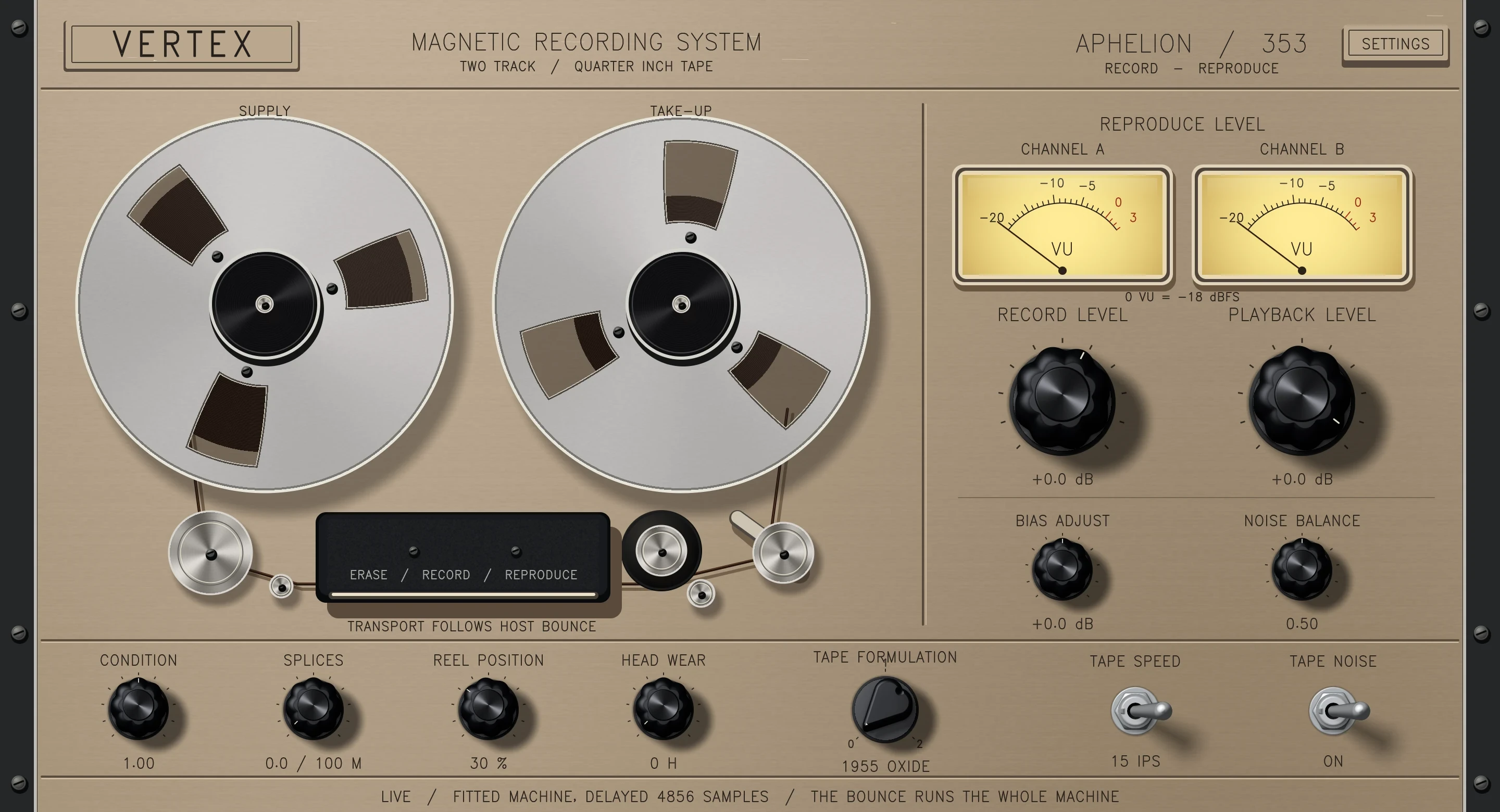
Running every layer of the tape and every stage of the electronics takes far longer than the music does, so Vertex 353 keeps two machines and tells you which one you are hearing. The panel prints it along its foot, at 48 kHz:
LIVE / FITTED MACHINE, DELAYED 4856 SAMPLES / THE BOUNCE RUNS THE WHOLE MACHINE
LIVE
The fitted machine.
While you play, each stage is the cheapest thing that reproduces what that stage of the full machine measurably does, every number measured from the full machine: the record side's response, the tape's curve and its level-dependent treble loss, the heads' response, the particles' noise. The transport's mechanics run as they are. It is a general impression of what a bounce will be, not a preview of it, and the bounce has the final say.
BOUNCE
The whole machine.
When your DAW renders offline, Vertex 353 runs the whole machine: the electronics at the bias's own rate, every layer of the tape written and read, and the transport underneath. Both machines have the same delay, the tape's trip from head to head, so a bounce lines up with playback to the sample.
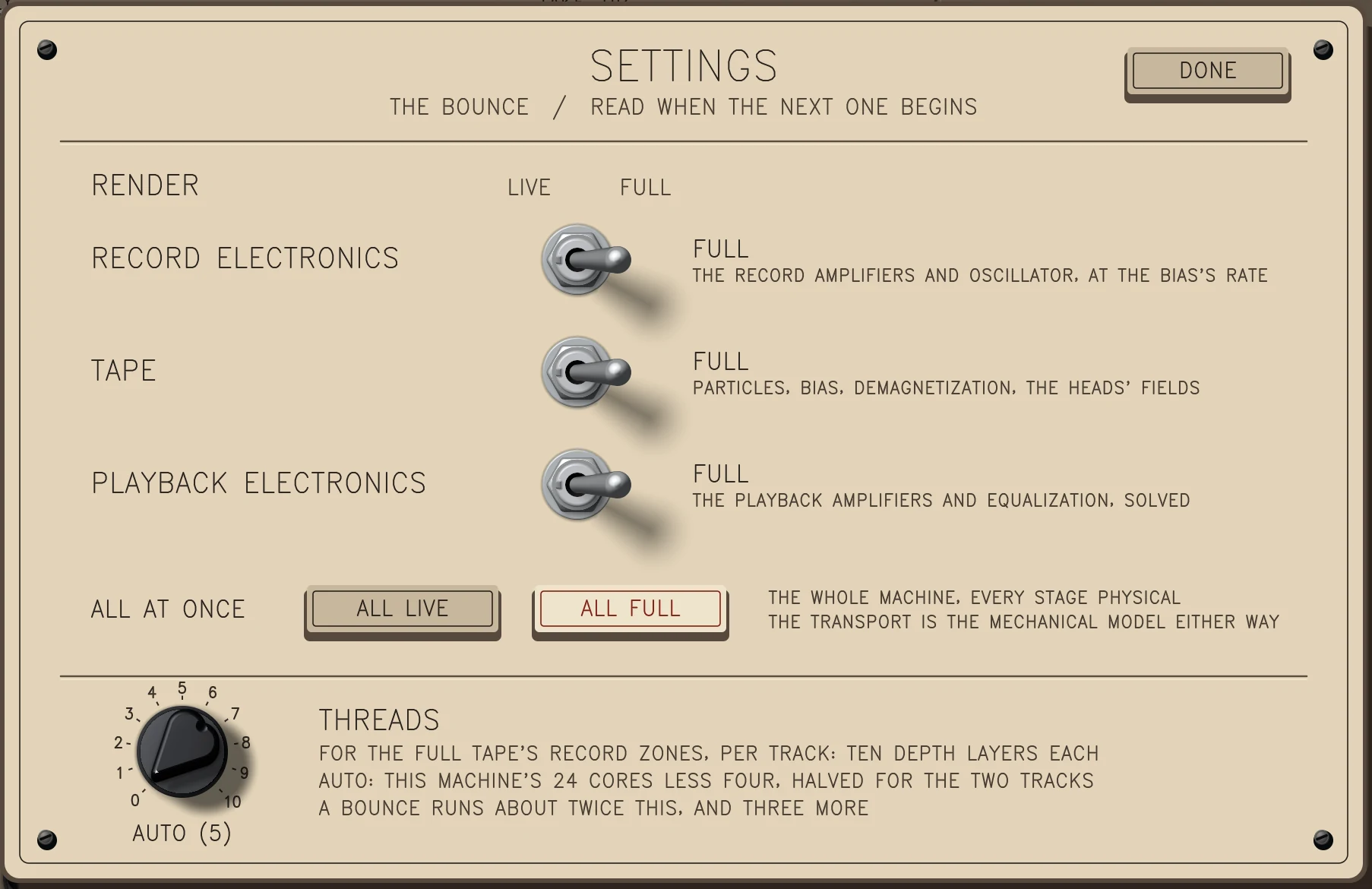
The SETTINGS page splits the bounce into its three parts, each LIVE or FULL. THREADS sets how many threads the tape uses a track; on AUTO it takes the computer's cores less four, halved for the two tracks, and the page names your count (here, a 24-core machine).
What a bounce runs at each setting of the SETTINGS page, and how long it takes
RECORD ELECTRONICS
TAPE
PLAYBACK ELECTRONICS
A BOUNCE RUNS
HOW LONG IT TAKES
LIVE
LIVE
LIVE
ALL LIVE: the fitted machine, rendered, so the bounce is what plays live.
Faster than the song
LIVE
LIVE
FULL
The fitted record side and tape, into the playback electronics solved from their netlist.
More than ten times slower than real time
EITHER FULL
ANY
The full parts meet the live ones at the heads: the field at the record head's gap on one side, what the reproduce head reads on the other.
Tens of times slower than real time
FULL
FULL
FULL
ALL FULL: the whole machine, every stage physical. The transport is the mechanical model either way.
Tens of times slower than real time: a three-minute song can take an hour or more
The panel
The deck. Its wear and tear.
The levels and the bias along the right, the tape and the speed along the foot, and four controls for the state the machine is in: how worn, how spliced, how far through the reel, how many hours on the heads.
RECORD LEVEL
How hard the line drives the tape, from -24 to +16 dB about the alignment, where +4 dBu records the operating level. Up past it, the tape starts doing things.
PLAYBACK LEVEL
The reproduce side's level, about the alignment, where the operating level plays back at +4.
BIAS ADJUST
The bias, 6 dB either side of the aligned peak: under it the tape is brighter and rougher, over it duller and cleaner.
NOISE BALANCE
The bias oscillator's symmetry, trimmed as a technician would. Heard on the bounce.
TAPE FORMULATION
1955 OXIDE, 1965 LOW NOISE or 1975 HIGH OUTPUT, each with the machine's alignment for it.
TAPE SPEED
15 or 7.5 IPS. At the slower speed every wavelength on the tape is half as long, and the tape treats the treble accordingly.
TAPE NOISE
ON, the particles' own noise as each is written; OFF, the coating as a smooth continuum.
CONDITION
How worn the transport is: the capstan's runout, the coating's texture, the mains' wander.
SPLICES
Up to 20 every 100 meters: the butt joint, and the lift as it crosses the heads.
REEL POSITION
From the head of the reel to its tail: the holdback's tension rises as the supply reel empties.
HEAD WEAR
Up to 5000 hours of it, as spacing between the heads and the tape.
REPRODUCE LEVEL
A VU meter a track, CHANNEL A and CHANNEL B, 0 VU at -18 dBFS.
SETTINGS
The bounce: RECORD ELECTRONICS, TAPE and PLAYBACK ELECTRONICS, each LIVE or FULL; ALL LIVE and ALL FULL; and THREADS for the tape.
What it is, and what it is not
Its own sound.
Vertex 353 is not a replica of any one machine, and we do not claim it sounds like one. Where the manual's schematic was legible we used its values, where its parts list settled a doubt we followed it, and where it publishes nothing we estimated, and marked the estimate in the netlist.
SOLVED
The record and playback electronics, tubes and all, the bias oscillator and the supply from the mains; the tape's particles layer by layer; the heads' fields; the transport's mechanics. ALL FULL runs every one of them.
NOT MODELED
The heaters, which run on DC. The bounce records on fresh tape, so the erase heads have nothing to erase. Live playback also leaves out the bias's beats with the signal, the tape's memory at low level and the supply's sag, which is why the bounce has the final word.
ESTIMATED
The manual publishes nothing about the heads, so every head value is an estimate, as are the transformers' and the transport's geometry. Each is marked in the netlist.
The tape recorder, solved
Vertex 353
Vertex 353 Magnetic Recording System
It takes a while because the tape is doing things. Lo-Fi things.