
The static curve
A 1 kHz tone stepped from −40 to 0 dBFS, each step's output read once it settles. THRESHOLD 5, DC THRESHOLD 2, TIME CONSTANT 1.
DIFFERENCE FROM THE FULL NETLIST, DB
Outboard gear for the master bus
Goodbaby Flexible Moo Netlist Master Bus Compressor
We didn't 'model the mojo'. We modeled every single component.
A compressor derived from a historically informed tube circuit, with a full netlist mode that is itself an instrument. Every part of the circuit is solved, both channels and the supply from the mains together, and the solver is checked against an ngspice simulation that shares no code with ours.
VST®3 effect · Windows 64-bit No activationmacOS VST3 and Audio Unit are in development.
Listen
The same sixteen seconds, dry and through Goodbaby, matched in loudness, so what changes when you switch is the sound and not the level. The two play together, so switching keeps your place: listen to WET for a while, then press DRY.
Where it came from
We started from a legendary tube compressor topology, solved the entire circuit, and ended up with Goodbaby.
Most compressors in software begin with a sound and work backward: a curve for the gain, a filter for the color, a dash of saturation for the mojo. Goodbaby begins with the schematic. Every resistor, capacitor, transformer winding, diode and tube on it is in the netlist, with both channels, the sidechain that drives them and the power supply from the wall socket, and the solver works out what the whole circuit does, sample by sample.
The sound was never tuned toward a target. It is what the circuit does: a compressor derived from a historically informed tube circuit, with a full netlist mode that is itself an instrument.
What is in the netlist
Not a model of each stage joined to the next, but one circuit: the program path, the sidechain that listens to it and the supply that feeds them both, for both channels, solved together. A change anywhere is heard everywhere, as it is in the circuit.
THE GAIN STAGE Remote-cutoff triodes, four sections in parallel on each side of a push-pull pair. As the control voltage pulls their grids down, the tubes' own amplification factor, their mu, falls smoothly, and that is the whole of the gain reduction. Nothing else is turning the level down.
Validated against ngspice
A solver that agrees with itself proves little. So we translated the same netlist, line for line, into ngspice, the open-source circuit simulator descended from Berkeley SPICE, and solved it there as well: a simulation that shares no code with ours, written by other people with other numerical methods. Where two solvers like that agree, the answer belongs to the circuit, not to the solver.
The largest difference between ngspice and Goodbaby's full netlist on each comparison. After the five-second warm-up from power-on, ngspice puts the 240-volt rail at 239.806 V and Goodbaby's netlist at 239.809 V.
A 1 kHz tone stepped from −40 to 0 dBFS, each step's output read once it settles. THRESHOLD 5, DC THRESHOLD 2, TIME CONSTANT 1.
DIFFERENCE FROM THE FULL NETLIST, DB
A 1 kHz tone at −30 dBFS steps up to −6 dBFS from 100 to 250 ms, then back; the level in 1 ms windows. THRESHOLD full, DC THRESHOLD 0, TIME CONSTANT 1.
Thirty-one tones from 20 Hz to 20 kHz at −40 dBFS, THRESHOLD 0, so no gain reduction: the transformers and the stages, small-signal.
DIFFERENCE FROM THE FULL NETLIST, DB
The static curve's −10 dBFS step: each harmonic against the fundamental. The even ones sit far down because the circuit is balanced.
| ENGINE | STATIC CURVE | ATTACK AND RELEASE | RESPONSE TO 16 KHZ | AT 20 KHZ | ODD HARMONICS |
|---|---|---|---|---|---|
| ngspice | 0.01 | 0.02 | 0.07 | 0.30 | 0.22 |
| Fast (playback) | 0.56 | 2.12 | 0.32 | 0.37 | 11.21 |
| Bounce FAST | 0.02 | 0.55 | 0.01 | 0.00 | 0.27 |
WHAT NGSPICE WAS GIVEN
ngspice 47 solved the same netlist, warmed for five seconds from power-on as Goodbaby's reference is, the tubes as behavioral sources carrying the same laws in closed form with their interelectrode capacitances, and read straight from the circuit, with no converters. Both solvers ran the same signals.
WHERE THEY PART, AND WHY
At 20 kHz the two netlist solvers part by 0.3 dB, and the difference is ours: the plug-in's converters, which ngspice does not have. A bounce on FAST stays within 0.02 dB of the full netlist on the curve and 0.01 dB on the response, and its largest difference on the attack is 0.55 dB.
THE FAST MODEL, SHOWN AS IT IS
Playback's shortcuts show here, and we leave them showing. Its largest difference is 0.56 dB on the curve and 0.37 dB on the response; its attack differs most in the first milliseconds of a hard onset, by up to 2.12 dB; and its seventh and ninth harmonics come out 5 and 11 dB quieter than the netlist's. The bounce has the final word.
THE NUMBERS BEHIND THE CHARTS
Every point drawn here, from all four engines, is yours to check: the curve, the attack, the response and the harmonics, as CSV.
Playback and bounce
Solving every part of a circuit this size takes far longer than the music does, so Goodbaby keeps two engines and tells you which one you are hearing. The panel prints it under the meters:
PLAYBACK: THE FAST MODEL. A BOUNCE SOLVES THE NETLIST
PLAYBACK
While you play, Goodbaby runs the circuit reduced to what real time allows: the triode pairs by the same tube laws, the transformers' response as filters fitted to the netlist's, and everything else from the circuit's values or calibrated against the full netlist. It runs about ten times faster than real time, and it is held to a looser standard than a bounce, on purpose. Its largest difference from the netlist is 0.56 dB on the static curve and 0.37 dB on the frequency response.
BOUNCE
When your DAW renders offline, Goodbaby solves the netlist instead, at the quality the three BOUNCE QUALITY switches set: SUPPLY, PROGRAM and SIDECHAIN, each FAST or FULL. They start on FAST, so a bounce matches playback unless you ask it to wait. Every engine has the same delay, so a bounce lines up with playback to the sample, and a bounce starts from a circuit already warmed, never from a cold switch-on.
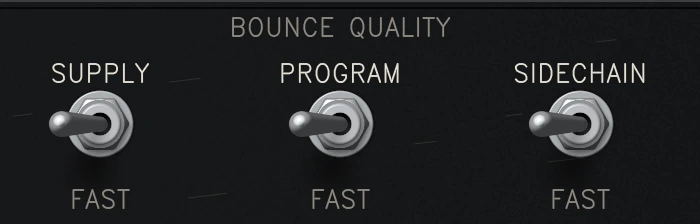
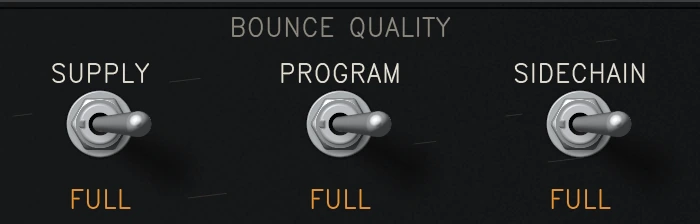
| SUPPLY | PROGRAM | SIDECHAIN | A BOUNCE SOLVES | HOW LONG IT TAKES |
|---|---|---|---|---|
| FAST | FAST | FAST | The netlist's checked reductions: ideal rails, the channels apart, each channel cut into its program path and its sidechain on a fixed step. Each reduction is derived from the netlist and checked against the full solve. | About as long as the song |
| FAST | ONE OR BOTH FULL | The program path, the sidechain or both on the full netlist's own variable step, with the supply's rails still held ideal. | Several times as long as the song, more on dense material | |
| FULL | ANY | ANY | The whole netlist: every part, both channels and the supply from the 117 V mains, solved together on a variable step, the supply sagging under the attack as it does in the circuit. | Tens of times slower than real time: a three-minute master can take an hour or more |
Outboard, in software
Goodbaby is not a compressor to sprinkle across every track. Think of it the way you would think of a rare unit in a mastering rack: there is one, the whole mix goes through it, and it is set with care. It is specialized, boutique gear for an unusually discerning producer, and a full bounce asks for patience in return.
A FULL NETLIST MODE THAT IS ITSELF AN INSTRUMENT
Because nothing in a full bounce is a shortcut, everything the circuit does is there to be played. Hit it hard and the supply sags under the attack, and the other channel hears the sag. Turn DC THRESHOLD and the sidechain amplifier moves from class A toward class B. Link the sides and their timing capacitors share one charge. None of these is a feature we added: each is what the circuit does when every part of it is solved.
What it is, and what it is not
Goodbaby is not a replica of any one unit, and we do not claim it sounds like one. Where the schematic was legible we used its values; where the published literature filled a gap we followed it; where nothing was published we estimated, and marked the estimate in the netlist. What comes out is what that circuit does, and it is Goodbaby's sound.
SOLVED
Every part on the schematic, both channels and the mains supply, solved together: the tubes by their laws, with their interelectrode capacitances and grid current; the transformers with their windings, their resistance and their core loss; the germanium bridge, the rectifier and the regulator.
NOT MODELED
The heaters, with every tube at its rated emission; thermal drift; noise; and the transformers' core saturation, since no core data was published: the cores are linear, with their losses. Several of the transformers' values are estimates.
THE TRANSFORMERS' SIGNATURE
Those transformers shape the extremes. With no gain reduction the netlist's response falls 7.2 dB at 20 Hz and rises 5.2 dB near 16 kHz, in both netlist solvers. That is the circuit as solved, and it is part of Goodbaby's sound, in playback and in the bounce alike.
The panel
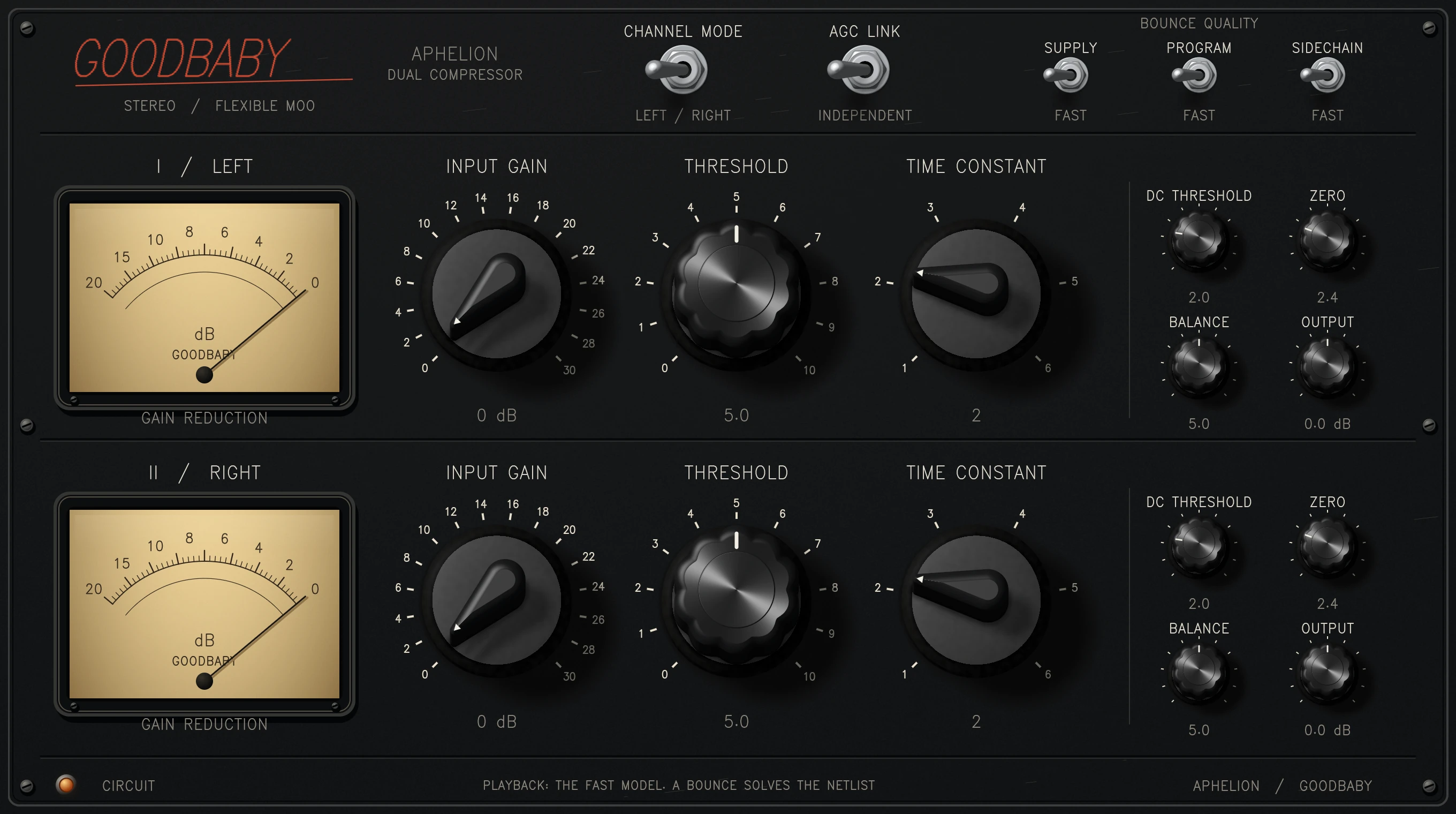
A side for each channel, every control a part in the netlist rather than a parameter of a model, and the BOUNCE QUALITY switches in the corner.
INPUT GAIN
The input attenuator, from 0 to 30 dB in 2 dB steps: how hard the program drives the stage.
THRESHOLD
How much of the output the sidechain hears, from 0 to 10. At 0 there is no gain reduction at all.
TIME CONSTANT
Six positions of the timing network: how fast it grabs and how slowly it lets go.
DC THRESHOLD
The sidechain amplifier's bias: class A at the low settings, toward class B at the high ones, which changes where and how the compression begins.
ZERO
Where the control voltage rests, which is where the meter reads zero.
BALANCE
Trims each side's push-pull pair, so a change in the control voltage is not heard as a thump.
OUTPUT
The level out, in decibels.
CHANNEL MODE
LEFT / RIGHT, two channels of their own; or LAT / VERT, the sum and the difference through the same transformers, as the circuit's mode switch wires them.
AGC LINK
INDEPENDENT, or LINKED: the two sides' control voltages tied together, their timing capacitors sharing one charge.
GAIN REDUCTION
A meter a side, scaled in decibels from the circuit's own gain.
The master bus compressor, solved
Goodbaby Flexible Moo Netlist Master Bus Compressor
We didn't 'model the mojo'. We modeled every single component.
VST®3 effect · Windows 64-bit No activationmacOS VST3 and Audio Unit are in development.
At a glance
| Format | VST®3 effect · Windows 64-bit |
|---|---|
| In development | macOS VST3 and Audio Unit |
| Requires | 64-bit Windows 11, in any version Microsoft still supports. When the Mac version ships: macOS 15 or later, on Apple silicon or Intel. |
| The netlist | Every part on the schematic · both channels and the 117 V mains supply, solved together |
| Validated against | ngspice 47 on the same netlist · 0.01 dB static curve, 0.02 dB attack and release, 0.07 dB response to 16 kHz |
| Playback | The fast model, calibrated against the netlist · about ten times faster than real time |
| Bounce | The netlist · BOUNCE QUALITY: SUPPLY, PROGRAM and SIDECHAIN, each FAST or FULL |
| Bounce time | All FAST about as long as the song · SUPPLY FULL tens of times slower than real time |
| Controls, a side | INPUT GAIN, THRESHOLD, TIME CONSTANT, DC THRESHOLD, ZERO, BALANCE and OUTPUT |
| Modes | CHANNEL MODE LEFT / RIGHT or LAT / VERT · AGC LINK INDEPENDENT or LINKED |
| Latency | The same in playback and every bounce, so a bounce lines up to the sample |
| Not modeled | Heaters, thermal drift, noise and transformer core saturation |
| The panel | 1360 by 760 · two meters, two channels and the BOUNCE QUALITY switches |
| Validation | 47 of 47 validator tests · host-tested |
| Activation | None. No license server, no phone-home |
| Security updates | Until November 2031 |
| License | License agreement · Facts sheet |

VST is a registered trademark of Steinberg Media Technologies GmbH.