
THE CORE
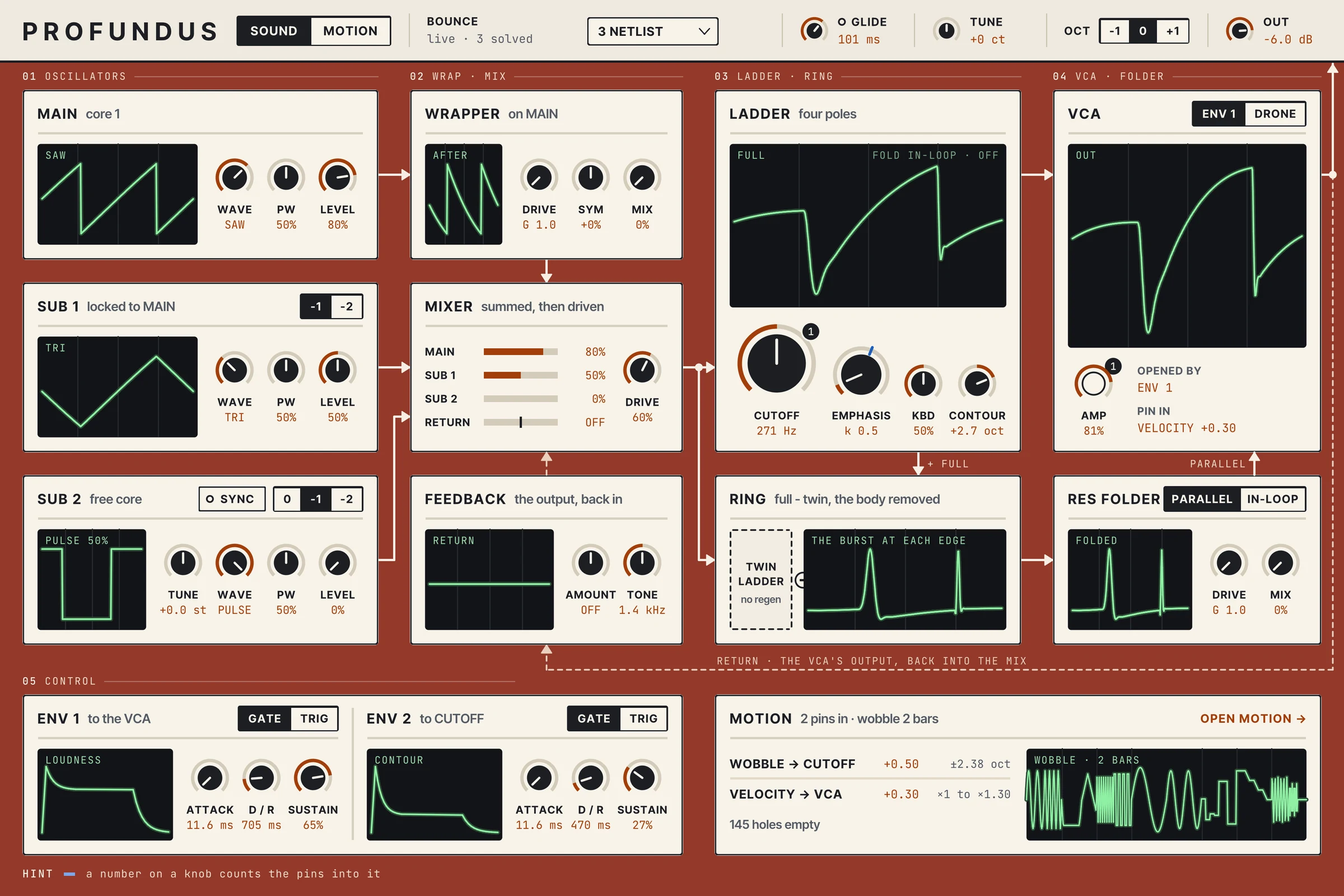
Each of the three oscillators is the saw core of a 1974 American expander module, with its designators, the core the Overtime Eight-Tone is built from.
Monophonic Netlist Bass Synthesizer
The sound of a chainsaw ripping through a dollhouse.
One voice of low end, written out part by part: three oscillators that sweep from sine to pulse, a ladder filter from the schematic of a 1970s bass pedal, a folder for its ring, and a wobble that keeps time with your song.
VST®3 instrument · Windows 64-bit No activationmacOS VST3 and Audio Unit are in development.
THE CORE
Each of the three oscillators is the saw core of a 1974 American expander module, with its designators, the core the Overtime Eight-Tone is built from.
THE LADDER
The filter is the four-pole ladder of a 1970s American bass-pedal synthesizer, and it lands on the voltages its schematic prints.
OUR OWN
A wave wrapper, a folder for the ladder's ring alone, and FEEDBACK, the output back into the mix. Written out the same way, part by part.
Listen
Six takes from Profundus, thirty-two seconds each, in stereo. They were raised together to sit with our other synths' takes, so their balance is as it was made; nothing else was done to them on the way here.
THE SOUND PAGE
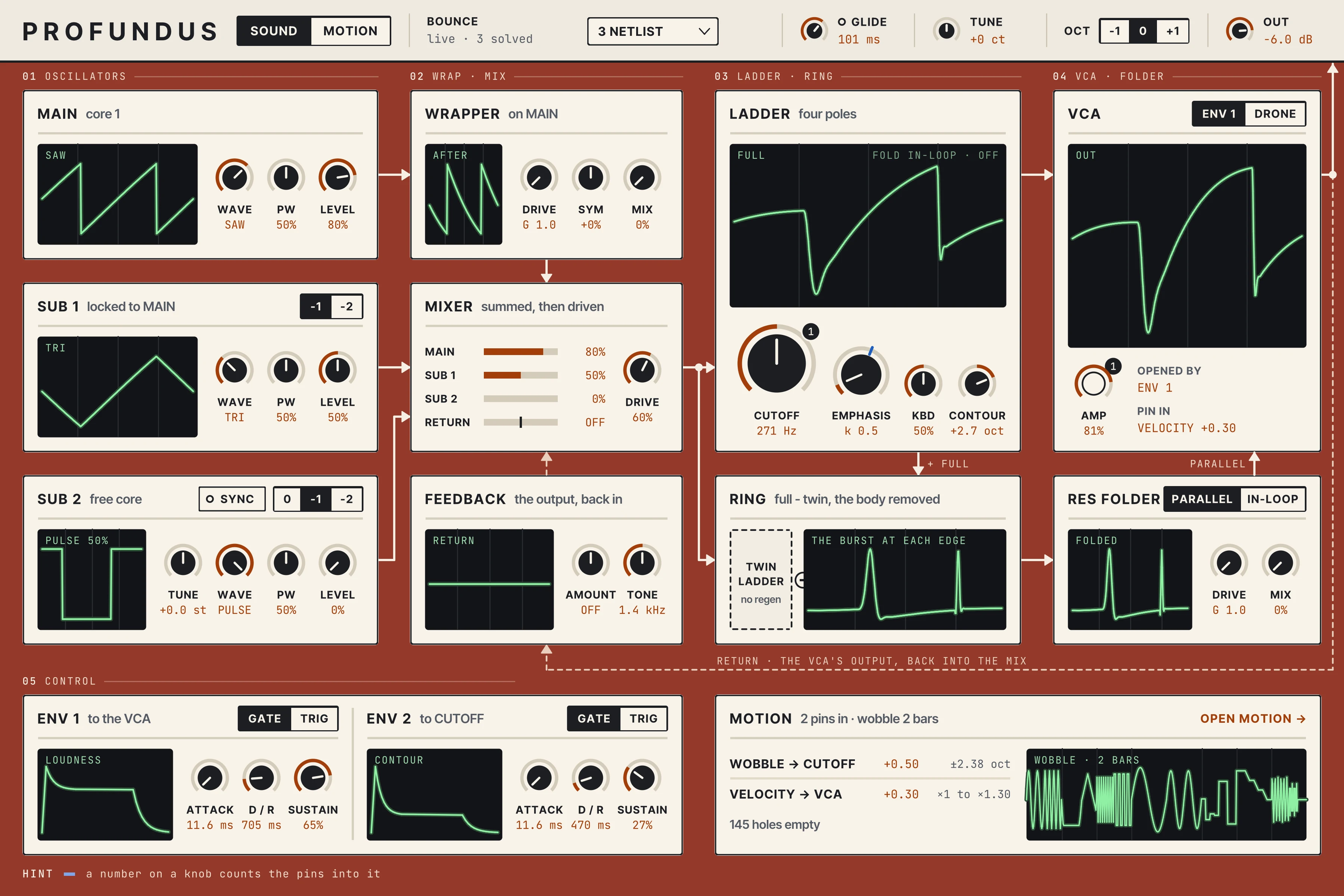
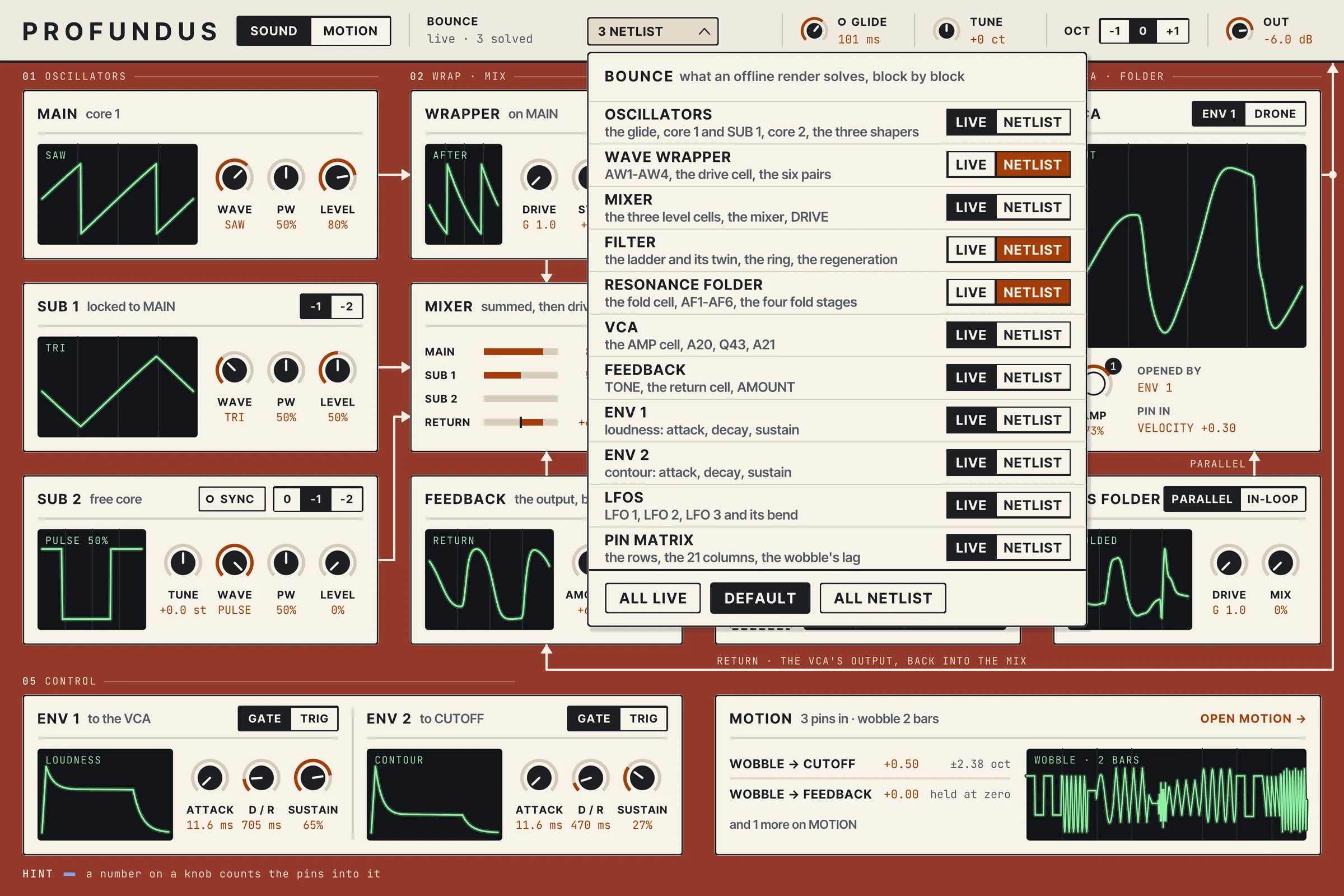
Every block on the SOUND page is a stage of the circuit, wired the way the signal flows, with a black scope at each tap drawing what the engine is doing there. MOTION, the second page, is everything that moves it.
LADDER · four poles
The filter is a four-pole transistor ladder transcribed from the schematic of a 1970s American bass-pedal synthesizer, its designators kept. The schematic prints its own DC voltages, and the netlist lands on them with nothing tuned. That is how we know it was read right.
| NODE | PRINTED | NETLIST |
|---|---|---|
| Q502, Q503 emitters | 10 V | 10.06 V |
| Q504, Q505 emitters | 8.5 V | 8.53 V |
| Q506, Q507 emitters | 6.9 V | 6.93 V |
| Q508, Q509 emitters | 5.3 V | 5.33 V |
| Q510, Q511 bases | 4.2 V | 4.30 V |
| Q512 collector | 3.6 V | 3.60 V |
| Q513 emitter | -1.7 V | -1.57 V |
CUTOFF runs the ladder's pole from 51 Hz to 28 kHz, and CONTOUR sweeps it 5.4 octaves either way on ENV 2. KBD makes it follow the key. DRIVE sets how hard the mixer pushes into it: warm with one oscillator, well into the ladder's own saturation with three.
EMPHASIS is the regeneration, a reverse-audio pot as on the original, so most of the knob is spent on the top tenth. Past the blue tick on the panel the filter sings on its own, a clean sine.
FEEDBACK · the VCA's output, back into the mix
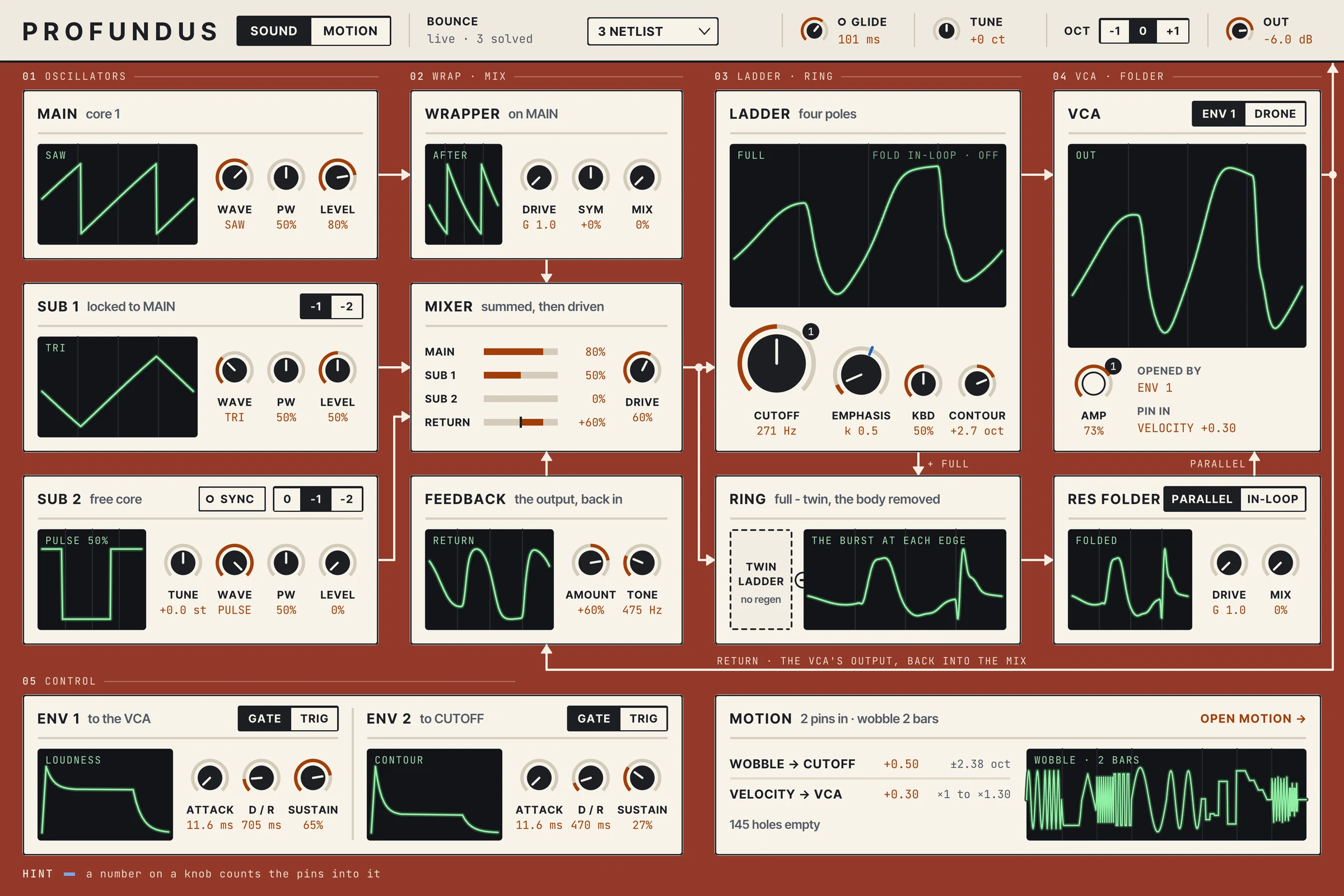
The old trick of patching a bass synth's output back into its own mixer, built as a circuit. TONE darkens the return from 16 kHz down to 161 Hz, and AMOUNT is centre-tapped: positive one way, negative the other, nothing at the middle. Its own gain cell rounds the loop off, so it growls rather than running away.
| AMOUNT | NETLIST | LIVE | WHAT IT DOES |
|---|---|---|---|
| +40 % | +4.8 dB | +5.0 dB | louder |
| +100 % | +10.8 dB | +10.9 dB | 31 to 250 Hz up 8 to 13 dB, the pitch held |
| -40 % | -3.6 dB | -3.4 dB | the bass thins |
| -100 % | -1.4 dB | -1.5 dB | the bass down, a peak near the cutoff |
Turned all the way up with TONE dark, the loop halves the period and growls an octave under the note; all the way down with TONE open, it screeches near 9 kHz; with the oscillators off, it sings by itself. The loop closes through the VCA, so it dies with ENV 1.
MOTION · LFOs · PINS · WOBBLE
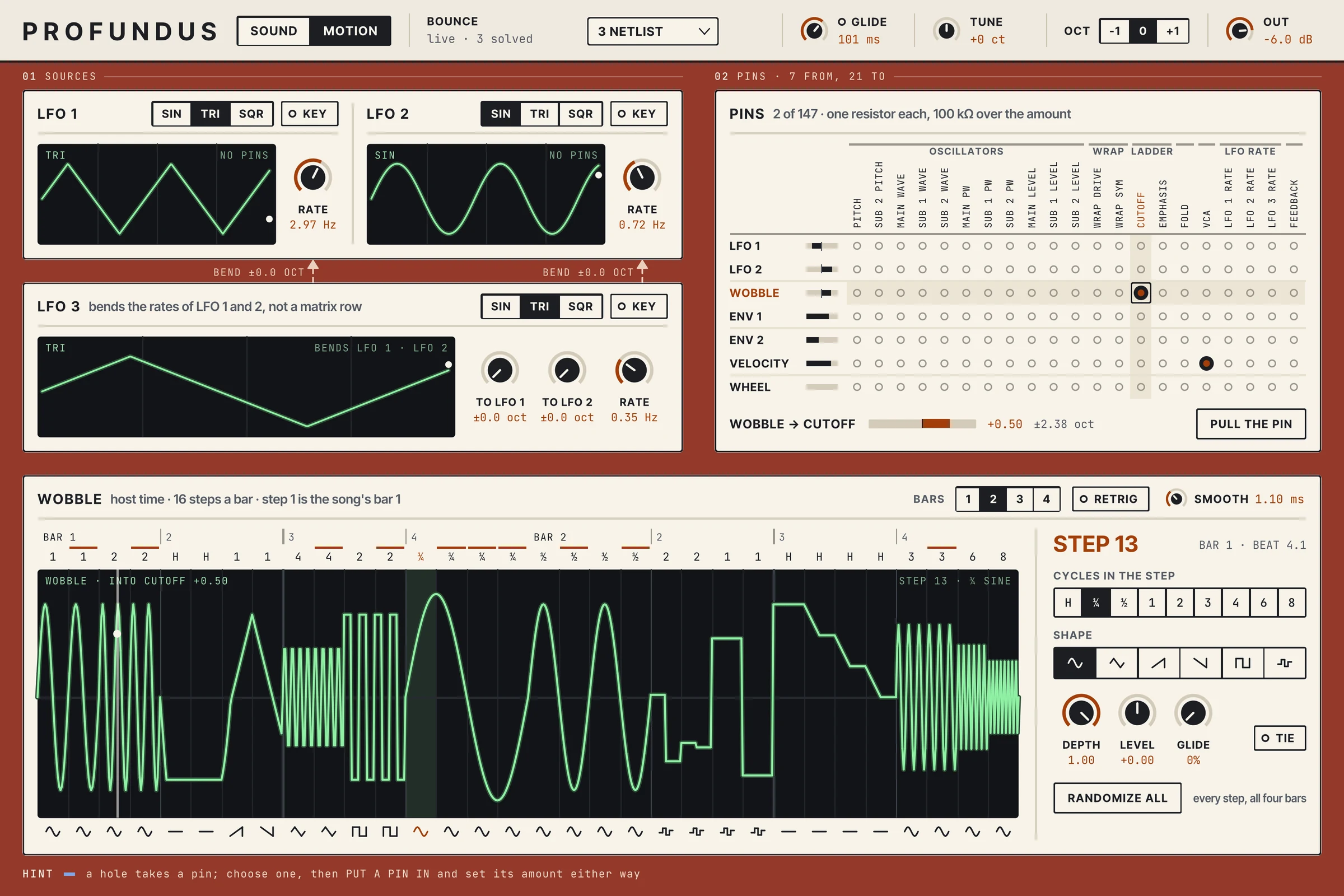
The second page of the panel is everything that moves. 7 sources reach 21 destinations through a pin matrix where every pin is a resistor, 100 kΩ over its amount: PUT A PIN IN, set its amount either way, PULL THE PIN.
LFO 1 · LFO 2 · LFO 3
Three analog LFOs in the circuit: SIN, TRI or SQR, from 0.04 to 55 Hz, each with KEY to restart at a note. LFO 3 does nothing but bend the rates of the other two.
WOBBLE
One to four BARS of sixteen steps. Each step holds its CYCLES IN THE STEP, from H to 8, a SHAPE, DEPTH, LEVEL, GLIDE and TIE. RANDOMIZE ALL writes all of them anew; SMOOTH rounds the edges.
ON THE BEAT
The wobble reads its place from your song's position, so seeking, looping and bouncing all land on the same value. With the transport stopped it runs from the last note; RETRIG restarts it at every note.
FROM
TO
Playback and bounce
While you play, Profundus runs the same parts as equations, every block worked from the netlist's own resistors. When your DAW renders offline it solves the circuit for the blocks the BOUNCE menu names, and the live engine plays the rest. Both have the same latency, 29 samples at 48 kHz, so a bounce lines up with playback to the sample.
1.88 s
for each second of audio with the default blocks, on one thread
9.74 s
with all eleven blocks solved
-0.54 to +0.61 dB
the default bounce against the live engine on a bass line, within 0.1 dB on 10 of 13 patches
Those times are the default patch; a busy one costs far more. If the circuit ever faults, the panel says so and the fault is logged.
What it is, and what it is not
SOLVED
On a bounce, the blocks you choose, down to every part; with ALL NETLIST, the whole instrument. The wobble is digital, worked out in song time as a step sequencer's would be; everything it moves is the circuit.
READ, AND KEPT
Three values the schematic's scan cannot confirm are kept as read. The core's ramp is slightly bowed, as the original's is, so the sine carries a little second harmonic. IN-LOOP folding is chaotic, and there the live engine and the bounce differ most. The live engine is a model of the circuit.
NOT YET
The Mac: Profundus is Windows only for now, with the Mac VST3 and Audio Unit in development. Nothing on this page is for sale yet.
The sound of a chainsaw ripping through a dollhouse.
VST®3 instrument · Windows 64-bit No activationmacOS VST3 and Audio Unit are in development.
At a glance
| Format | VST®3 instrument · Windows 64-bit |
|---|---|
| In development | macOS VST3 and Audio Unit |
| Requires | 64-bit Windows 11, in any version Microsoft still supports. When the Mac version ships: macOS 15 or later, on Apple silicon or Intel. |
| Voice | Monophonic · last, low or high note priority · legato · glide |
| Oscillators | MAIN, SUB 1 locked one or two octaves down, SUB 2 free · WAVE sine to triangle to saw to pulse · PW |
| Filter | A four-pole transistor ladder from a 1970s bass-pedal synthesizer's schematic · CUTOFF · EMPHASIS · KBD · CONTOUR |
| Wrapper and folder | WAVE WRAPPER on the main · RES FOLDER on the ladder's ring, PARALLEL or IN-LOOP |
| Feedback | The VCA's output into the mixer · AMOUNT positive or negative · TONE 161 Hz to 16 kHz |
| Modulation | Three analog LFOs, LFO 3 bending the other two · two envelopes · a pin matrix, 7 sources by 21 destinations |
| Wobble | 1 to 4 bars of 16 steps · cycles, shape, depth, level, glide and tie a step · read from the song's position |
| Playback | The same parts as equations |
| Bounce | Eleven blocks, each LIVE or NETLIST · the wrapper, the filter and the folder solved by default |
| Bounce time | About two times slower than real time with the default blocks · about ten with all eleven (the default patch, one thread) |
| Latency | 29 samples at 48 kHz, the same in playback and the bounce |
| The panel | 1200 by 800 · SOUND and MOTION |
| Validation | 47 of 47 validator tests · host-tested |
| Activation | None. No license server, no phone-home |
| Security updates | Until November 2031 |
| License | License agreement · Facts sheet |

VST is a registered trademark of Steinberg Media Technologies GmbH.