Solved from its schematicAll Netlist Effects

A stereo state-variable filter

OvertimeState-Variable Filter

The Genuine FIZZ you've been craving.

The 12 dB state-variable filter of a 1974 American expander module, solved from its netlist: lowpass, NOTCH and highpass on one continuous MODE knob, a bandpass beside them, and three LFOs that enter the circuit where the module's own controls do.

VST®3 effect · Windows 64-bit No activationmacOS VST3 and Audio Unit are in development.

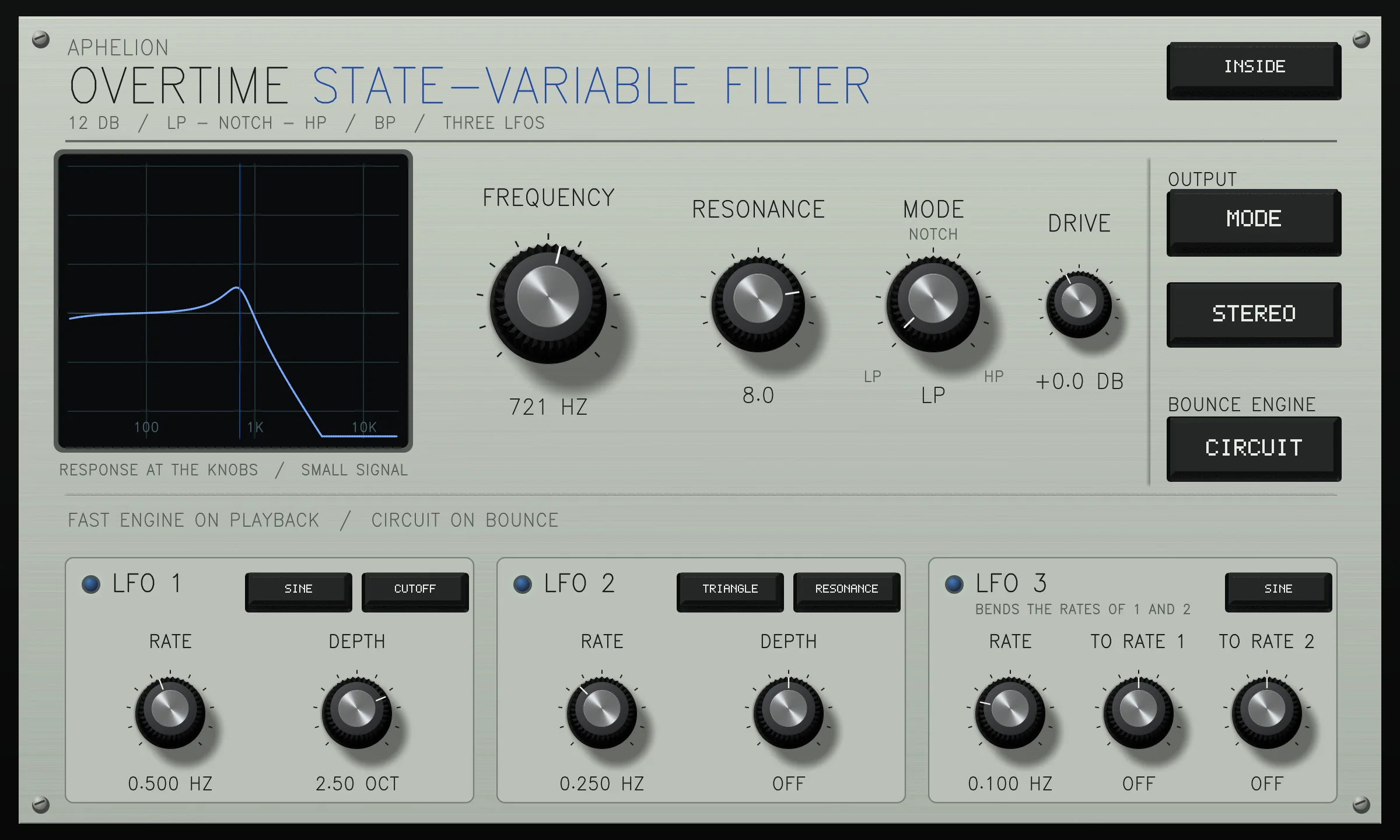
The FRONT face of the Overtime State-Variable Filter panel in pale green-grey brushed metal: APHELION over OVERTIME STATE-VARIABLE FILTER, the last three words in blue, and the line 12 DB / LP - NOTCH - HP / BP / THREE LFOS; on the left a dark window, RESPONSE AT THE KNOBS / SMALL SIGNAL, its blue trace a lowpass with a resonant peak near 1K; the FREQUENCY knob at 721 HZ, RESONANCE at 8.0, MODE at LP between LP, NOTCH and HP, and DRIVE at +0.0 DB; on the right the OUTPUT key on MODE, the STEREO key, and BOUNCE ENGINE on CIRCUIT, with the INSIDE key above them; the line FAST ENGINE ON PLAYBACK / CIRCUIT ON BOUNCE; and along the bottom three boxes, LFO 1 with SINE and CUTOFF keys, RATE at 0.500 HZ and DEPTH at 2.50 OCT, LFO 2 with TRIANGLE and RESONANCE keys, RATE at 0.250 HZ and DEPTH OFF, and LFO 3, BENDS THE RATES OF 1 AND 2, with a SINE key, RATE at 0.100 HZ, TO RATE 1 and TO RATE 2 both OFF.
  • 12 dB an octave
  • LP · NOTCH · HP
  • 20 Hz to 14.2 kHz
  • Three LFOs

Listen

Four takes, three LFOs.

Each take is a bounce: the netlist itself, with the LFOs moving its parts. The sources are plain synth waves, so what you hear changing is the filter.

  • LFO 1 on the cutoff

    FREQUENCY 721 HZ · RESONANCE 8.0 · LFO 1 SINE 0.500 HZ to CUTOFF, 2.50 OCT

    A chord through the lowpass, the cutoff swung two and a half octaves either way, slowly.

  • Sample and hold, and the resonance breathing

    FREQUENCY 520 HZ · RESONANCE 6.0 · LFO 1 S/H 8.00 HZ to CUTOFF, 1.50 OCT · LFO 2 TRIANGLE 0.200 HZ to RESONANCE, 4.0 OF 10

    A bassline, a new cutoff eight times a second, while the second LFO lifts and lowers the resonance under it.

  • MODE, swung through NOTCH

    FREQUENCY 1.14 KHZ · RESONANCE 6.0 · MODE NOTCH · LFO 1 TRIANGLE 0.250 HZ to MODE, 5.0 OF 10

    The chord again, the MODE pot carried from LP through NOTCH to HP and back.

  • LFO 3 bending LFO 1

    FREQUENCY 721 HZ · RESONANCE 8.5 · LFO 1 SINE 2.00 HZ to CUTOFF, 1.25 OCT · LFO 3 SINE 0.125 HZ, TO RATE 1 3.00 OCT

    A wobble on the cutoff whose own speed is swept, from a quarter of a hertz to sixteen and back.

Mono, eight seconds each, levels as they came from the bounce but for two takes turned down to keep their peaks under full scale.

Where it came from

The fizz is the circuit.

A state-variable filter is two integrators in a loop. Feed the input in, take the first integrator's output and you have a bandpass, the second's and you have a lowpass, and what goes into the first is the highpass. Overtime is the one inside a 1974 American expander module, solved from one hand-drawn sheet of its schematic: the summer, the two integrators, the damping, the MODE pot that blends highpass into lowpass, and the converter that sets the frequency.

We did not draw its character as a curve. The integrators are transconductance amplifiers, solved with their own curves and limits; the damping runs through a pair of diodes as well as the RESONANCE pot, so the resonance rises on quiet signals and is held down on loud ones. Whatever you call the sound that makes, it is what the netlist does, and that is why it is on the Netlist shelf.

What is in the netlist

Two integrators, one loop.

The whole filter from the input's summing resistor to the output, solved together: every highpass, bandpass and lowpass it gives you is a point on the same loop, and the damping and the converter act on all of them at once.

THE DAMPING The bandpass returns to the summer through RESONANCE's pot and, beside it, a pair of diodes back to back. Turned up, the pot's damping falls away and the diodes' remains: the resonance rises on quiet signals and is held down on loud ones.

Checked against itself

Two engines, one filter.

The fast engine that plays is held against the netlist that bounces: the same settings, the same material, and the difference between them measured.

  • 9.5octaves of FREQUENCY, 20 Hz to 14.2 kHz
  • 33.9 dBthe netlist's resonant peak at full RESONANCE, near 1 kHz
  • 0.5 dBbetween that peak and the fast engine's, at the same frequency
  • -55.1 dBthe fast engine's difference from the netlist on a chord
THE RESONANT PEAK, BOTH ENGINES
THE PANELFAST ENGINETHE NETLIST
FREQUENCY near 1 kHz, RESONANCE 9.011.08 dB at 973 Hz11.11 dB at 983 Hz
FREQUENCY near 1 kHz, RESONANCE full33.4 dB at 998.7 Hz33.9 dB at 998.7 Hz
FREQUENCY near 10 kHz, RESONANCE 9.09.37 dB at 10.18 kHz9.71 dB at 10.18 kHz
THE SAME MATERIAL THROUGH BOTH: HOW FAR UNDER IT THEIR DIFFERENCE SITS
WHATTHE DIFFERENCE
A chord, RESONANCE 8.0-55.1 dB
The chord at RESONANCE 9.0, FREQUENCY swept bottom to top and back in 2 s-41.9 dB
LFO 1 on CUTOFF, SINE, 2.5 octaves-47.3 dB
LFO 1 on RESONANCE, TRIANGLE-55.3 dB
LFO 1 on MODE, SINE about NOTCH-53.2 dB
LFO 1 on DRIVE, SQUARE-58.1 dB
LFO 1 on CUTOFF, its rate bent by LFO 3-52.5 dB

WHAT THE SHEET COULD NOT SETTLE

The converter's two transistors are drawn with arrows too faint to read at this scan; only one reading gives the integrators a current to draw, so that is the one in the netlist. The pair of diodes in the damping path was placed from a six-times enlargement of the drawing. No pot is marked with a taper, and the sheet carries no calibration notes, so the factory trims are inferred: 20 Hz at the bottom of FREQUENCY and a volt an octave.

HOW THE INTEGRATORS WERE CHECKED

Their amplifiers were modeled twice: once by the datasheet's behaviour, which is what the netlist runs, and once transistor by transistor, fitted to the same datasheet. At full RESONANCE the two put the resonant peak at 34.2 and 33.7 dB, at the same frequency. The converter's law, solved on its own, agrees with the netlist across FREQUENCY's travel within 0.26 percent.

Three LFOs

They enter where you would.

LFO 1 and LFO 2 each go to CUTOFF, RESONANCE, MODE or DRIVE; two on one destination add. LFO 3 goes nowhere itself and bends the other two's rates. They move playback and the bounce alike, and a bounce starts all three at phase zero, so it renders the same every time.

Where each LFO destination enters the circuit, and how far it reaches at full depth
TOWHERE IT ENTERSAT FULL DEPTH
CUTOFFAs a voltage into the module's own modulation input, so in a bounce the netlist's frequency summer and exponential converter carry it.5 octaves either way
RESONANCERESONANCE's pot wiper, moved as a hand on the knob would move it.The whole travel
MODEMODE's pot wiper, the same way: an LFO can carry it from LP through NOTCH to HP.The whole travel
DRIVEThe level in, and back out after, so it moves how hard the circuit works.18 dB either way
LFO 3Nowhere in the circuit: it bends the rates of LFO 1 and LFO 2.3 octaves either way

Playback and bounce

Play it fast. Bounce the circuit.

The netlist cannot promise real time on every kind of material, so Overtime keeps two engines and tells you which one you are hearing. The panel prints it under the filter:

FAST ENGINE ON PLAYBACK / CIRCUIT ON BOUNCE

PLAYBACK

The fast engine.

While you play, the filter's own equations are solved exactly at every step of a grid twice the host's rate, part for part: the integrators' amplifiers as the netlist has them, the followers, the damping and its diodes, the MODE pot and the bandpass, and the converter's law read from the netlist's own. It takes under a tenth of one core. It leaves out the op-amps' own speed and offsets.

BOUNCE ENGINE: CIRCUIT

The netlist.

When your DAW renders offline, Overtime solves the netlist, one a side in STEREO. The knobs and the LFOs move their parts as it goes, so the bounce follows your automation, and both engines have the same delay, so a bounce lines up with playback to the sample.

What a bounce runs at each setting of BOUNCE ENGINE, and how long it takes
BOUNCE ENGINETHE PANEL SAYSA BOUNCE RUNSHOW LONG IT TAKES
LIVEFAST ENGINE / PLAYBACK + BOUNCEThe fast engine, exactly as it plays.Faster than the song
CIRCUITFAST ENGINE ON PLAYBACK / CIRCUIT ON BOUNCEThe netlist: the summer, the integrators, the damping and its diodes, the MODE blend, the bandpass and the converter.From about the length of the song to several times longer on bright, resonant material

The panel

Four knobs, three LFOs.

FRONT is the filter, with a window drawing its response at the knobs, RESPONSE AT THE KNOBS / SMALL SIGNAL, and the three LFOs beneath. INSIDE holds the trims a technician would reach.

FREQUENCY

The filter's natural frequency, 20 Hz to 14.2 kHz, shown in hertz. It sets the current the exponential converter gives both integrators.

RESONANCE

From the most damping to the least, 0 to 10. The diodes in the damping path hold loud signals down as it rises.

MODE

From LP through NOTCH to HP, continuously: a pot between the highpass and the lowpass, the notch where they cancel.

DRIVE

The level in, from -12 to +18 dB, and back out, so it changes how hard the circuit works rather than how loud it is.

OUTPUT

MODE, the blend MODE sets; or BANDPASS, the bandpass in its place.

STEREO

STEREO, one filter a side; or MONO, the two inputs summed into one filter and fed to both sides.

BOUNCE ENGINE

CIRCUIT, an offline render solves the netlist; or LIVE, it renders the fast engine, as quick as playback.

LFO 1, LFO 2

RATE, 0.02 to 40 Hz; DEPTH, either way; a key for the shape, SINE, TRIANGLE, SAW UP, SAW DOWN, SQUARE or S/H; and a key for where it goes, CUTOFF, RESONANCE, MODE or DRIVE. Each click steps to the next.

LFO 3

BENDS THE RATES OF 1 AND 2: its RATE and shape, and TO RATE 1 and TO RATE 2, up to three octaves either way.

INSIDE / FRONT

The key at the top right turns the panel round: FRONT is the filter, INSIDE its trims.

INIT FREQ

TRIMS. Where FREQUENCY's travel starts: 20 Hz, the factory's setting as we infer it.

OFFSET 1, OFFSET 2

TRIMS. Each integrator's input offset, centered; off center, the filter sits off its rest.

What it is, and what it is not

Its own sound.

Overtime is not a replica of any one unit, and we do not claim it sounds like one. It is what the circuit on that sheet does, with what the sheet left open chosen inside the parts' own ranges and the rest estimated and marked.

SOLVED

The input summer and its op-amp, the damping path and its diodes, the two integrators' transconductance amplifiers and source followers, the MODE blend, the bandpass switch, the frequency summer and the exponential converter, and the coupling capacitors in and out.

NOT MODELED

The module's other inputs, its oscillators' and its CV jacks: Overtime has one input a side. The power supply: the rails are ideal. In playback, also the op-amps' own speed and offsets, which is why the circuit has the final word.

ESTIMATED

The amplifiers' output swing; the transistors' and followers' constants; the pots' tapers, linear since none is marked; and the factory trims, 20 Hz at FREQUENCY's bottom and a volt an octave, inferred, since the sheet carries no calibration notes. Each is marked in the netlist.

The state-variable filter, solved

OvertimeState-Variable Filter

The Genuine FIZZ you've been craving.

VST®3 effect · Windows 64-bit No activationmacOS VST3 and Audio Unit are in development.

At a glance

Overtime specifications

Technical specifications for Overtime, State-Variable Filter
FormatVST®3 effect · Windows 64-bit
In developmentmacOS VST3 and Audio Unit
Requires64-bit Windows 11, in any version Microsoft still supports. When the Mac version ships: macOS 15 or later, on Apple silicon or Intel.
ChannelsSTEREO, one filter a side · MONO, the inputs summed into one
The netlistThe input summer, two integrators and their followers, the damping and its diodes, the NOTCH blend, the bandpass, the exponential converter
Response12 dB an octave · lowpass, notch, highpass and every blend between · bandpass
Frequency20 Hz to 14.2 kHz, 9.5 octaves
ModulationThree LFOs · six shapes, 0.02 to 40 Hz · to CUTOFF, RESONANCE, MODE or DRIVE · LFO 3 bends their rates
PlaybackThe fast engine, calibrated against the netlist · under a tenth of one core
BounceBOUNCE ENGINE CIRCUIT: the netlist · LIVE: the fast engine
Bounce timeFrom about the length of the song to several times longer
FRONTFREQUENCY, RESONANCE, MODE, DRIVE · OUTPUT MODE or BANDPASS · STEREO or MONO · BOUNCE ENGINE · LFO 1, 2 and 3
INSIDEINIT FREQ · OFFSET 1 and OFFSET 2
LatencyThe same in playback and the bounce, so a bounce lines up to the sample
The panel1200 by 720 · two faces
Validation47 of 47 validator tests · host-tested
ActivationNone. No license server, no phone-home
Security updatesUntil November 2031
LicenseLicense agreement · Facts sheet
VST Compatible

VST is a registered trademark of Steinberg Media Technologies GmbH.