An original circuitFreeAll Drums

Analog-circuit drum machine

Bruxer

WE MUST HAVE GONE INSANE!!

Eight voices built from real parts, every one with a tooth stage of its own: a wavefolder, a triode, a fuzz, a crusher, a clipper. Hit harder and the trigger hits harder, so ghost notes stay clean and accents snarl.

Hear it How it bites

VST®3 instrument · Windows 64-bit Free · no accountmacOS VST3 and Audio Unit are in development.

  • 8 voices
  • 55 flavour knobs
  • 237 grooves from Thump
  • Free no account
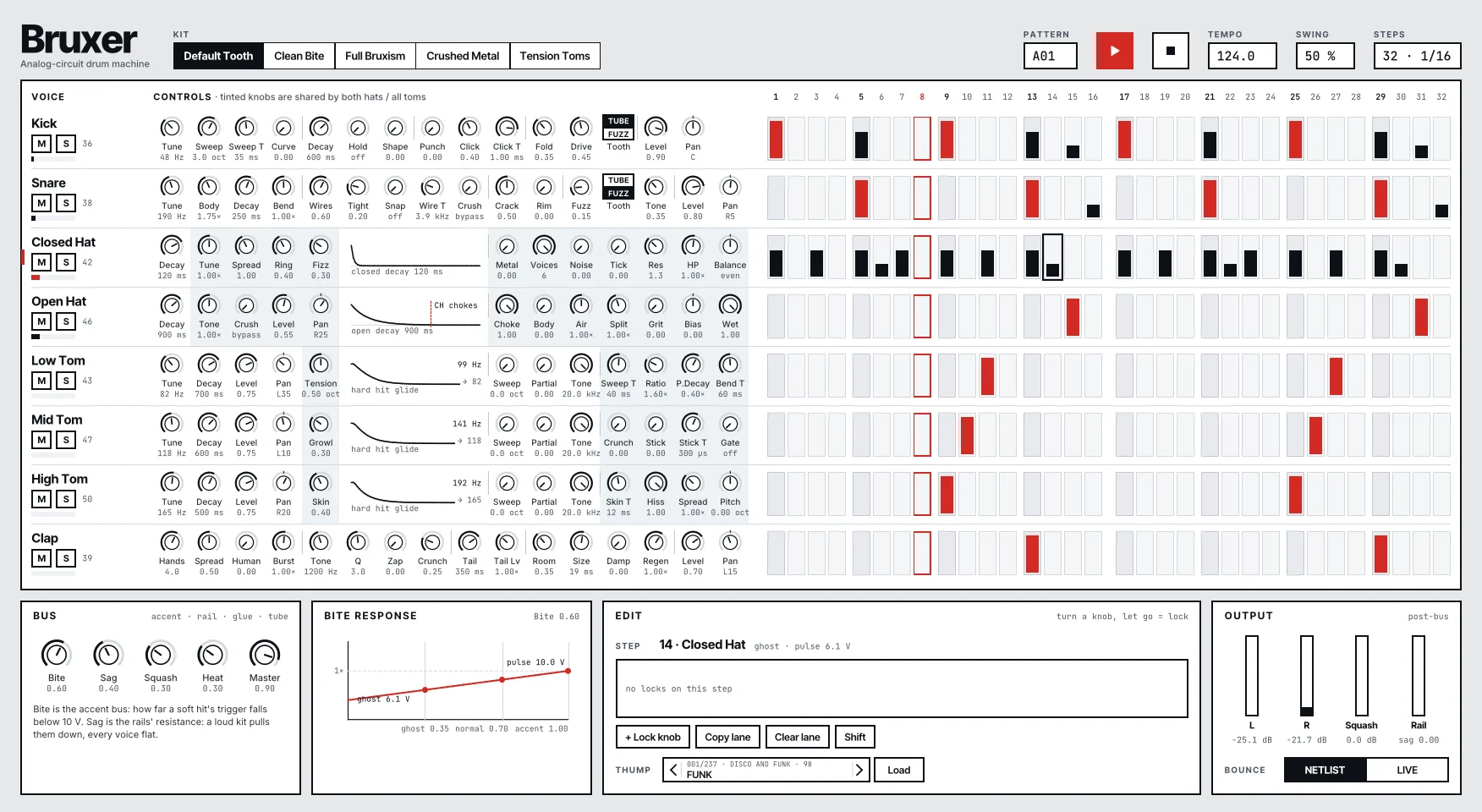
The Bruxer panel, white and steel grey with black lettering and red accents, playing on Default Tooth: the KIT keys Default Tooth, Clean Bite, Full Bruxism, Crushed Metal and Tension Toms, PATTERN A01, a red PLAY key, TEMPO 124.0, SWING 50 % and STEPS 32 at 1/16. Eight voice lanes, Kick, Snare, Closed Hat, Open Hat, Low Tom, Mid Tom, High Tom and Clap, each with M and S keys, its MIDI note, up to sixteen controls, among them the kick's and the snare's TUBE and FUZZ Tooth switches, and 32 steps lit black for ghost and normal hits and red for accents, the playhead on step 8. The hat lanes draw their decays and the tom lanes each tom's hard-hit glide. Along the bottom: BUS with Bite, Sag, Squash, Heat and Master; BITE RESPONSE, the trigger's height from ghost 6.1 V to pulse 10.0 V; EDIT with step 14 of the Closed Hat selected, + Lock knob, Copy lane, Clear lane, Shift, and the THUMP slot reading 001/237 DISCO AND FUNK, FUNK, with Load; and OUTPUT with the L and R meters, Squash, Rail and the BOUNCE switch on NETLIST.

Listen

Six takes. Press play.

Six takes from Bruxer, twelve to sixteen seconds each, in stereo. They are here as they were given, at the levels they came at, so some play quieter than others.

  1. TAKE 10:00 / 0:12
  2. TAKE 20:00 / 0:16
  3. TAKE 30:00 / 0:14
  4. TAKE 40:00 / 0:14
  5. TAKE 50:00 / 0:14
  6. TAKE 60:00 / 0:12

Accent

Harder, not just louder.

Every hit is a voltage pulse into the circuit, and Bite sets how far a soft hit's pulse falls below 10 V. The pulse's height is everything the hit does: the kick's start and its sweep, how hard the snare and toms ring and so how hard they fold, fuzz, saturate and growl, the hats' envelope and their fizz, the clap's window. At 0 every hit is the same hit. Turned up, a ghost note is a smaller, cleaner hit, not just a quieter one.

Ghost0.35

pulse6.1 V

Normal0.70

pulse8.2 V

Accent1.00

pulse10.0 V

Worked out from the circuit's accent law as you move it. At the kits' 0.60, a ghost note fires 6.1 V, a normal hit 8.2 V and an accent 10.0 V, as the panel's graph shows; at full Bite a ghost note falls to 3.5 V.

Eight voices

A tooth on every one.

Every voice is a board of real parts with its own stage of grit, and each one is part of the circuit, not an effect after it. The tags are the knobs that bite.

Kick

  • Fold
  • Drive
  • Tooth

A state-variable oscillator on two OTAs, swept down by an exponential converter from its own pitch envelope. On the trigger's edge a one-shot opens two JFET switches, so every hit starts at the same phase and the trigger's height sets how hard. Two diode fold stages fold the attack, the click rides the edge, and an op-amp drive pushes it into a triode stage, or into the snare's fuzz with Tooth on FUZZ.

Tune · Sweep · Sweep T · Curve · Decay · Hold · Shape · Punch · Click · Click T · Fold · Drive · Tooth · Level · Pan

Snare

  • Fuzz
  • Tooth

Two band-pass filters rung by the trigger, a JFET pulling their pitch up for the first moments of the hit. The wires are noise through an OTA that the body's own swing opens past Tight; the crack is a band-pass pinged by the edge. Then a one-transistor fuzz whose coupling capacitor shifts its bias as it plays, so loud hits sputter, or a triode with Tooth on TUBE.

Tune · Body · Decay · Bend · Wires · Tight · Snap · Wire T · Crush · Crack · Rim · Fuzz · Tooth · Tone · Level · Pan

Closed Hat, Open Hat

  • Fizz
  • Ring
  • Crush

Six square-wave oscillators, each its own small circuit, switched by JFETs into three ring-modulated pairs that Ring crossfades with their plain sum. An op-amp drives the fizz into strings of diodes, two band-passes at 7.2 and 11 kHz shape it, and an OTA opens it on the closed and open envelopes; the closed hat chokes the open one in the circuit. Crush is a JFET sample-and-hold whose clock runs from 16 kHz down to 1.5 kHz.

Decay · Tune · Spread · Ring · Fizz · Metal · Voices · Noise · Tick · Res · HP · Balance, closed · Decay · Tone · Crush · Level · Pan · Choke · Body · Air · Split · Grit · Bias · Wet, open

Low Tom, Mid Tom, High Tom

  • Growl
  • Tension
  • Crunch

Each an OTA resonator struck by the trigger, with skin noise let in by a JFET for the first moments. A detector follows the tom's own loudness and bends its pitch up while it rings loud, so a hard hit starts high and glides down: that is Tension. Growl opens the resonator's own inputs until the loop clips inside itself, so it changes how the drum rings, not just how it ends.

Tune · Decay · Level · Pan · Sweep · Partial · Tone, each · Tension · Growl · Skin · Sweep T · Ratio · P.Decay · Bend T · Crunch · Stick · Stick T · Gate · Skin T · Hiss · Spread · Pitch, shared

Clap

  • Crunch
  • Room
  • Zap

The trigger opens a window, Hands. A burst oscillator sends pulses through it that fade as it closes, so the slaps spread apart like hands that are not quite together. Noise through a resonant band-pass, crunched, through an OTA; then the room, a 1024-stage bucket brigade, 19 ms long, its echo halved through a diode clip and fed back.

Hands · Spread · Human · Burst · Tone · Q · Zap · Crunch · Tail · Tail Lv · Room · Size · Damp · Regen · Level · Pan

Bus

  • Sag
  • Squash
  • Heat

The pans, at equal power. SQUASH, a log-domain compressor; HEAT, a triode on each side; the master; a soft ceiling. And the rails: every voice and a monitor amplifier hang off them, so a loud kit pulls them down, and with them every voice's pitch and headroom. Lean on the kick and the hats lean back. Sag is how much the rails give.

Bite · Sag · Squash · Heat · Master

The flavour knobs

55 ways to season it.

Beyond the knobs that make each voice, every one has more to season it with: 55 across the kit, each a real part on its voice's board, a pot or a switch, in both engines.

Kick

6 knobs
  • Punch
  • Click T
  • Shape
  • Curve
  • Hold
  • Tooth

Punch starts every hit at its peak; Curve turns the pitch sweep into a straight dive; Hold keeps the body ringing, then shuts it; Tooth swaps the triode for a fuzz.

Snare

7 knobs
  • Tone
  • Snap
  • Wire T
  • Bend
  • Rim
  • Crush
  • Tooth

Snap gives the wires their own envelope, Wire T moves them from 2.9 to 10 kHz, Rim adds a third ring, Crush puts the hats' sample-and-hold on it, and Tooth swaps the fuzz for a triode.

Hats

14 knobs
  • Metal
  • Voices
  • Noise
  • Tick
  • Res
  • HP
  • Balance
  • Choke
  • Body
  • Air
  • Split
  • Grit
  • Bias
  • Wet

Metal moves the six oscillators' ratios toward a drum skin's, Voices thins them out, Body adds a band at 2.4 kHz, Choke sets how hard the closed hat cuts the open one.

Toms

21 knobs
  • Sweep
  • Partial
  • Tone
  • Sweep T
  • Ratio
  • P.Decay
  • Bend T
  • Crunch
  • Stick
  • Stick T
  • Gate
  • Skin T
  • Hiss
  • Spread
  • Pitch

Each tom gets the kick's pitch sweep, an overtone of its own and a tone control; all three share a stick, a gate, a crunch, and how far apart and how high they sit.

Clap

7 knobs
  • Burst
  • Tail Lv
  • Human
  • Size
  • Damp
  • Regen
  • Zap

Human puts the hands out of step, Size is the bucket brigade's clock and so the room's length, Regen brings it round again, and Zap sweeps the band-pass with the tail.

The sequencer

Click it, then lock it.

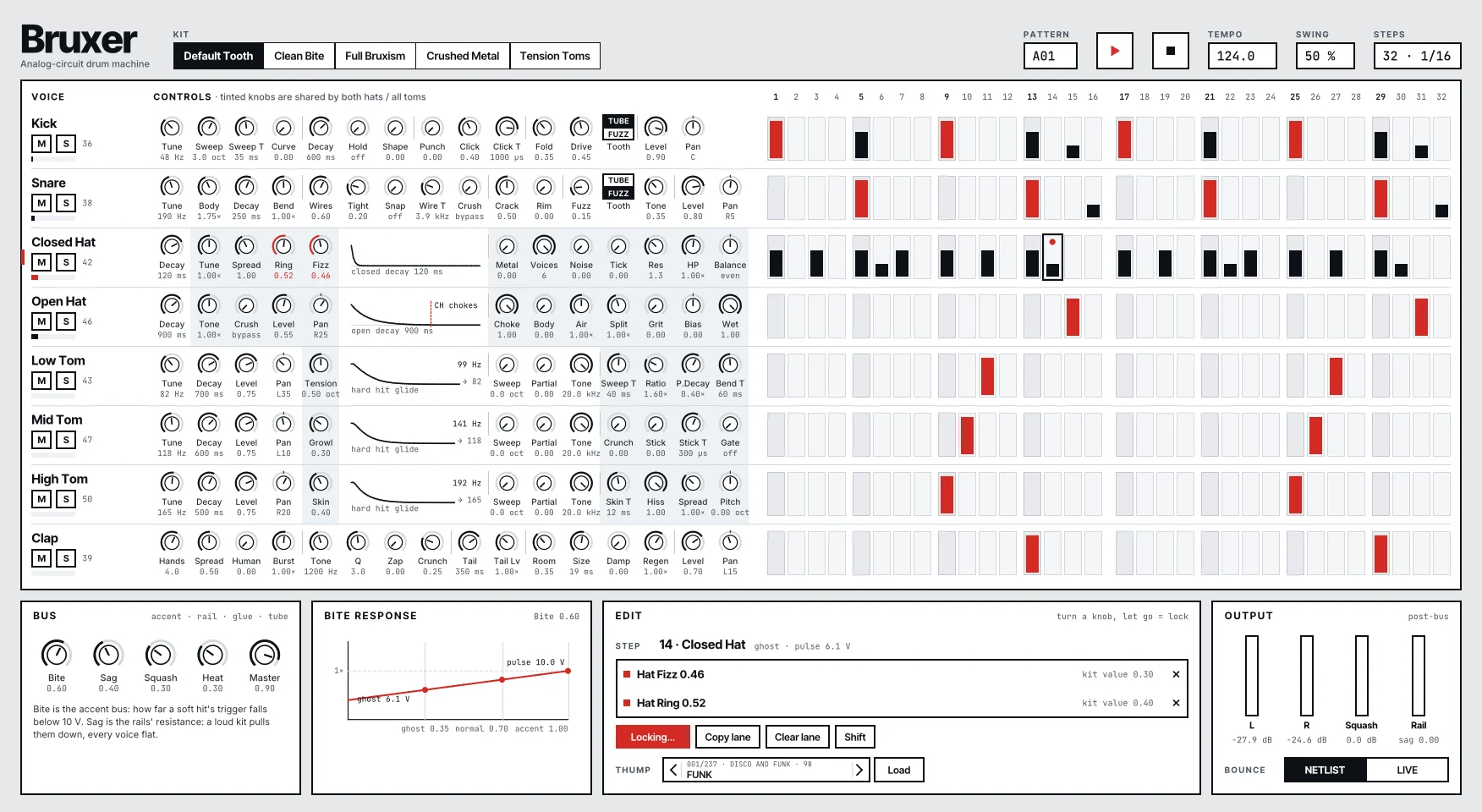
The Bruxer panel with step 14 of the Closed Hat lane selected, a ghost hit with a 6.1 V pulse, and + Lock knob armed, shown as a red Locking... key. The hat's Ring and Fizz knobs read 0.52 and 0.46 in red, and EDIT lists the step's two locks, Hat Fizz 0.46 against its kit value 0.30 and Hat Ring 0.52 against 0.40, each with a cross to remove it. The step itself carries a red dot.
Two locks on one closed-hat step: Fizz and Ring turned for that hit alone, the kit's values beside them.

Sixteen patterns, A01 to A16, each of eight lanes and 32 steps. Click a step to select it; click it again and it cycles ghost, normal, accent and off. Drag along a lane to paint a run of normal hits, or to erase one that is lit. With Bite up, the three levels are three different hits, not three volumes.

Select a step and press + Lock knob, then turn any knob: you hear it at once, and when you let go it becomes a lock on that step while the kit's value plays again. Up to four locks a step, each snapped in at the hit and let go at the lane's next one; a double-click clears one. Copy lane, Clear lane and Shift do what they say.

STEPS (1 to 32), the rate (1/8, 1/16, 1/16T or 1/32) and SWING are shared by every lane. The sequencer follows your host while it plays and runs on its own TEMPO from PLAY when it does not. MIDI plays the voices on the usual drum notes, on any channel, and M and S mute and solo a lane for both.

Five kits come with it, as the KIT keys name them: Default Tooth, Clean Bite, Full Bruxism, Crushed Metal, Tension Toms. They leave the flavour knobs at their defaults.

Thump, inside

237 grooves to start from.

Bruxer carries the whole of Thump, this site's genre library: 237 grooves in 17 families. Click the groove slot under EDIT and a menu opens, the families on the left with their counts and their grooves on the right with their tempos. LOAD writes the groove into the selected pattern and sets TEMPO, SWING and 32 steps at 1/16; a double-click picks and loads at once.

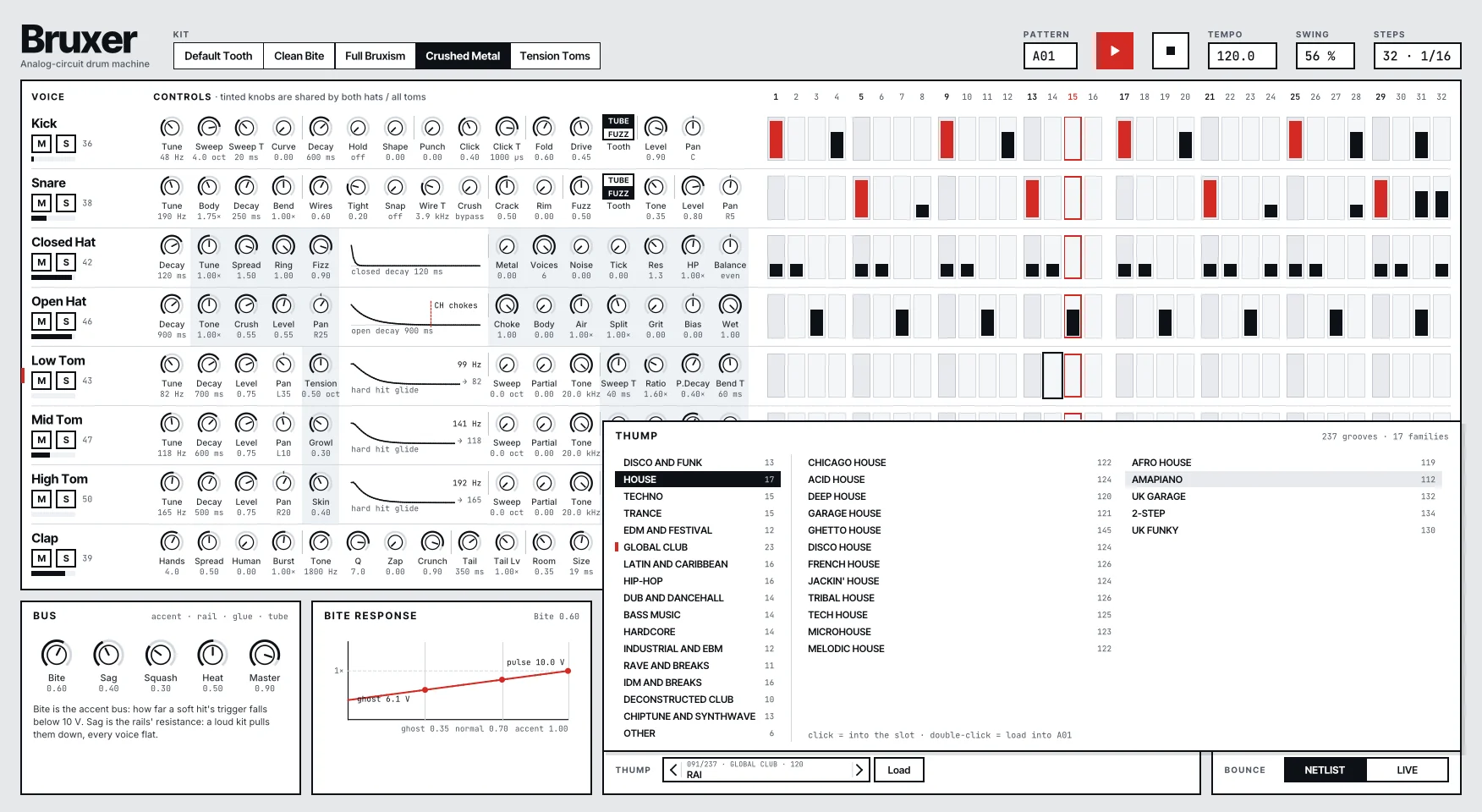
The Bruxer panel on Crushed Metal with THUMP's menu open over the lower lanes, headed 237 grooves, 17 families: the families down the left with their counts, from DISCO AND FUNK and HOUSE to CHIPTUNE AND SYNTHWAVE and OTHER, HOUSE selected, GLOBAL CLUB marked red as the family of the groove in the slot; HOUSE's seventeen grooves in two columns on the right with their tempos, from CHICAGO HOUSE at 122 to UK FUNKY at 130, AMAPIANO highlighted. Under it: click into the slot, double-click to load into A01. The slot reads 091/237, GLOBAL CLUB, 120, RAI.
THUMP's menu, opened from the groove slot: every family, and each family's grooves with their tempos.

Each groove is mapped onto Bruxer's eight voices: the toms by register, rims to the snare as ghost notes, rides and shakers to the closed hat, and the catalogue's velocities onto ghost, normal and accent. Cowbells, claves, woodblocks, agogos and triangles have no voice in Bruxer, so they are left out.

Playback and bounce

Play the equations. Bounce the parts.

Every part in Bruxer's circuit is a component: resistors, capacitors, diodes and zeners, transistors and matched pairs, JFET switches, op-amps, OTAs, triodes, a bucket-brigade delay and the power transistors of a monitor amplifier. No behavioural blocks. The knobs are pots, the triggers are voltage pulses, the supplies are rails with a resistance and reservoir capacitors, and the noise is a zener's. It is an original circuit, designed this way; there was never a box to copy.

PLAYBACK

The same boards, as equations.

While you play, Bruxer runs every board as equations at four times the session's rate at 44.1 and 48 kHz, from the same pots: the OTAs, the converters, the op-amps inside their swing, the diodes, the fuzz transistor and the triodes, each by its own law. On the kit's demo groove it takes about 29 percent of one core.

BOUNCE: NETLIST

The parts themselves.

When your DAW renders offline, Bruxer solves the circuit: fifteen blocks on a fixed step of 5.2 microseconds at 48 kHz, each sleeping while it rests. About 8 times slower than real time on a kick, a snare and a closed hat struck together. Both engines have the same latency, 28 samples at 44.1 and 48 kHz, so a bounce lines up with playback to the sample.

THE BOUNCE SWITCH

NETLIST or LIVE.

OUTPUT's BOUNCE switch says what an offline render plays: NETLIST, the default, solves the parts; LIVE renders the equations. If the netlist ever fails mid-render, the live engine takes the rest of the render over, the panel says so, and the fault is logged.

+0.29 dB

live against the netlist on a kick, a snare and a closed hat

0.5 dB

or closer, the kick, snare, hats and toms each struck at full accent, through the decay

1.1 to 1.6 dB

the crushed hats, a sample-and-hold being sensitive to the step

about 2 dB

across every flavour knob on its own voice, the kick within 0.3

The snare and the hats each carry one measured trim for what the equations leave out, and the live snare is a little brighter in its wires. The live engine is a model of the circuit, and says so.

The panel

Every lane, on one page.

The panel is 1752 by 960. Each voice is a lane: its name, M and S, up to sixteen controls, and its 32 steps. Tinted knobs are shared, by both hats or by all three toms. Along the bottom, BUS, BITE RESPONSE, EDIT with THUMP at its foot, and OUTPUT, where the meters read the squash and the rails' sag as they happen and the BOUNCE switch sits.

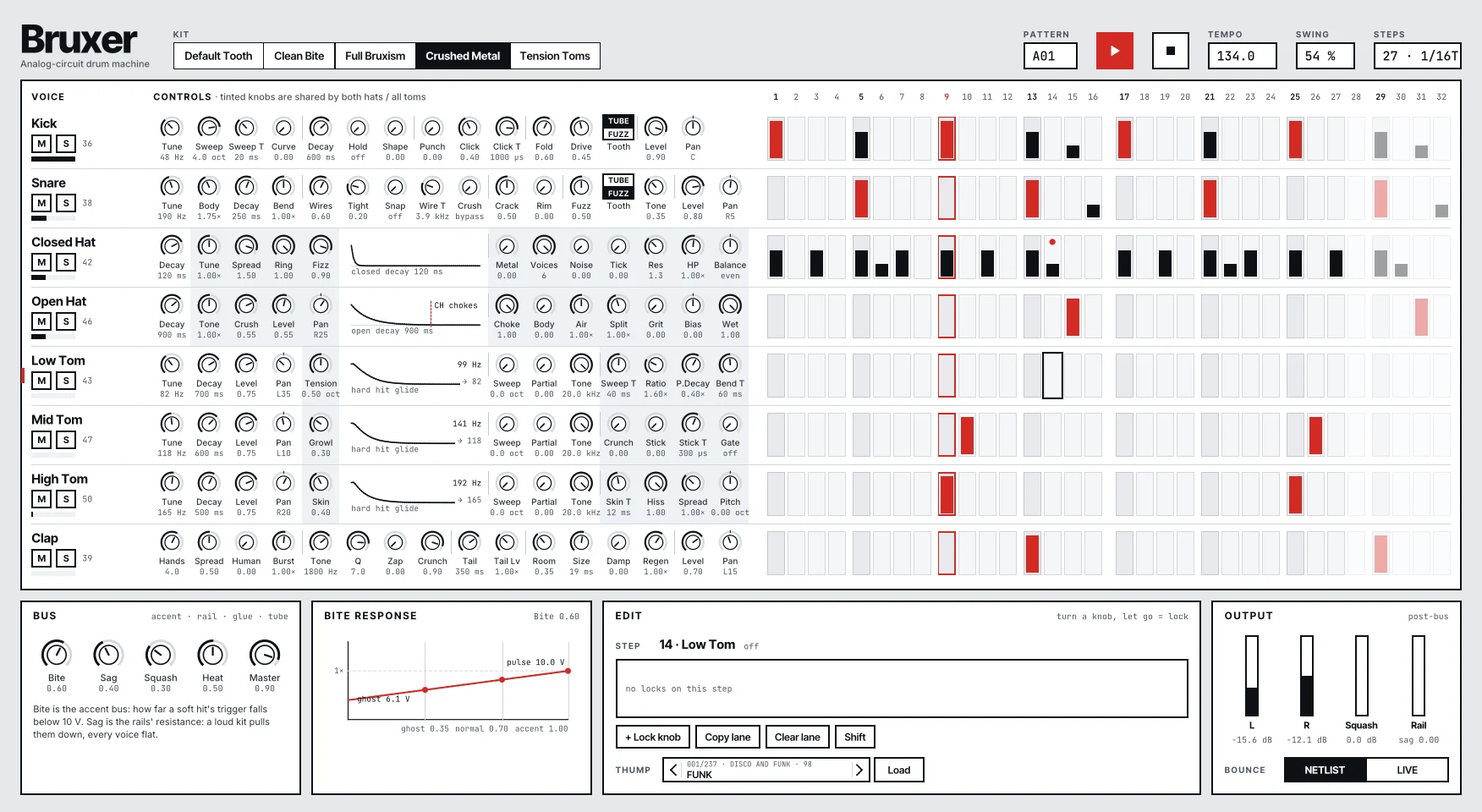
The Bruxer panel on the Crushed Metal kit, TEMPO 134.0, SWING 54 % and STEPS 27 at 1/16T, the playhead on step 9: the kick's Sweep at 4.0 oct and Fold at 0.60, the closed hat's Spread 1.50, Ring 1.00 and Fizz 0.90, the open hat's Crush at 0.55, the clap's Tone at 1800 Hz, Q 7.0 and Crunch 0.90, and the steps past 27 greyed out. The meters read L -15.6 dB and R -12.1 dB.
Crushed Metal: the hats rung, fizzed and crushed, a fast-swept folded kick, a narrow crunchy clap, 27 steps of triplets.

What it is, and what it is not

Solved, modeled, and not yet.

SOLVED

On a bounce, the whole circuit: every voice's board, the triodes, the rails and their sag, and the bus. The bucket brigade's delay line and the zeners' noise are ours, the same in both engines.

MODELED

The live model is a model of the circuit: the same boards as equations, each part by its law, close, and closest where nothing is noise. Two of its voices carry a measured trim.

NOT YET

The Mac: Bruxer is Windows only for now, with the Mac VST3 and Audio Unit in development. Kits that use the flavour knobs. And a download: it is free, and it will be here when it is ready.

Free, no account, nothing to unlock

WE MUST HAVE GONE INSANE!!

All Drums

VST®3 instrument · Windows 64-bit Free · no accountmacOS VST3 and Audio Unit are in development.

At a glance

Bruxer specifications

Technical specifications for Bruxer, Netlist Drum Machine · Free Plugin
FormatVST®3 instrument · Windows 64-bit
In developmentmacOS VST3 and Audio Unit
Requires64-bit Windows 11, in any version Microsoft still supports. When the Mac version ships: macOS 15 or later, on Apple silicon or Intel.
Voices8 · kick, snare, closed hat, open hat, low, mid and high tom, clap
The circuitAn original analog circuit, every part a component · op-amps, OTAs, JFET switches, triodes, a 1024-stage bucket brigade · no behavioural blocks
AccentBite: the trigger's height, 10 V at a full hit · at 0.60 a ghost note 6.1 V
Flavour55 knobs on the voices' boards, every one a real part
BusSag on the shared rails · Squash, a log-domain compressor · Heat, a triode each side · Master
Sequencer16 patterns × 8 lanes × 32 steps · ghost, normal, accent · up to four locks a step
TimingSTEPS 1 to 32 · RATE 1/8, 1/16, 1/16T, 1/32 · SWING · host sync, or PLAY at its own TEMPO
GroovesThump's whole library: 237 grooves in 17 families, from a menu
MIDIDrum notes 36, 38, 42, 46, 43, 47, 50 and 39, any channel
KitsDefault Tooth, Clean Bite, Full Bruxism, Crushed Metal, Tension Toms
PlaybackThe same boards as equations · about 29 percent of one core on the demo groove
BounceBOUNCE NETLIST: the parts, solved · LIVE: the equations
Bounce timeAbout eight times slower than real time on a kick, a snare and a closed hat together
Latency28 samples at 44.1 and 48 kHz, the same in playback and the bounce
The panel1752 by 960
Validation47 of 47 validator tests · host-tested
PriceFree
ActivationNone. No license server, no phone-home
Security updatesUntil November 2031
LicenseLicense agreement · Facts sheet
VST Compatible

VST is a registered trademark of Steinberg Media Technologies GmbH.