
Lesson 1
The harmonic engine
At any moment your project is on a chord. Not one per track - one, for everything. Almost all of this course is a consequence of that single fact.
One chord, shared
Phonon keeps a harmonic context: a chord that is current for the whole project, that changes on a schedule you write, and that anything in the application is allowed to read.
This is the reason the lattice on the right of the window has anything to draw, and the reason a generator you drop on an empty track already knows which notes are in play. Neither of them is guessing. They are reading the same chord.
It lives outside the tracks
Near the top of the hierarchy there is a Structure rack holding three things: Song Structure, the Harmonic Engine, and the Melodic Engine.
The shape will be familiar from the control rack, and it is there for the same reason. None of these three is in anyone's signal path, so putting them in a track would imply a chain position they do not have. The rack is permanent: you do not add it, and you cannot delete what is in it.
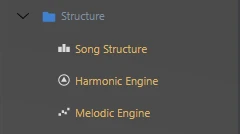
The rack at the size it really is. Three permanent occupants, none of them on a track.
What a progression is made of
There are three parts, and they nest.
- A chord is a root, a quality and a length in bars. There are nineteen qualities, from plain major and minor out to half-diminished, suspended dominants and stacked fourths.
- A section is a named run of chords - A, B, and so on. A section is the unit you write once and reuse.
- The form is the list of which section plays when. A, A, B, A is four slots and, at four bars a section, sixteen bars.
Sections and a form rather than one long list of chords, because music repeats. Changing a chord in section A changes it in all three places A appears, which is almost always what you wanted.
A bank with sections but an empty form plays nothing at all. That is not a fault, it follows from the form being the thing that says when anything happens - but it used to be a silent surprise, so the panel now tells you outright when the form is empty.
There is no key setting
Worth saying plainly, because it is the first thing people go looking for and there is nothing to find. You do not tell Phonon what key you are in. It works the key out from the chords you wrote, and reports it - the panel says key ≈ C rather than key: C, and the approximately sign is doing real work.
The reasoning is that the chords are the fact and the key is a reading of them. A progression that leans between two keys should be reported as the ambiguous thing it is, not forced to declare.
You already have one
A new project is not harmonically blank. It opens on a bank called Verse, with a section A of C minor, G sharp and F sharp, a section B of four more, and a form of A, A, B, A. Sixteen bars, already looping.
So the first thing you can do with this course is not build a progression from nothing. It is open the panel and change the one you were given.
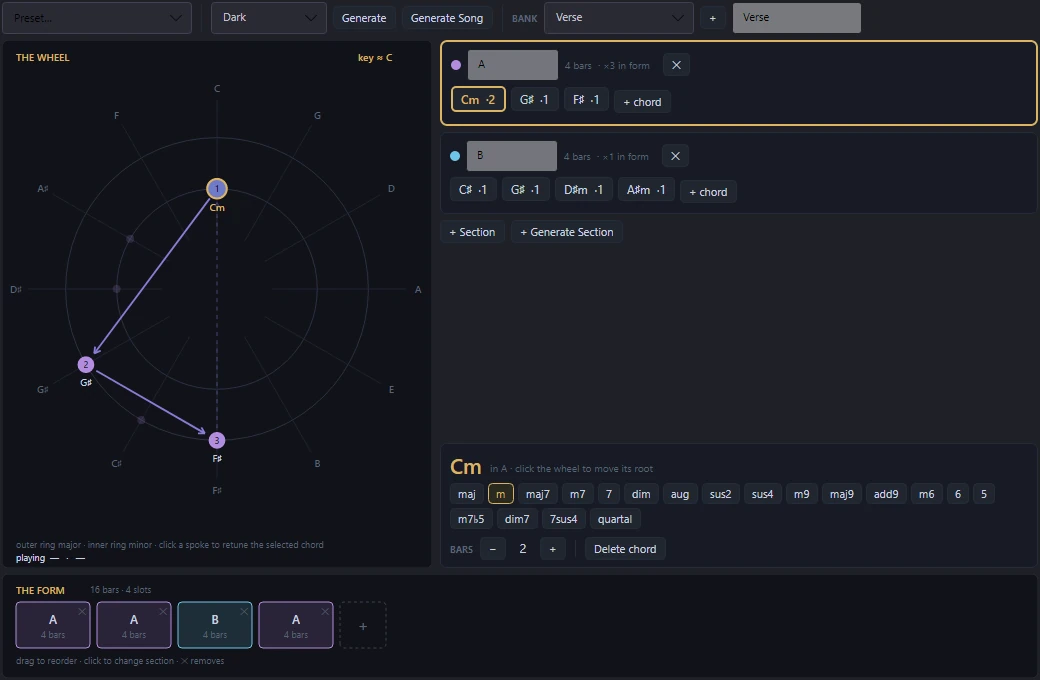
The whole panel, as it opens on a new project. The wheel on the left, the sections on the right, the form along the bottom - all three are lesson 2.