
THE COST
About 1.2 seconds a second.
Measured with INIT and a four-note chord held at 48 kHz: about 1.2 seconds of computing for every second of sound. Most of it is the sixteen lanes, each with its three shapers, its high-pass and its filter.
Polyphonic Ripple Synthesizer
THE GATES OF HEAVEN HAVE OPENED.
Four voices of four cores, three of them ripple oscillators, each core bent through its own shapers and filters: sixteen lanes and 49 shapers at once, every lane landing somewhere new in the stereo field, and a MOD chit under every one of 288 knobs.
VST®3 instrument · Windows 64-bit No activationmacOS VST3 and Audio Unit are in development.
The idea
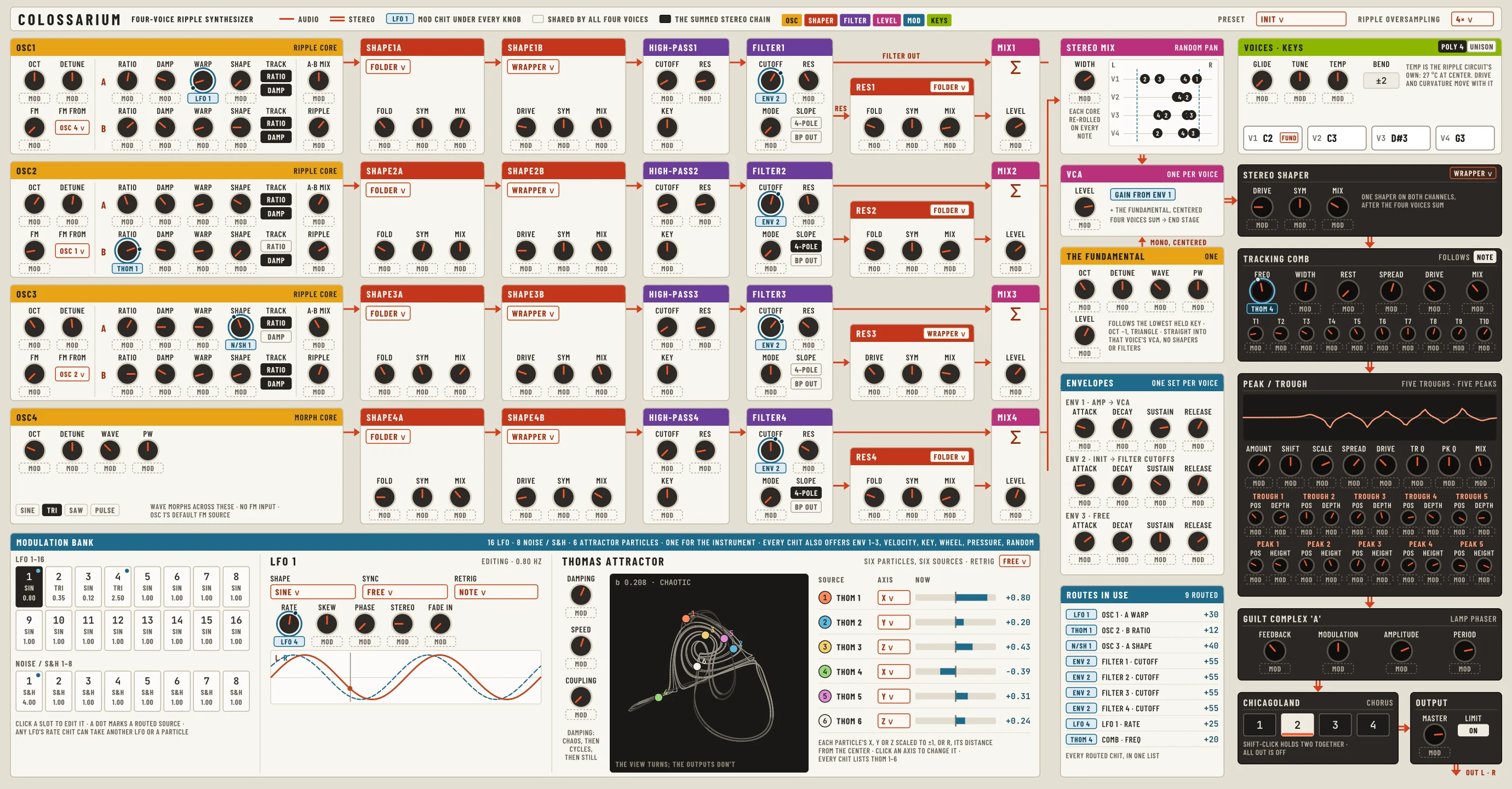
Colossarium is not a netlist synth: there is no netlist inside it, and nothing to bounce. Instead, all of its equations are derived from real netlists and checked against SPICE, and nearly everything in it is a real circuit's architecture, running live. The exception is the modulation: the LFOs, the noise and S&H sources, the attractor and the envelopes are digital.
Sixteen lanes run up to the VCA, four in every voice; after it, one chain for all of them.
There is no netlist inside it and nothing to bounce. Every circuit runs live, and its equations come from real netlists, checked against SPICE.
Four voices of four cores, each core a lane of two shapers, a high-pass and a filter with a shaper on its resonance.
Every lane lands somewhere new in the stereo field, and the sum runs through a comb, a cascade, a phaser and a chorus.
Hear it
Sixteen takes of Colossarium in two flavors, takes and arpeggios, about half a minute each, in stereo. Nothing has been done to them on the way here but the encoding, so some are a good deal louder than others.
0:32
0:32
0:32
0:32
0:34
0:32
0:32
0:32
OSC 1 · 2 · 3 · RIPPLE CORE
A ripple core is a base tone with two ripple elements riding on it. Each element is a small oscillator forced back to its start once a cycle of the base tone, and fading out through its own decay. So every cycle carries two bursts of ripples: two formants, and you choose where each one sits. RATIO sets how many ripples a cycle, DAMP how fast they die, WARP bends them as they fade, SHAPE runs them from round to square, and TRACK keeps RATIO and DAMP on the note or frees them from it.
Three cycles of A2, the dashed lines at each cycle's start: the plug-in's own ripple core, recorded, not drawn by hand.

SHAPE A · SHAPE B · RES · STEREO SHAPER
Every lane has two shapers in a row and a third on its filter's resonance, and the summed mix has one more: 32 and 16 and 1. Each is any of seven types, picked in a dropdown, and its three knobs take that type's words. Here is one cycle of a sine through each, from the plug-in's own code.
FOLDER
FOLD · SYM · MIX
WRAPPER
DRIVE · SYM · MIX
TRIAD
DRIVE · CROSS · MIX
TRACK & HOLD
STEPS · SYNC · MIX
CHEBYSHEV
LEVEL · ORDER · MIX
EXP PULSE
DRIVE · BAL · MIX
DEAD ZONE
DRIVE · SYM · MIX
A 3 V sine at 218 Hz, its second knob at the middle and MIX full wet; each curve is scaled to fit its screen. FIRST KNOB is FOLD, DRIVE, STEPS or LEVEL, as the type names it.
THE PANEL
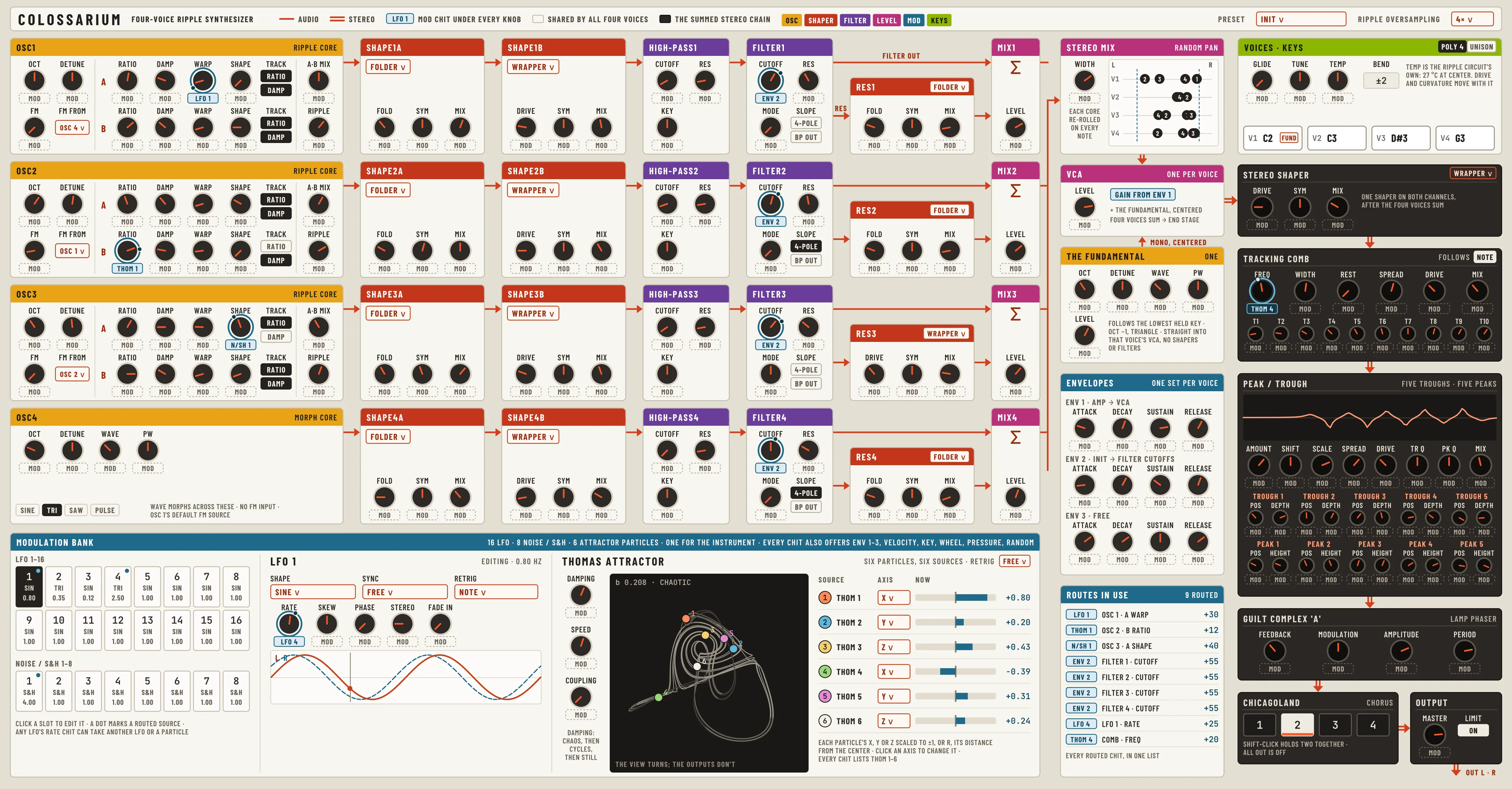
Each band's colour is its job: OSC amber, SHAPER red, FILTER violet, LEVEL magenta, MOD petrol, KEYS lime. The four rows on the left are one voice's four lanes, shared by all four voices; the column on the right is the summed stereo chain.
STEREO MIX · RANDOM PAN
Whenever a voice takes a note, each of its four lanes draws a new place in the stereo field, anywhere from left to right, and WIDTH sets how far from the middle those places can fall. A chord spreads differently every time you play it. The gains glide to their new places, so a stolen voice moving does not click.
Play a note: the next voice round takes it, and its four lanes draw their places.
The summed stereo chain
After the voices sum, the mix runs through five more circuits, one after another, each running live, and each the one it is on another of our plug-ins.
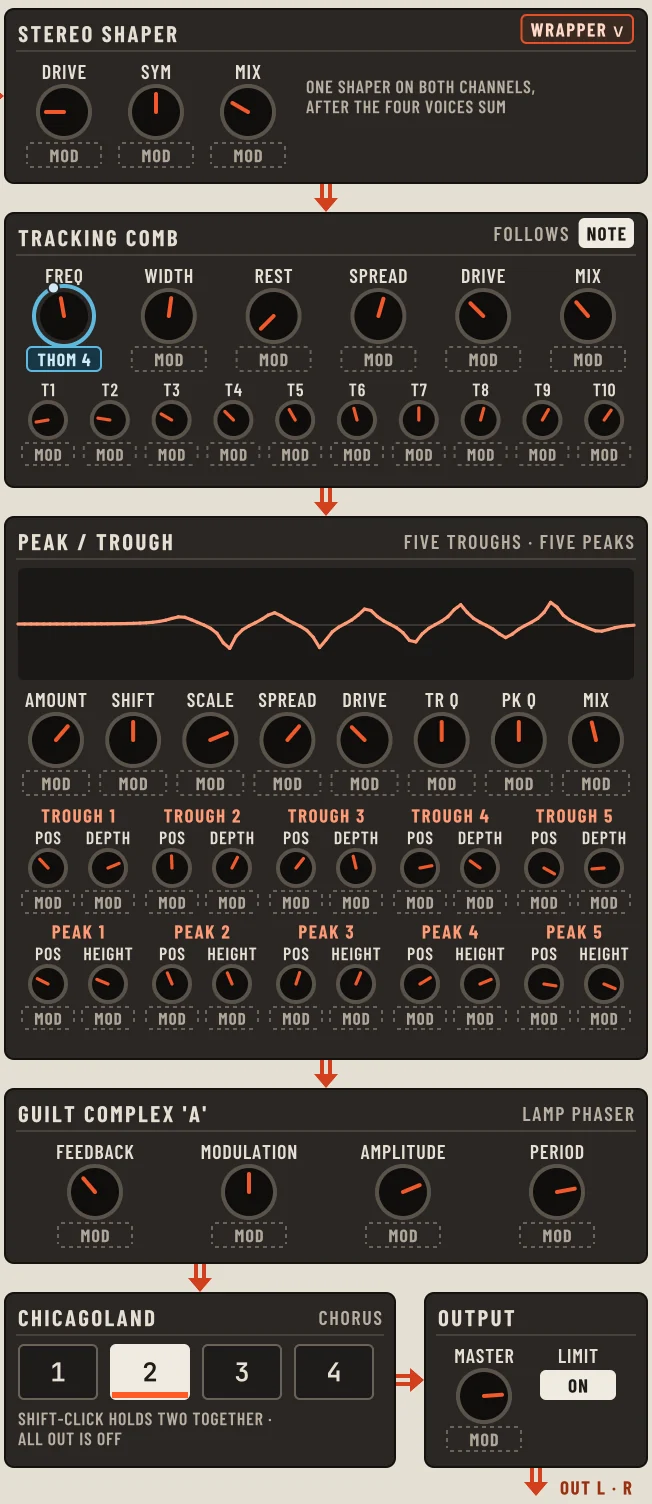
STEREO SHAPER
The forty-ninth: any of the seven types, after the four voices sum, on both channels.
TRACKING COMB · PEAK / TROUGH
The tracking comb, ten teeth that follow the note you play, then the cascade of five troughs and five peaks: pages one and two of Ramjet, run as its live models, on each side.
GUILT COMPLEX 'A'
Guilt Complex 'A', carried whole: FEEDBACK, MODULATION, AMPLITUDE and PERIOD, two units on one LFO.
CHICAGOLAND · OUTPUT
Chicagoland's four buttons: a click lights one, SHIFT-click holds two together, all out is off. Then MASTER, and LIMIT, which holds the peaks under -1 dBFS.
The arithmetic
123in every voice17for the instrument80on the LFOs24on the noise sources44on the comb and the cascade
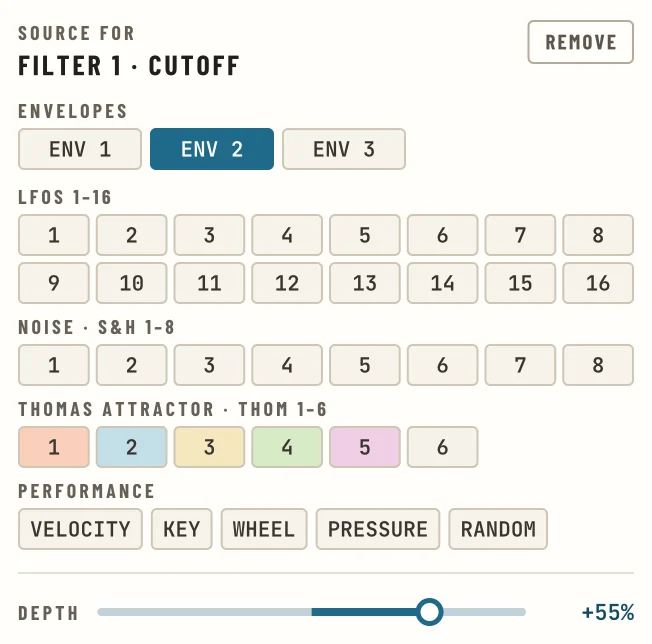
Even OCT has one, so a source can move a core whole octaves. Click a chit and pick one of 38 sources: three envelopes, sixteen LFOs, eight noise and sample-and-hold sources, the attractor's six particles, and VELOCITY, KEY, WHEEL, PRESSURE and RANDOM. DEPTH sets how far, either way.
THOMAS ATTRACTOR · THOM 1-6
Six particles move on a strange attractor, x' = sin y - b·x, and the same for y and z in turn. Each is a MOD source, read out as its X, Y, Z or its distance from the middle. DAMPING is b: low, they wander apart and never repeat; higher, they settle into cycles; higher still, they stop. COUPLING pulls them together.
b 0.208 · CHAOTIC
Live, all of it
There is no netlist inside Colossarium and no BOUNCE menu: every circuit runs its live model, the same in playback and when your DAW renders. That is why it asks for the machine it does.
THE COST
Measured with INIT and a four-note chord held at 48 kHz: about 1.2 seconds of computing for every second of sound. Most of it is the sixteen lanes, each with its three shapers, its high-pass and its filter.
THE THREADS
The four voices render each block side by side, on three threads of Colossarium's own and your DAW's audio thread, which brings the same chord down to about 0.4 seconds on the clock for every second of sound.
RIPPLE OVERSAMPLING
The ripple cores run at four times your DAW's rate, or eight. Every edge in them is placed exactly in time and smoothed from a table, so they stay clean up the keyboard. The latency is 24 samples at 48 kHz.
And the rest of it
THE FUNDAMENTAL
One core for the whole instrument, on the voice holding the lowest key: OCT, DETUNE, WAVE, PW and LEVEL, an octave down and a triangle at INIT, straight into that voice's VCA, in the middle, with no shapers or filters. It moves when that key lifts.
ENVELOPES
ENV 1 opens the VCA, ENV 2 reaches the four filters' cutoffs at INIT, ENV 3 is free. ATTACK, DECAY, SUSTAIN and RELEASE, each with a chit; a note played again starts from where its envelope stands.
VOICES · KEYS
POLY 4 or UNISON, GLIDE, TUNE and BEND. TEMP is the ripple circuit's own temperature, 0 to 54 °C, 27 at the centre: its drive and its curvature move with it, as the circuit's would.
PERFORMANCE
VELOCITY, KEY, WHEEL and PRESSURE are sources like any LFO, and RANDOM draws a fresh value for every note. The sustain pedal holds and the pitch wheel bends.
PRESET
INIT, TRIAD BELLS, STAIRCASE, CHEBYSHEV ORGAN, EXP PULSE BASS and DEAD ZONE PLUCK. INIT is the panel as it was drawn, its nine routes in ROUTES IN USE; every picture on this page has it loaded.
YOURS
No license server, and no phone-home.
A polyphonic ripple synthesizer
THE GATES OF HEAVEN HAVE OPENED.
The ripple oscillator is a circuit of our own, and so are four of its seven shaper types: the TRACK & HOLD, the CHEBYSHEV, the EXP PULSE and the DEAD ZONE. The TRIAD is Ramjet's cross-modulated triad, played as a shaper. Its morph core is the saw core inside Profundus and Cinderblock, its high-pass the APH-21 Quadrifier's, its filter the one Cinderblock carries, its wrapper the Overtime Eight-Tone's; the comb and the cascade are Ramjet's, the phaser and the chorus are Guilt Complex 'A' and Chicagoland. All of them run live.
VST®3 instrument · Windows 64-bit No activationmacOS VST3 and Audio Unit are in development.
At a glance
| Format | VST®3 instrument · Windows 64-bit |
|---|---|
| In development | macOS VST3 and Audio Unit |
| Requires | 64-bit Windows 11, in any version Microsoft still supports. When the Mac version ships: macOS 15 or later, on Apple silicon or Intel. |
| Machine | A 15-inch MacBook Pro with its display set to More Space and an M3 Apple silicon chip or better, or the Windows equivalent. |
| Voices | Four · POLY or UNISON · GLIDE, TUNE and TEMP |
| Cores | Three ripple cores a voice: OCT, DETUNE, FM from any core, two elements of RATIO, DAMP, WARP and SHAPE, A·B MIX, RIPPLE · OSC 4, the MORPH CORE: sine to triangle to saw to pulse, PW |
| Lanes | Sixteen: SHAPE A · SHAPE B · HIGH-PASS · FILTER, 2-pole or 4-POLE, BP OUT · a RES shaper on the resonance · LEVEL |
| Shapers | 49, each FOLDER, WRAPPER, TRIAD, TRACK & HOLD, CHEBYSHEV, EXP PULSE or DEAD ZONE |
| The Fundamental | One core under the lowest key held, in the middle |
| Stereo | Every lane panned anew on every note, within WIDTH |
| The mix | STEREO SHAPER · TRACKING COMB · PEAK / TROUGH · GUILT COMPLEX 'A' · CHICAGOLAND · MASTER · LIMIT |
| Modulation | 16 LFOs · 8 noise and S&H sources · a Thomas attractor of six particles · three envelopes · VELOCITY, KEY, WHEEL, PRESSURE, RANDOM · a MOD chit under each of 288 knobs |
| Engine | Every circuit live, in playback and in a bounce · no netlist |
| Computing | About 1.2 s a second for a four-note chord at 48 kHz, spread over three threads of its own beside the audio thread |
| Latency | 24 samples at 48 kHz |
| Presets | INIT · TRIAD BELLS · STAIRCASE · CHEBYSHEV ORGAN · EXP PULSE BASS · DEAD ZONE PLUCK |
| The panel | 1840 by 960 |
| Validation | 47 of 47 validator tests · host-tested |
| Activation | None. No license server, no phone-home |
| Security updates | Until November 2031 |
| License | License agreement · Facts sheet |

VST is a registered trademark of Steinberg Media Technologies GmbH.