
THE OSCILLATORS
Three expo-converter oscillators, each with coarse and fine tuning, a morph from sine through triangle and saw to pulse, pulse width and level.
harmonics 2 to 8, under the fundamentalsine39 dB→saw5 dB
Eight-Voice Subtractive Synthesizer
Congratulations, you found our secret synth. Shhh...
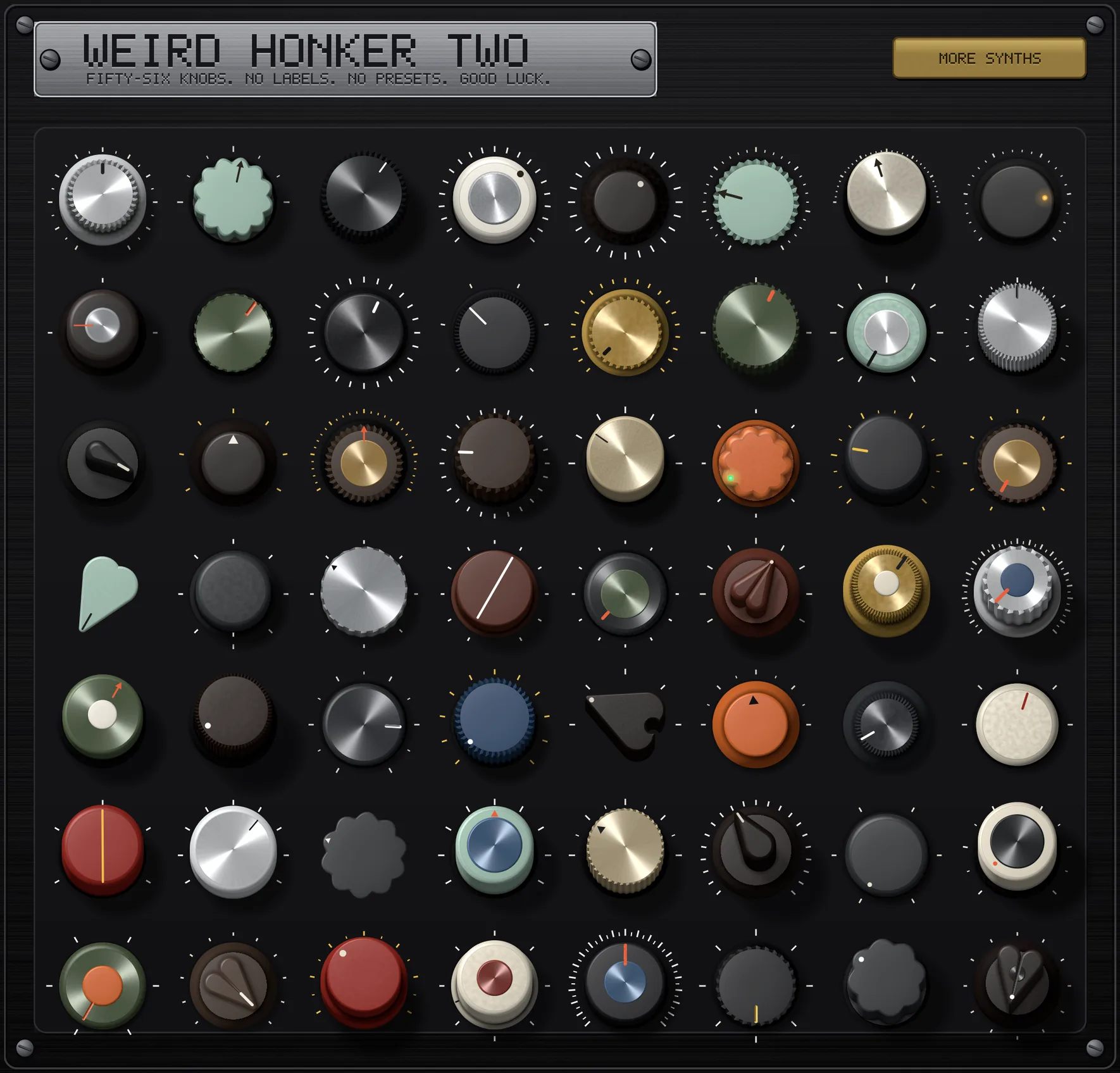
An eight-voice subtractive synthesizer with everything in it: three oscillators, FM two ways, AM, a ring, a wavefolder, noise, two filters from a wardrobe of five, two envelopes, three LFOs, glide and iron. What you get is a grid of fifty-six knobs with nothing written on them - no two of them the same knob, and not one of those differences a clue - in an order drawn once from a seed and frozen forever. The host is told KNOB 01 through KNOB 56 and nothing more. For the brave sonic adventurer who wants to fend for themselves.
VST3 · Windows 64-bit·No activationmacOS VST3 and Audio Unit are in development.
It is a Honker
There is no map. There is no menu and no patch bank, and the nameplate carries the only words on the panel. The defaults are the only patch, and double-clicking a knob puts it back there. Everything else you find by turning something and listening.
A seed, once
The order of the fifty-six was drawn once from a seed and fixed for good, so a project saved today reads the same forever - and a knob you learn stays learned.
Two copies built one after the other differ by exactly nothing, sample for sample.
Somewhere on the grid
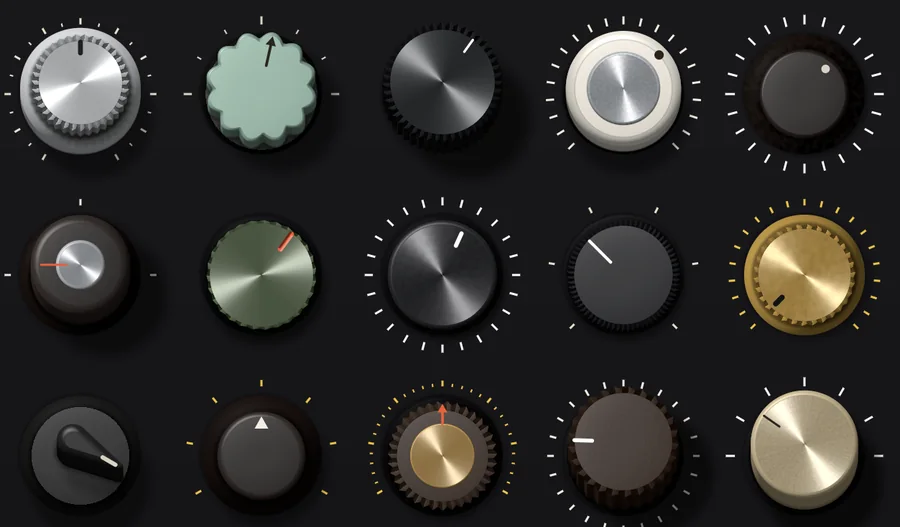
Every function is a circuit from the Phonon catalogue, and every one was measured doing its job through the grid. Here is what the fifty-six knobs add up to. Where each one is, you will have to find out.
Three expo-converter oscillators, each with coarse and fine tuning, a morph from sine through triangle and saw to pulse, pulse width and level.
harmonics 2 to 8, under the fundamentalsine39 dB→saw5 dB
FM two ways, AM, a diode ring, a wavefolder with its own symmetry, and noise.
exponential FM, 2 into 1: 500 Hz to 3 kHz against the carrierdown-106 dB→up+4 dB
thru-zero FM, 3 into 2: the carrier stays within5 cents
... while its sidebands lift+44 dB
AM: a line at 1.5 times the carrier, under it by6 dB
the ring: the sum, over what is left of the carriers+105 dB
the fold: a sine's harmonics 2 to 9, underdown39 dB→up2 dB
FM that stays in tune. The fold's symmetry moves the even harmonics.
Each filter is one of five circuits - a transistor ladder, a diode ladder, a two-pole lowpass and its mirrored highpass, a state-variable - with its own cutoff, resonance, envelope amount and key tracking. The second runs after the first or beside it.
cutoff moves 2 to 8 kHz by54 dB
resonance at 0.85, the band at the cutoff, on the ladder+31 dB
highpass against lowpass, the top against the fundamental+46 dB
a shut first filter, top beside against in series+54 dB
key tracking, A4's top+11 dB
The two ladders are driven where they still resonate. Measured alone, a transistor ladder at the usual level is a comparator with no peak; at a third of it, it sings.
Two RC envelopes, one into the filters and one into the VCA. Three relaxation oscillators - a Schmitt trigger charging a capacitor - each sine, triangle, square or sample-and-hold, each sent to one of ten places. Glide, and output iron.
filter envelope: top in the first 35 ms against half a second+38 dB
VCA attackshort0 ms→long420 ms
VCA release, 600 ms onshortsilence→long26 dB still there
an LFO on pitch at 4 Hz, a quarter turn, peak to peak600 cents
glide, an octave jumpshort10 ms→long1.5 s
output iron: a low note's 3rd harmonic, underdown37 dB→up15 dB
The ten places an LFO can go: pitch, either cutoff, the fold, pulse width, FM, AM, the ring, the third oscillator's pitch, or the level.
Eight of them
Straight out of the plugin, no processing on the way here.
Black crinkle
Fifty-six hardware knobs, no two of them the same - chrome skirts, fluted plastic, knurled black, brass, a chicken-head - turning under a fixed light, in eight columns and seven rows. Drag, wheel, shift for fine, double-click to reset a knob to the only patch. Eight voices, and a ninth note steals. It runs at five times realtime with all eight held, and the panel is 720 by 690, so it fits a laptop.
The sheet
Powered by Phonon
Weird Honker Two adds nothing to the Phonon engine. It quotes circuits already in the catalogue - the expo converter, the wardrobe of filters, the wavefolder, the relaxation LFO, the output iron - so the plugin and the DAW can never drift apart in sound.
VST3 · Windows 64-bit - macOS VST3 and Audio Unit are in development. No activation, and the plugin never asks who you are.
At a glance
| Format | VST3 · Windows 64-bit |
|---|---|
| In development | macOS VST3 and Audio Unit |
| Voices | 8 · a ninth note steals |
| The grid | 56 knobs, no labels · the host sees KNOB 01 to 56 |
| The order | Drawn once from a seed and frozen |
| Presets | None · the defaults are the only patch |
| Oscillators | 3 expo converters · sine to pulse, pulse width |
| Modulation | FM two ways, AM, ring, wavefolder, noise |
| Filters | 2, each one of 5 models · in series or beside |
| What moves | 2 RC envelopes · 3 LFOs to ten places · glide |
| FM | -106 dB to +4 · thru-zero carrier within 5 cents |
| Ring and fold | Ring +105 dB · fold 39 dB under to 2 |
| Resonance | +31 dB on the ladder · highpass top +46 dB |
| Performance | 5 times realtime, eight voices held |
| The panel | 720 by 690 · it fits a laptop |
| Activation | None. No license server, no phone-home |