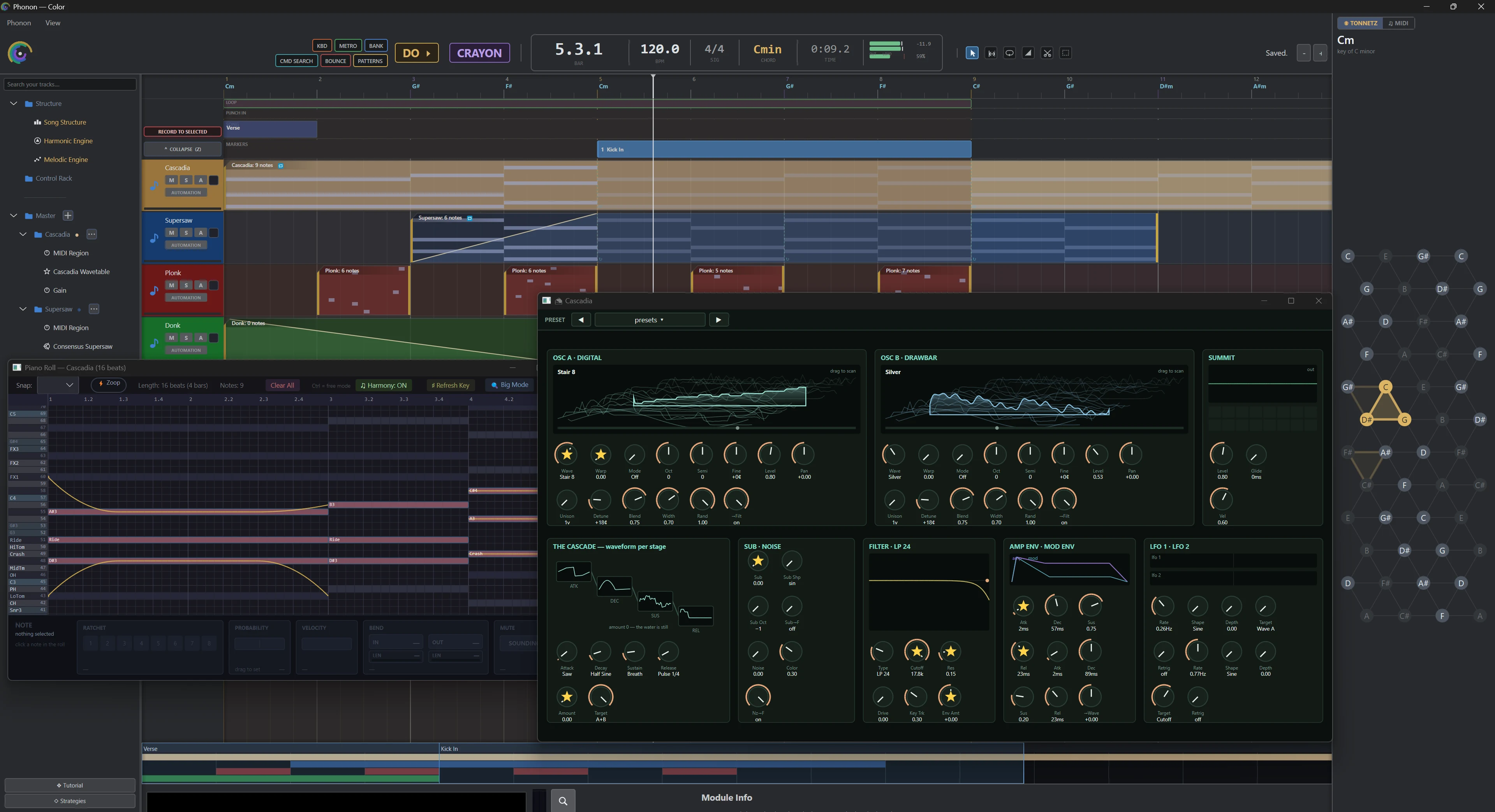
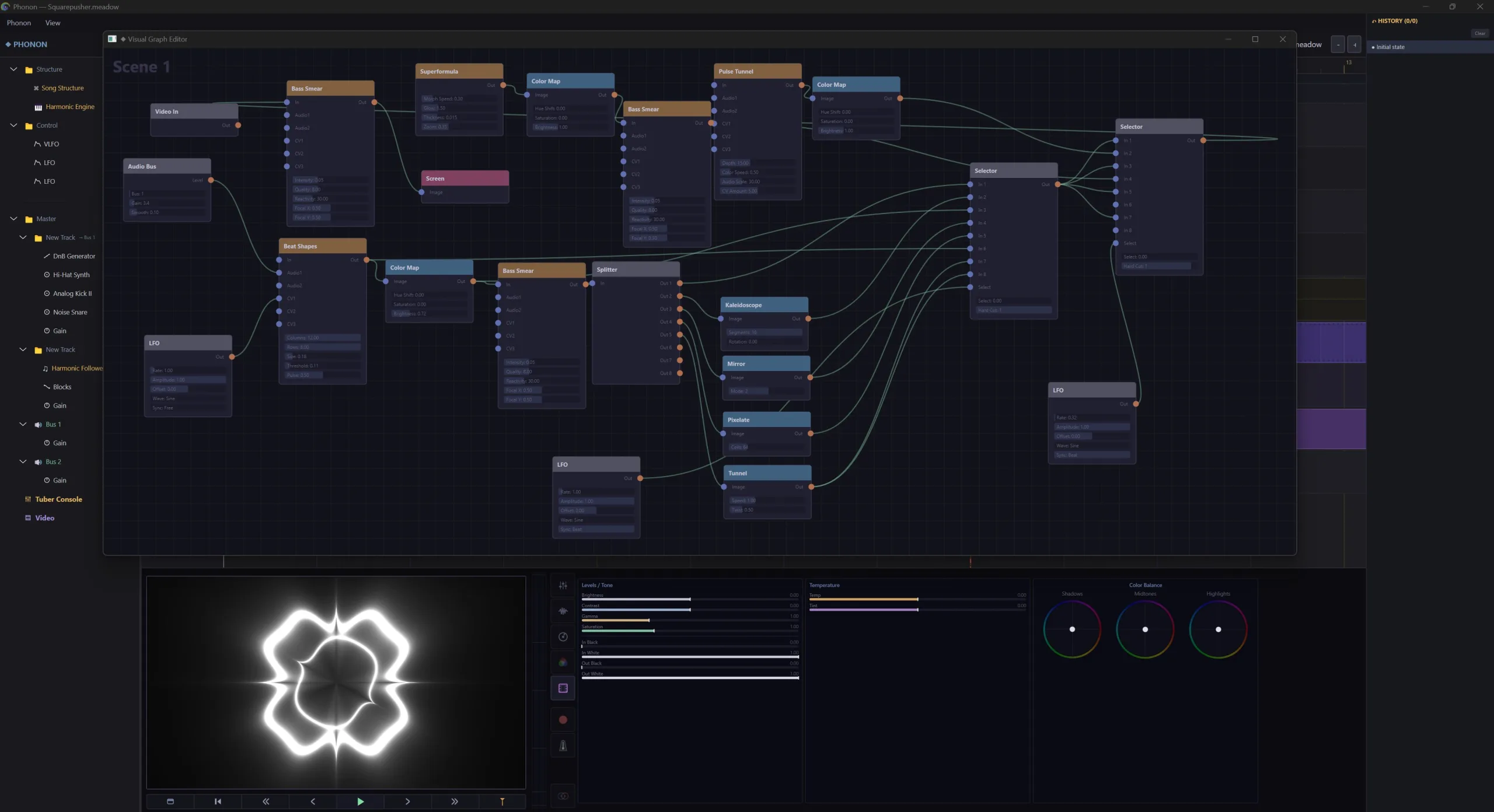
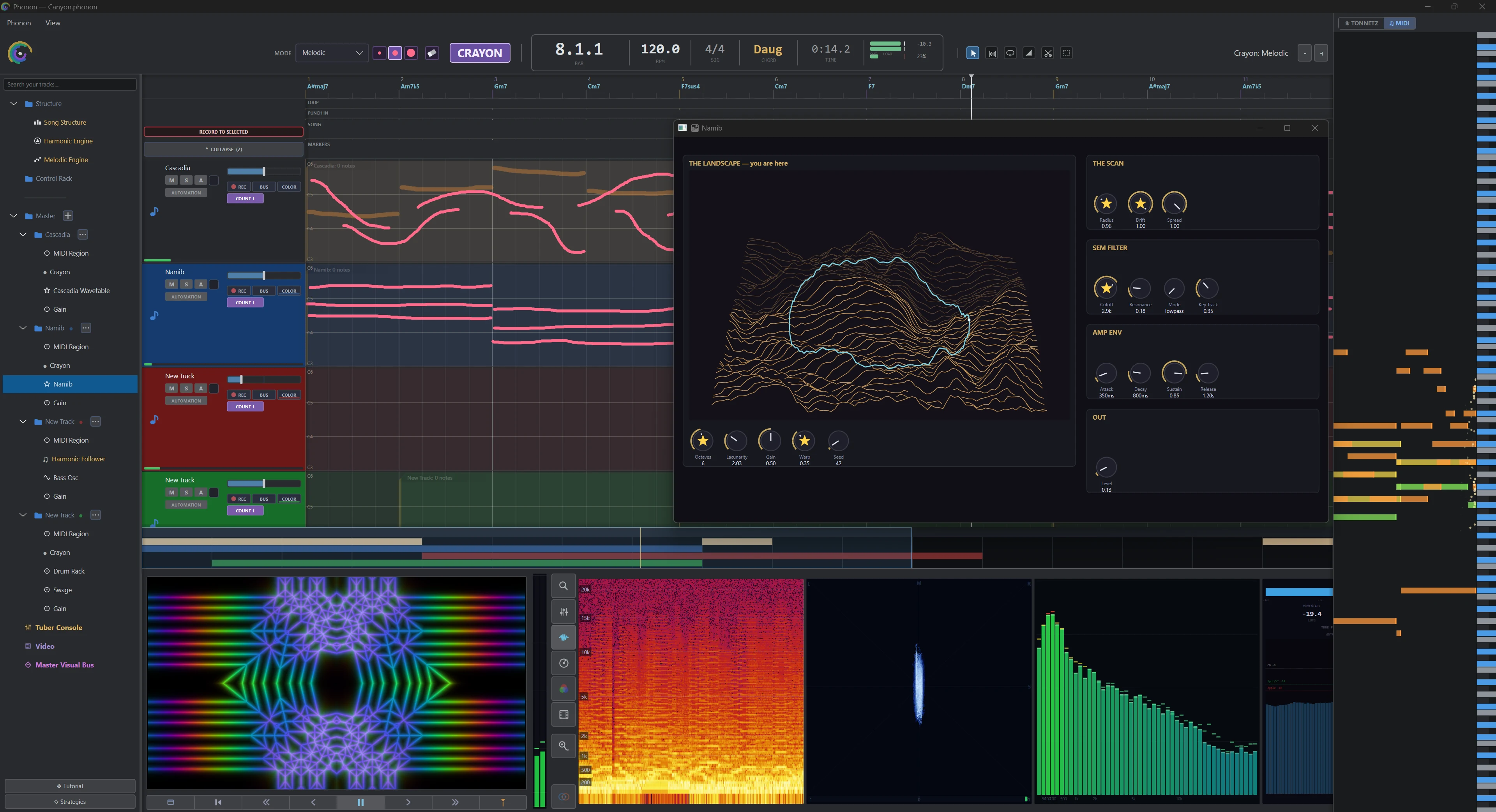
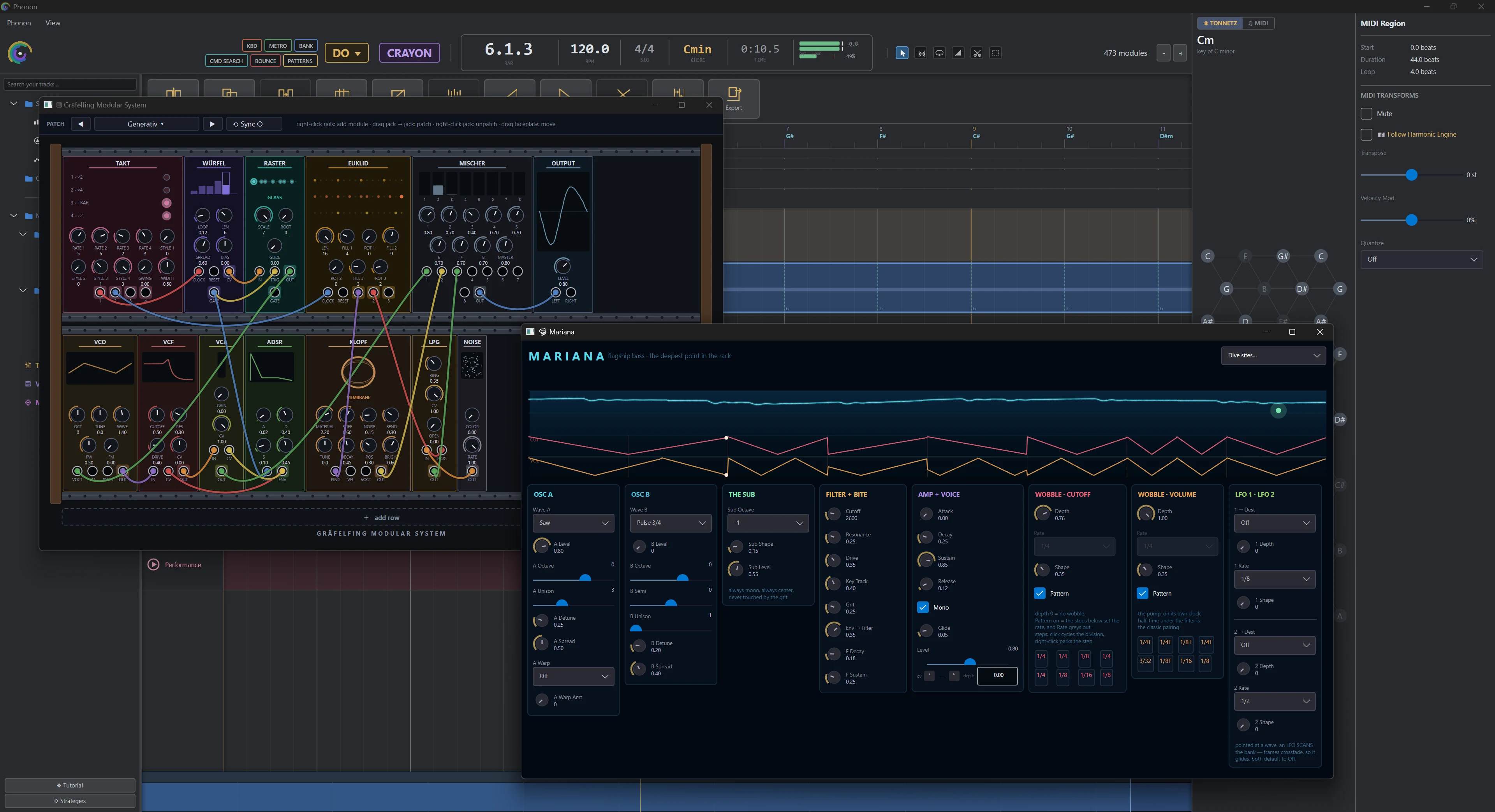
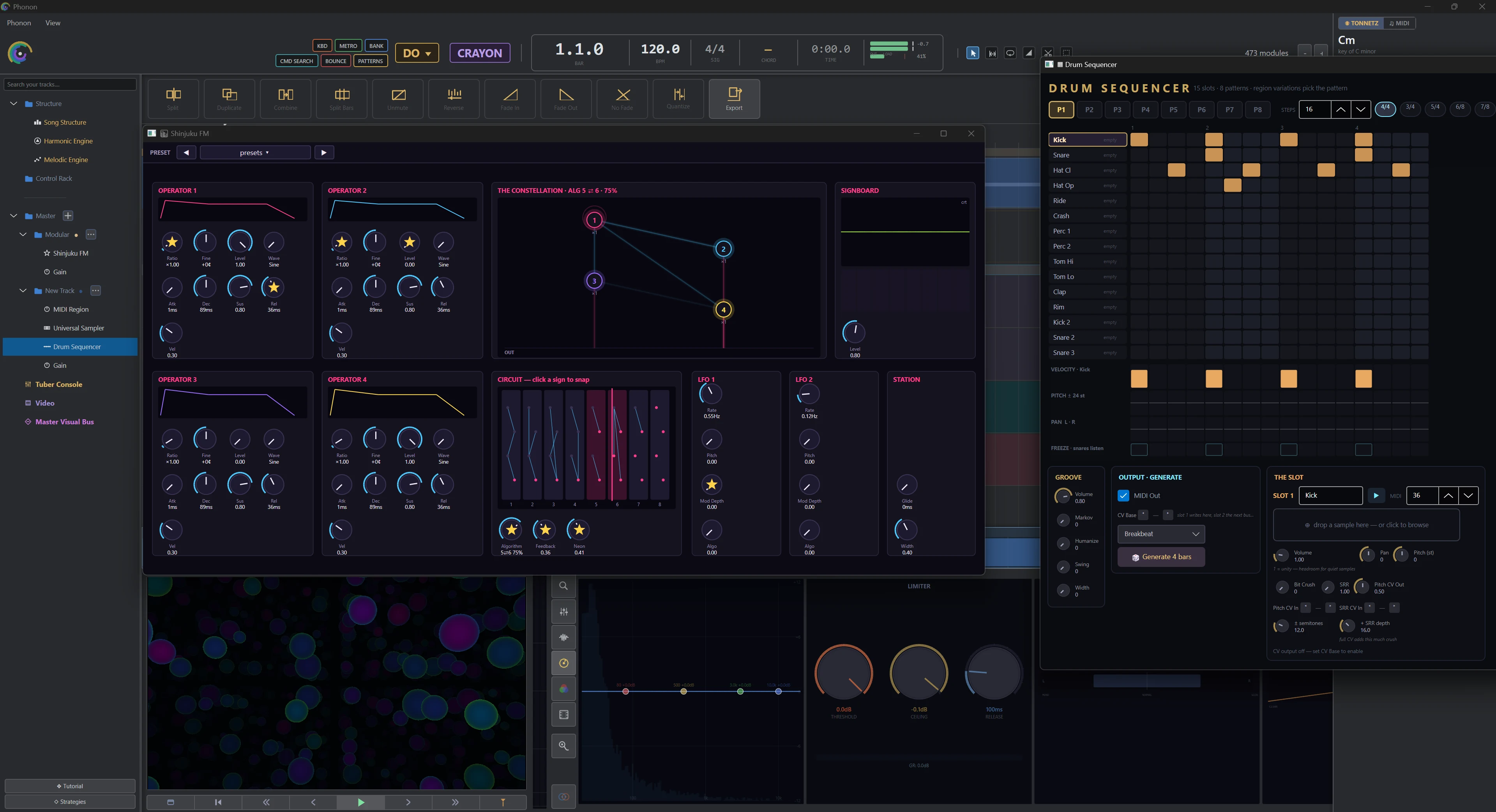
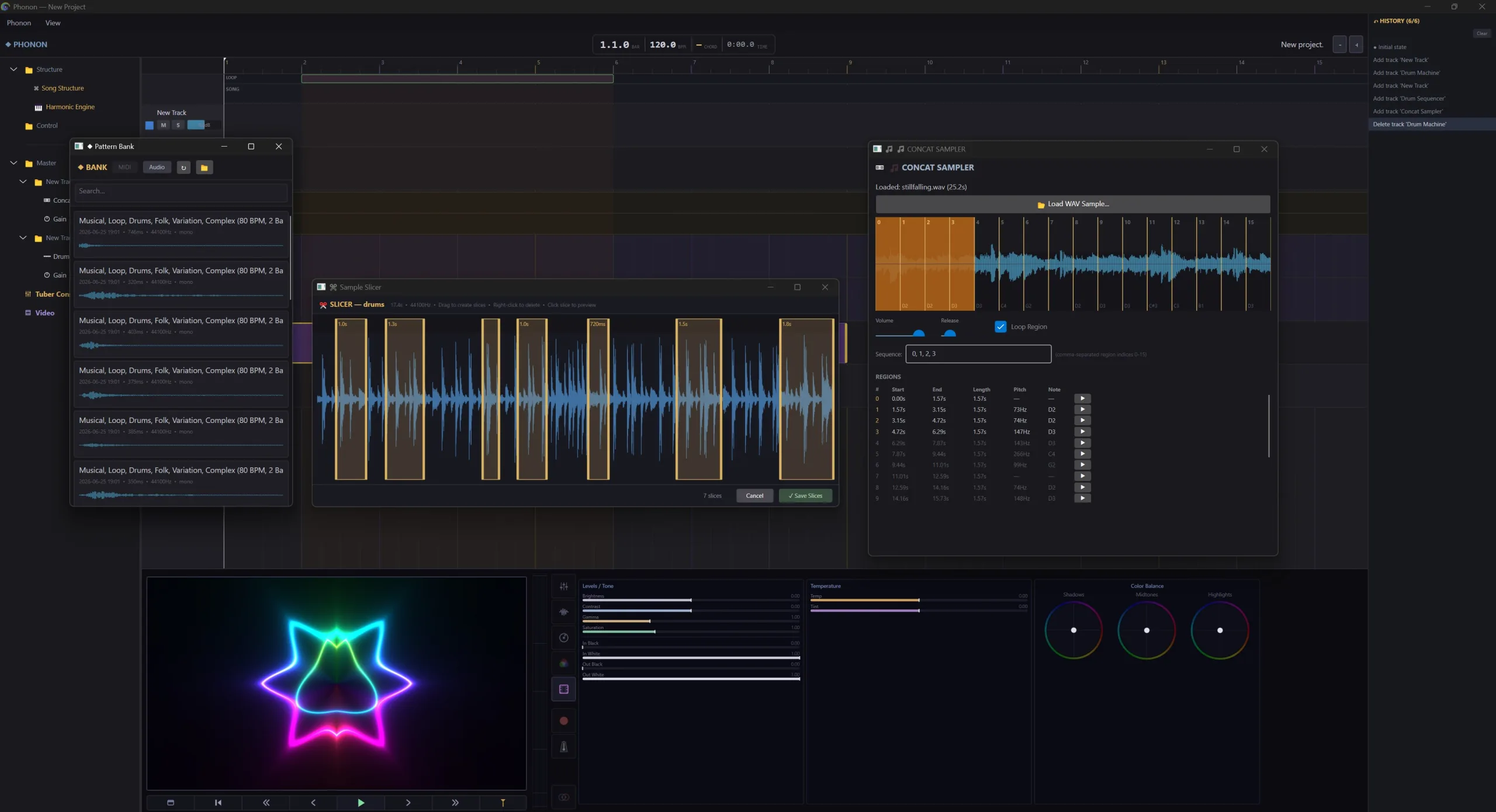
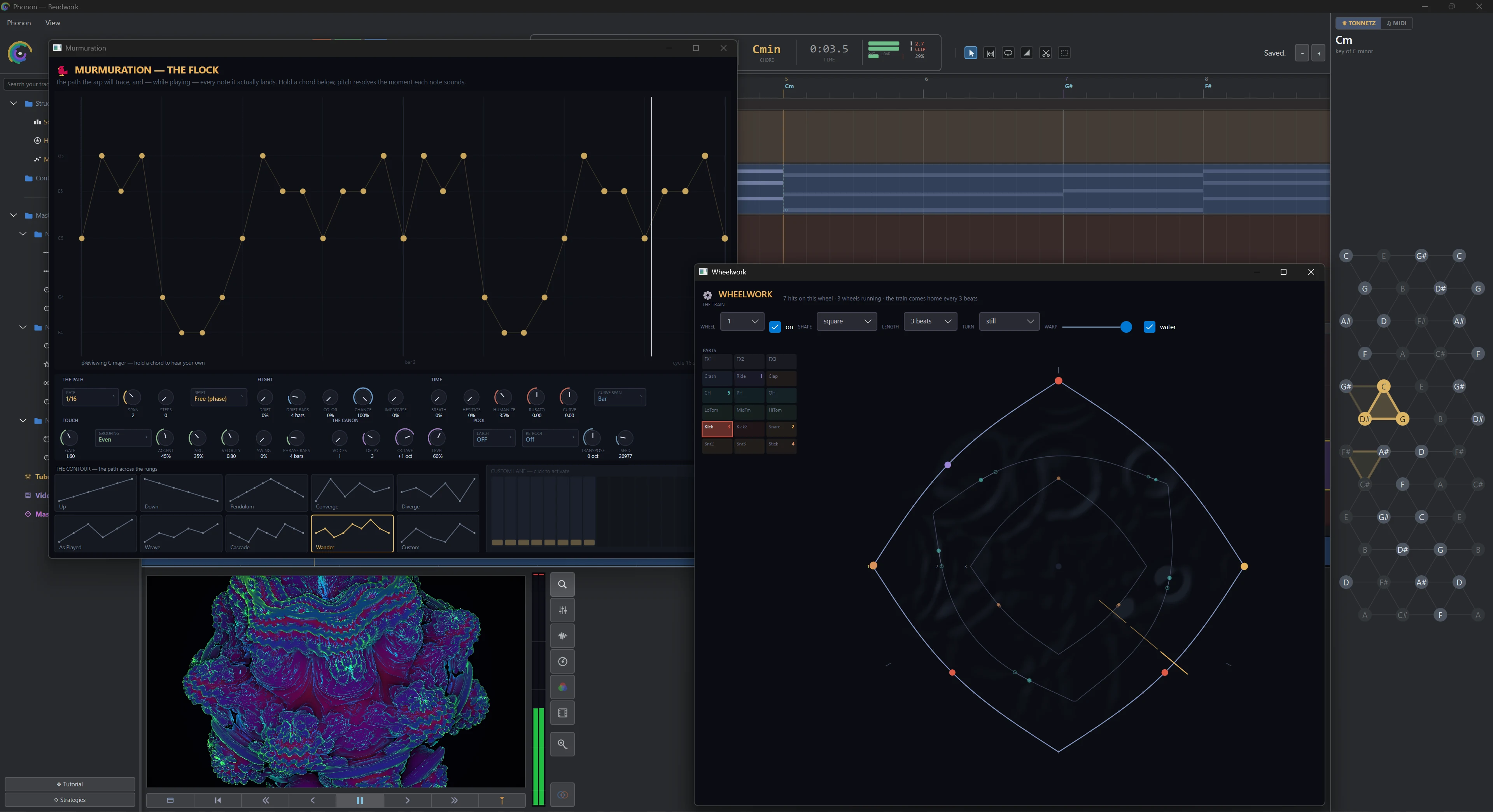
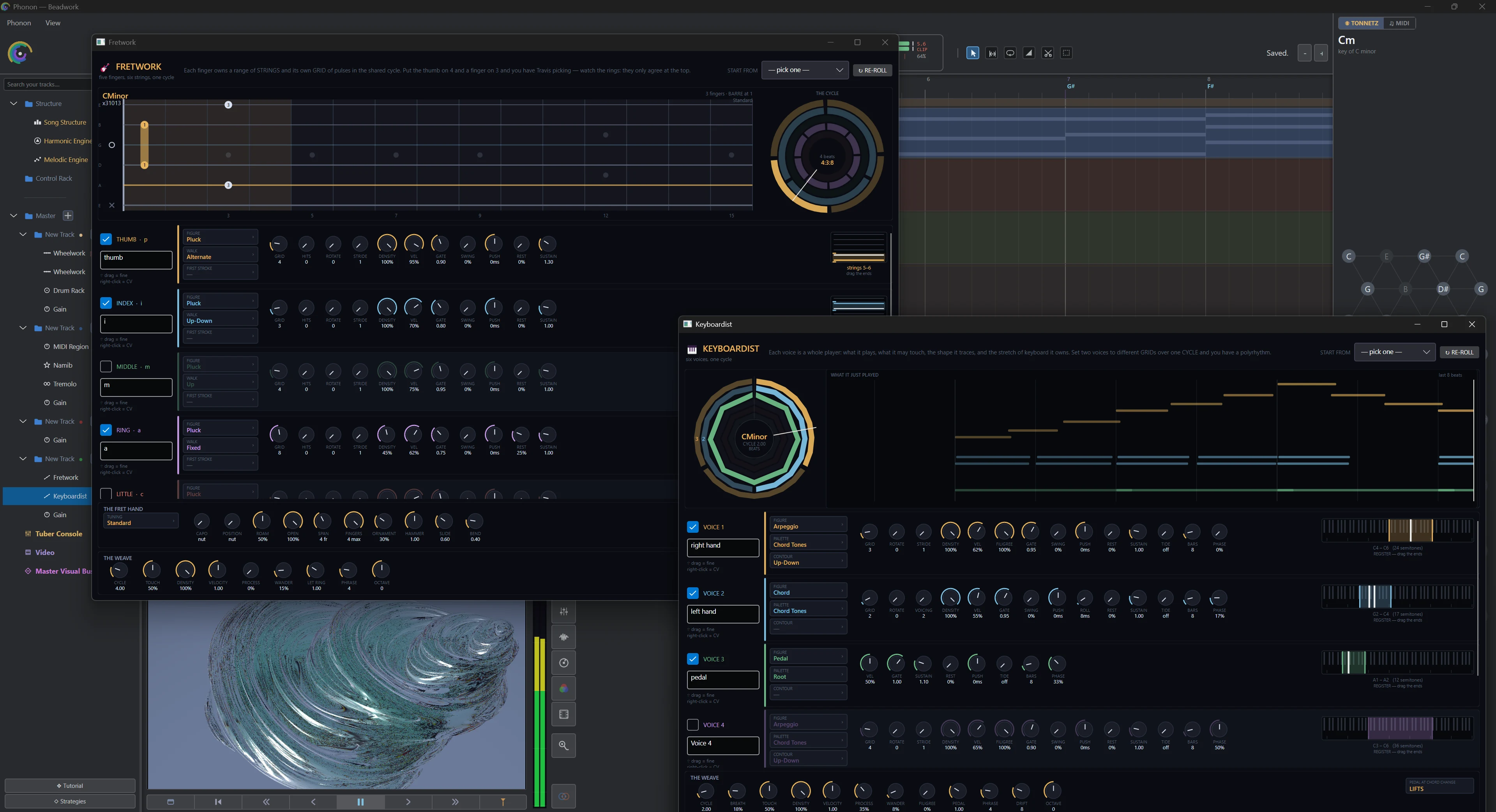
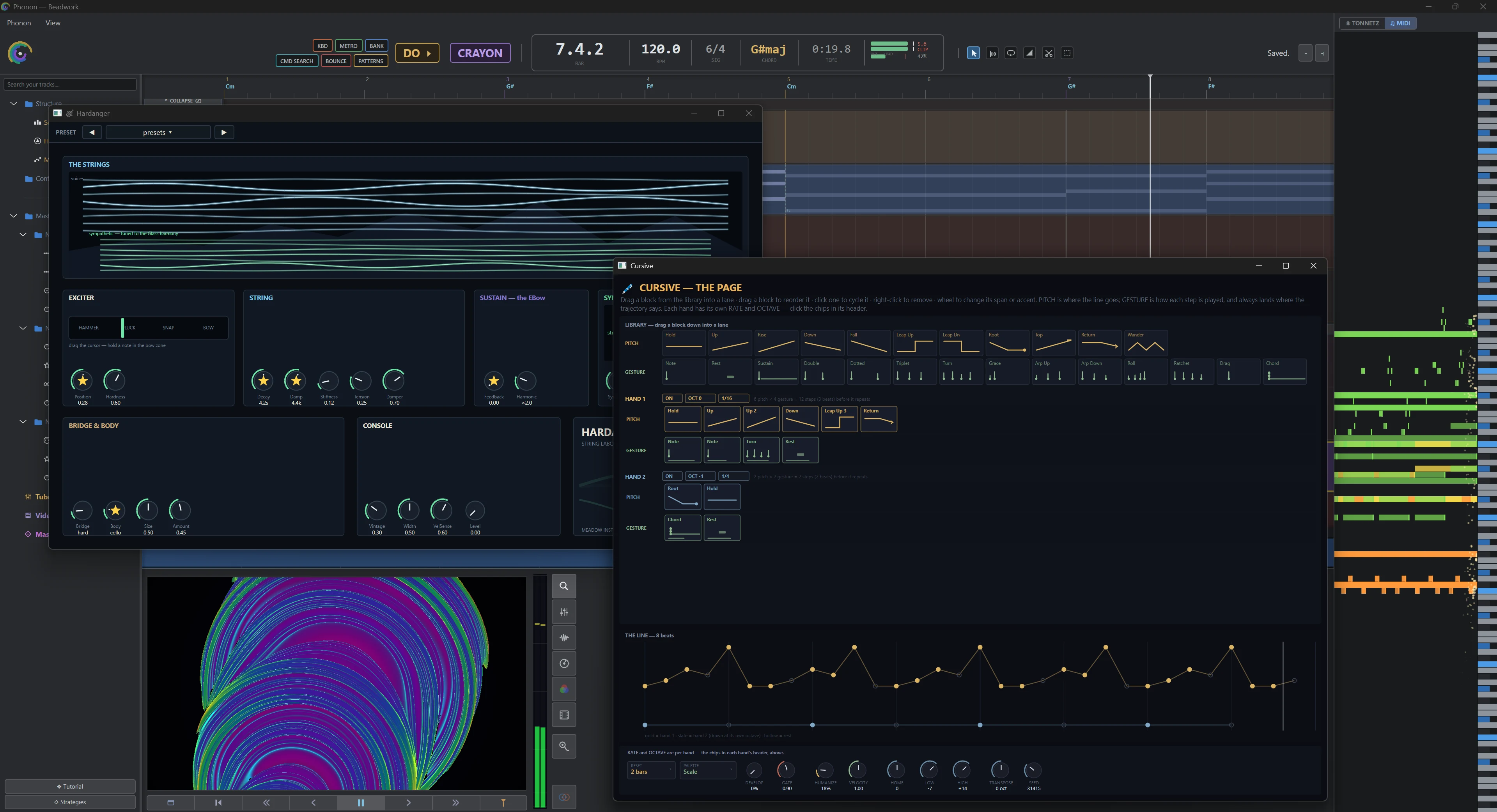
(opens the full-resolution image in a new tab)The arrangement.A session in C minor: MIDI tracks each with their own automation lane, a chord ruler along the top, markers, and the whole song laid out in the overview strip below. Cascadia - the flagship synth - is open over the timeline, the piano roll beneath it is drawing automation under the notes, and the Tonnetz lattice in the sidebar follows the harmony as it moves.(opens the full-resolution image in a new tab)Visual Graph editor.The node-based GLSL engine: Superformula, Pulse Tunnel, Beat Shapes, kaleidoscope, mirror, and pixelate nodes wired through selectors and beat-synced LFOs, with pro color grading on the render.(opens the full-resolution image in a new tab)Crayon, and the Namib terrain.Crayon in melodic mode: strokes drawn straight onto the arrangement become notes, so a line can be sketched at song scale instead of entered a note at a time. Namib is open in front of it - a wave-terrain synth where the path scanned across the landscape is the sound - with spectrogram, vectorscope, spectrum, and a live Visual Graph render running underneath.(opens the full-resolution image in a new tab)The modular system, and Mariana.Gräfelfing patched up: clock, dice, raster, and Euclidean sources across the top row feeding oscillator, filter, envelope, membrane, and low-pass gate below, wired by dragging cables between jacks. Mariana - the flagship bass - sits in front, and the inspector on the right can hand any MIDI region over to the Harmonic Engine.(opens the full-resolution image in a new tab)The Drum Sequencer.Fifteen slots and eight patterns, with region variations deciding which pattern plays where. Velocity, pitch, pan, and freeze lanes sit under the grid; Markov, humanize, and swing shape the groove; and any slot takes either a synthesized voice or a sample dropped onto it. Shinjuku FM is open alongside, its four operators wired through the algorithm view.(opens the full-resolution image in a new tab)The samplers.One sound through both samplers at once. The Universal Sampler maps zones across the keyboard - drag the blocks to remap them - with a granular engine per zone and chaos applied per trigger. Jena is the microscope beside it: the same specimen at four magnifications, from the whole file down through slices and grains to raw spectrum, with the lens pointed by clicking the stage.(opens the full-resolution image in a new tab)Wheelwork and Murmuration.Wheelwork's wheels, drawn concentrically: each ring has its own length, its own shape, and its own rate of turn, so the time map moves underneath while the written part stays exactly where you put it. The dial stands in a pool the hits disturb. Murmuration is behind it - hold a chord and the arpeggio traces whichever contour you choose.(opens the full-resolution image in a new tab)Fretwork and Keyboardist.Two generators that model a player rather than a pattern. Fretwork gives each of five fingers its own range of strings and its own grid of pulses inside one shared cycle - thumb on four against a finger on three is Travis picking, and the rings only agree at the top of the bar. Keyboardist does the same for six voices, each with its own figure, its own palette of notes, and its own stretch of the keyboard, so two voices on different grids over one cycle become a polyrhythm.(opens the full-resolution image in a new tab)Hardanger and Cursive.The Hardanger fiddle's sympathetic strings tune themselves to the session's harmony, excited by hammer, pluck, snap, or bow. Cursive writes a line by hand instead: drag pitch and gesture blocks into two independent hands and read the result on the line beneath.

 (opens the full-resolution image in a new tab)
 (opens the full-resolution image in a new tab)
 (opens the full-resolution image in a new tab)
 (opens the full-resolution image in a new tab)
 (opens the full-resolution image in a new tab)
 (opens the full-resolution image in a new tab)
 (opens the full-resolution image in a new tab)
 (opens the full-resolution image in a new tab)
 (opens the full-resolution image in a new tab)