
Analog Modeling Synthesizer
Krungus
27 oscillators. 57 filters. We simulated the whole f***ing thing.
Krungus is Aphelion's flagship analog-modeling synthesizer and research platform. Twenty-seven oscillator slots and fifty-seven filter slots, all in one instance. Every oscillator can load any of eleven circuit-modeled cores. Every filter slot can load any of nine circuit-modeled filters. And the whole instrument lives in one room, on one supply, at one age - so heat, rail sag, starvation and drift become part of the sound.
VST®3 instrument · Windows 64-bit No activationmacOS VST3 and Audio Unit are in development.
- 11 oscillator cores
- 9 filters
- 5 voices
- 256 routes
Hear it
Ten takes, as they came out.
Ten takes of Krungus, half a minute each, in stereo. Nothing has been done to them on the way here but the encoding, so some are a good deal louder than others.
0:32
0:32
0:32
0:32
0:32
0:32
0:32
0:32
0:32
0:32
The idea
Not a saw and a low-pass. Eleven cores, nine filters.
Most virtual analog synthesizers model a saw core and a lowpass filter. Aphelion goes much further.
In Krungus you choose every oscillator and every filter, and you can swap them whenever you like. Each of five slots in a voice takes any of eleven oscillator cores, and each slot's lane runs through two filters, each any of nine. Every one is a circuit written as its equations and run as you play: integrators, comparators, OTAs, diodes and transistor ladders, not a curve fitted to a recording.
Choose a core
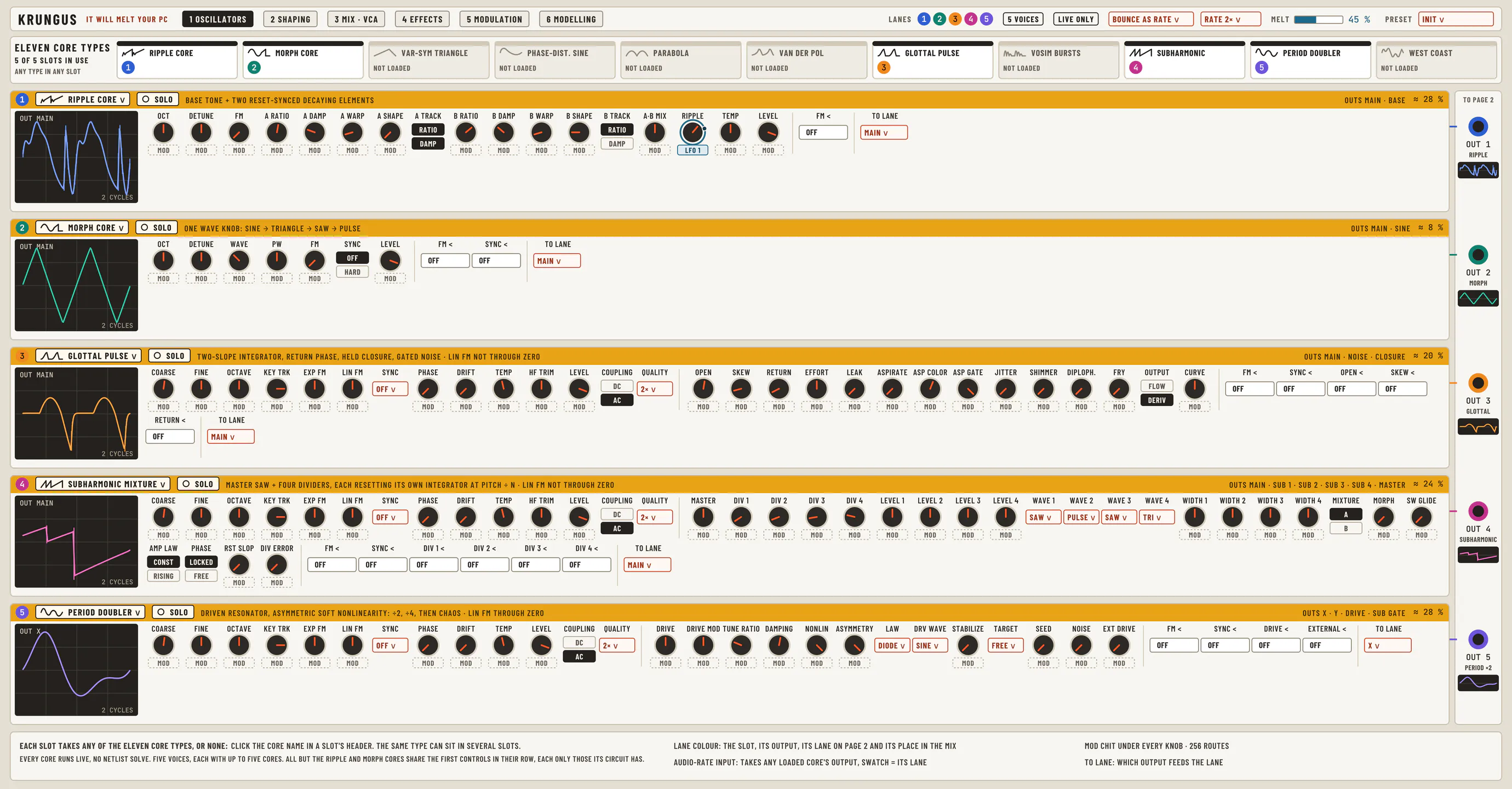
Page 1, OSCILLATORS: five slots, each with its core menu and a SOLO button. A slot keeps a full set of settings for every core type, so a core switched away and back finds its knobs where it left them.
Shape it, filter it, twice
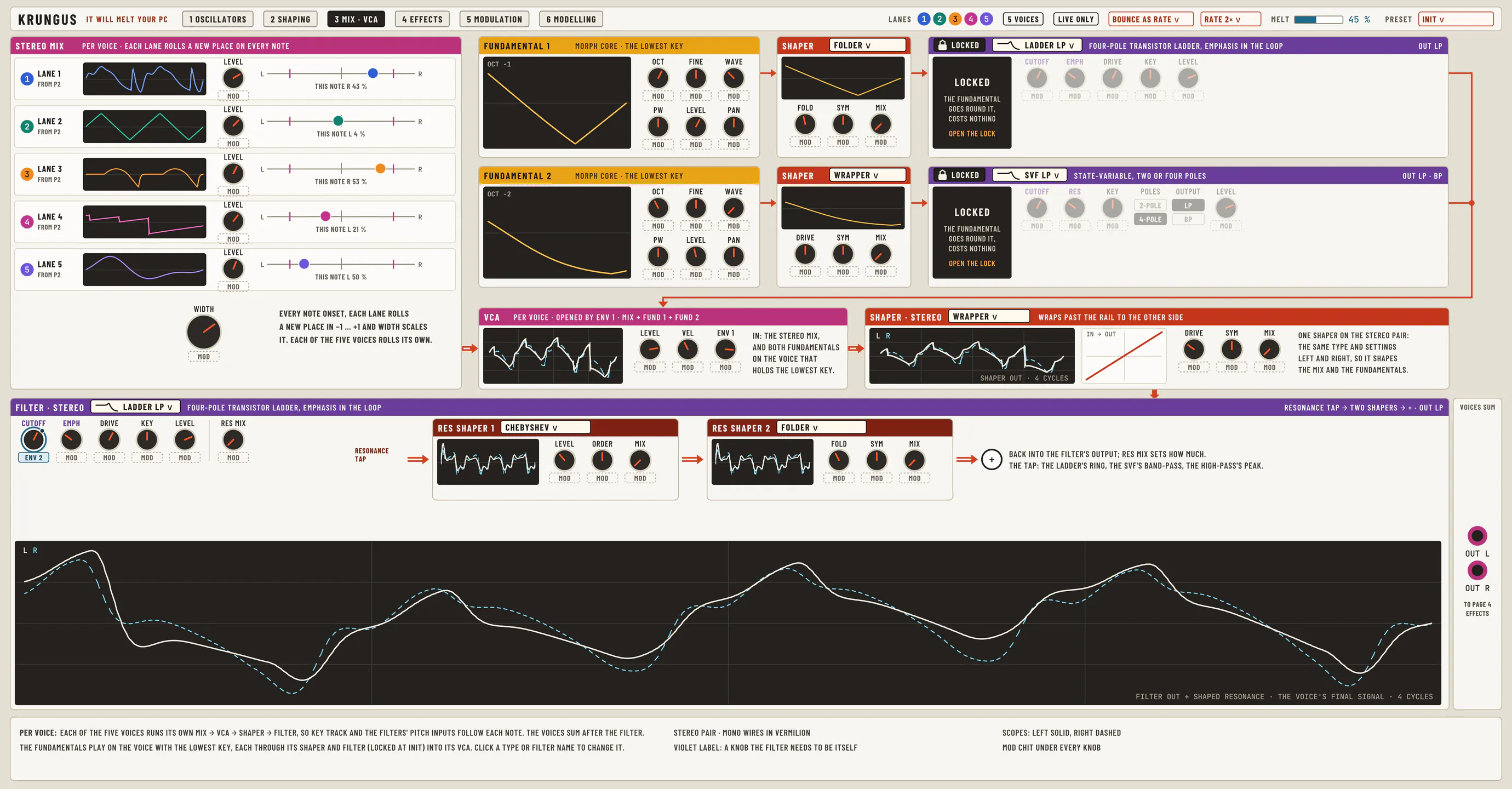
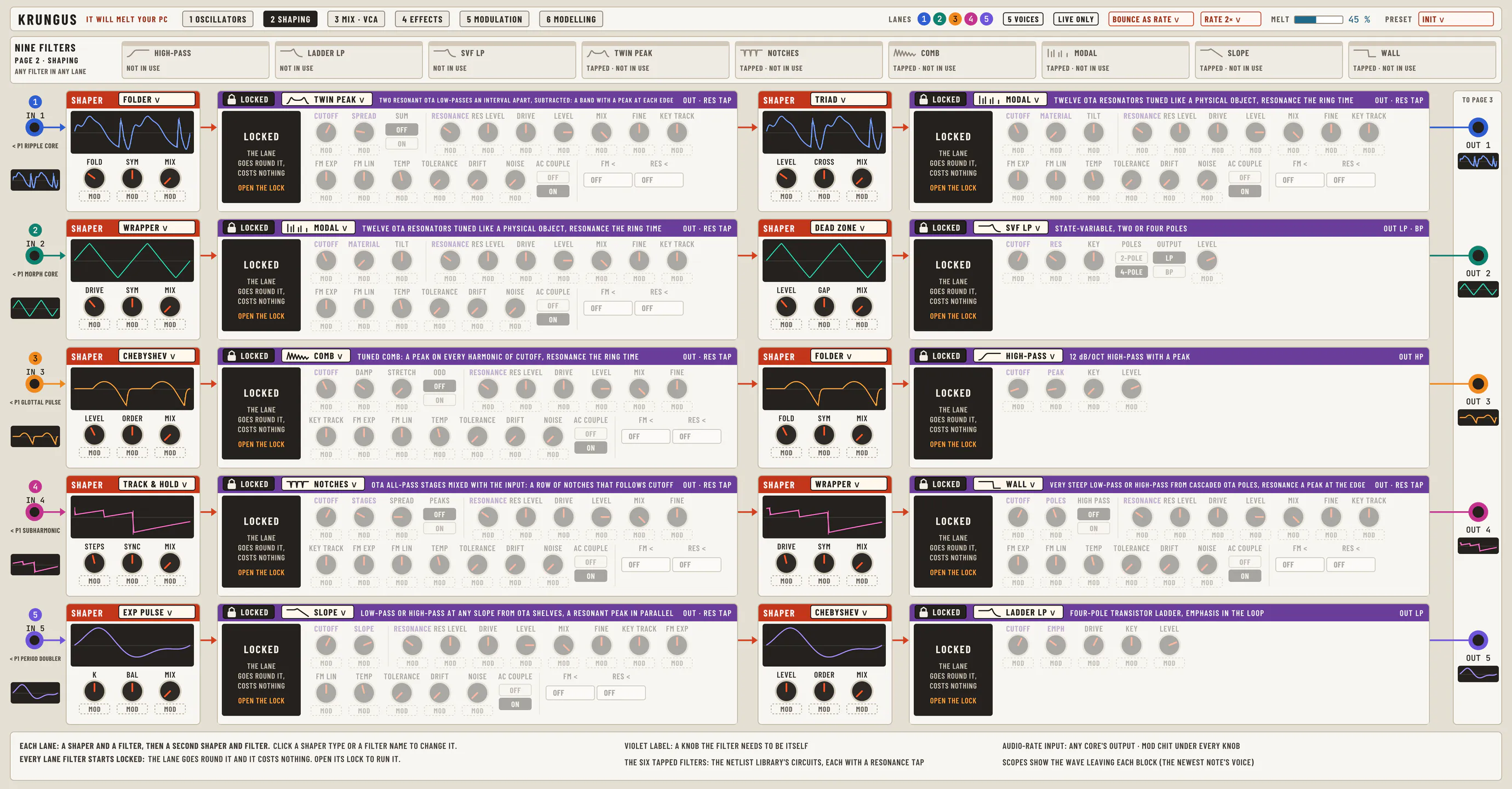
Page 2, SHAPING: every slot's lane runs IN, SHAPER, FILTER, SHAPER, FILTER, OUT. The ten lane filters start LOCKED and open one at a time with their padlocks; a locked plate's knobs still answer, so a filter can be set up before it is heard.
Then the whole case
Page 6, MODELLING: the room, the supply, the age of the parts, and five voice cards, each a little different from the others, as the cards in one case are.
Page 1 · Oscillators
Eleven oscillator cores, each a circuit.
Each core is the circuit inside it, modeled: where its comparators flip, where its integrators reset, how its nonlinear parts bend. Where a core has edges and corners, they are drawn at the instants they fall, between samples; where it has none, its equations are integrated as finely as the moment needs. Every core runs oversampled. The nine from VARIABLE-SYMMETRY TRIANGLE on share fourteen common controls, COARSE, FINE, OCTAVE, KEY TRK, EXP FM, LIN FM, SYNC, PHASE, DRIFT, TEMP, HF TRIM, LEVEL, COUPLING and QUALITY; the ripple and morph cores keep their own.
RIPPLE CORE
A base tone and two decaying elements, each restarted by the core's reset, so every cycle carries two bursts of ripples whose ratio, damping, warp and shape are knobs.
OUTMAIN · BASE
MORPH CORE
A saw core and its waveshaper, with one WAVE knob that runs sine to triangle to saw to pulse, and hard sync.
OUTMAIN · SINE
VARIABLE-SYMMETRY TRIANGLE
An OTA integrator and a Schmitt trigger with separate charge and discharge currents, so the triangle leans into a ramp either way, each segment bendable toward an RC curve, through a clipper.
OUTMAIN · PULSE · RISE GATE · FALL GATE
PHASE-DISTORTED SINE
The lopsided triangle into a sine shaper, an OTA or a diode network, with a window comparator that can distort each half-cycle on its own.
OUTMAIN · PHASE · PULSE
PARABOLA
A saw (or triangle) core into one or two integrators, each with a leak and a DC servo: the saw's spectrum falls as 1/n, the parabola's as 1/n², the cubic's as 1/n³.
OUTMAIN · SAW · PARABOLA · CUBIC · PULSE
VAN DER POL
Two integrators in a loop with a nonlinear damping element: a sine at low MU, a slow drift and a fast snap at high MU. Inject a signal and it locks to it or is pulled by it.
OUTX · Y · DAMPING
GLOTTAL PULSE
A two-slope integrator: a slow opening, a fast closing, an RC return and a held closed phase, with breath noise gated by the flow. The source half of a voice.
OUTMAIN · NOISE · CLOSURE
VOSIM BURSTS
A reset oscillator of sin² pulses, a pulse counter, an attenuator stepped once a pulse and a silent gap: the pulse rate is a formant, the burst rate the pitch, and the two are independent.
OUTMAIN · STAIRCASE · CLOCK
SUBHARMONIC MIXTURE
A master saw and four dividers, each counting the master's resets and discharging its own integrator every N of them. Two whole mixtures, A and B, crossfaded by MORPH.
OUTMAIN · SUB 1 · SUB 2 · SUB 3 · SUB 4 · MASTER
PERIOD DOUBLER
A resonator driven at the played pitch through a one-sided nonlinear element. Raise the drive and it takes two cycles to repeat, then four, then eight, then never: the period-doubling route to chaos.
OUTX · Y · DRIVE · SUB GATE
WEST COAST
The variable-symmetry triangle, or its OTA sine, through a VCA (TIMBRE) and an offset (SYMMETRY) into five op-amp folding cells in parallel with a direct path, summed into an integrator that rolls off at 1.33 kHz. Each cell folds where its op-amp meets its rail.
OUTMAIN · SOURCE
The RIPPLE CORE is the oscillator the Colossarium is built on. Two fundamentals ride beside the slots, each with a WAVE and a PW of its own and its own shaper and filter, on the voice holding the lowest key.
Page 2 · Shaping
Nine filters, every one resonant.
Any of them in either of a lane's two places, on a fundamental, or in MIX · VCA. Every one has a resonance tap, what its resonance adds taken off on its own: in MIX · VCA it runs through two RES SHAPERS and back in at RES MIX. The six from TWIN PEAK on are OTA circuits that share one block of controls: RESONANCE, RES LEVEL, DRIVE, LEVEL, MIX, FINE, KEY TRACK, FM EXP, FM LIN, TEMP, TOLERANCE, DRIFT, NOISE and AC COUPLE.
HIGH-PASS
A Sallen-Key high-pass whose two resistors are transistors, with a diode-limited peak loop: 6 dB per octave, as its circuit is wired.
LADDER LP
A four-pole transistor ladder, its emphasis inside the loop.
SVF LP
A state-variable filter of two or four poles.
TWIN PEAK
Two resonant OTA low-passes an interval apart, one taken from the other: a band with a peak at each edge.
NOTCHES
OTA all-pass stages mixed with the input: a row of notches, or of peaks, that follows CUTOFF.
COMB
A tuned comb, a peak on every harmonic of CUTOFF, RESONANCE its ring time.
MODAL
Twelve OTA resonators tuned like a physical object: a string, a bar, a membrane, a bell. RESONANCE is the ring time.
SLOPE
A low-pass or high-pass at any slope, whole poles and the fractions between them from OTA shelves, with a resonant peak in parallel.
WALL
A very steep low-pass or high-pass from cascaded OTA poles, its resonance a peak at the edge.
One part is ideal. No analog part delays a signal by a whole period across the audio band, so the COMB's delay is a delay line; everything around it, the summer, the damping, the coupling and the stretch, is circuit. On the six, TOLERANCE and NOISE are the circuits' own: every OTA offset, integrator rate and resistor ratio drawn for each filter in each voice, and noise at every summing node. At 0 and off, each is its circuit exactly.
Against ngspice
Every core against its circuit.
Each core's and each filter's circuit is built as a SPICE deck and simulated in ngspice, a circuit simulator that shares no code with ours, and the live model runs beside it at the same settings. A core is compared harmonic by harmonic, a filter through its response from 20 Hz to 20 kHz.
As of 2026-11-12The figures will move as the work goes on. A row reads Not run where no comparison is recorded; no figure on this page is an estimate.
| Core | dB |
|---|---|
| RIPPLE CORE | 0.024 |
| MORPH CORE | 0.19 |
| VARIABLE-SYMMETRY TRIANGLE | 0.04 to 0.07, per setting |
| PHASE-DISTORTED SINE | 0.02 to 0.06, per setting |
| PARABOLA | 0.0011 |
| VAN DER POL | 0.0014 |
| GLOTTAL PULSE | 0.0045 |
| VOSIM BURSTS | 0.049 |
| SUBHARMONIC MIXTURE | 0.091 |
| PERIOD DOUBLER | 0.0039 |
| WEST COAST | 0.026 |
The rms of the level differences on every harmonic above -70 dB, across every setting checked. The MORPH CORE's is its saw, and mostly a level offset: its level cell runs 0.18 dB loud. The VARIABLE-SYMMETRY TRIANGLE and the PHASE-DISTORTED SINE come from an earlier run, which kept each setting's figure and no overall one.
| Filter | dB |
|---|---|
| HIGH-PASS | 0.079 |
| LADDER LP | 0.309 |
| SVF LP | 0.078 |
| TWIN PEAK | 0.008 |
| NOTCHES | 0.057 |
| COMB | 0.079 |
| MODAL | 0.125 |
| SLOPE | 0.016 |
| WALL | 0.002 |
The rms of the level differences across the response within 20 dB of its peak, across every setting checked.
Why don't the others show you these numbers?
- Most don't have them. Some fitted a curve to a bit of data. We laid out every component in a netlist, simulated it, and compared it in ngspice against the model used in your synthesizer. Two completely different solvers that agree within fractions of a decibel.
- They're probably not that accurate. For too long the synthesizer industry has relied on vague handwaving in place of verifiable facts. "Authentic analog warmth." It wasn't just you - there really is a difference. We just made that difference so small that it's functionally inaudible.
Download every figure (CSV) Worst and best cases, waveform error, pitch, loud inputs and notes, for all eleven cores and nine filters.
The reference circuits share one idiom: one-pole op-amps (50 MHz, 100 dB at DC, soft ±13.5 V rails), fast comparators and ideal current sources, and each deck says what it idealizes. This compares the model with its circuit, not with a particular piece of hardware.
Page 6 · Modelling
One case, one supply, five voice cards.
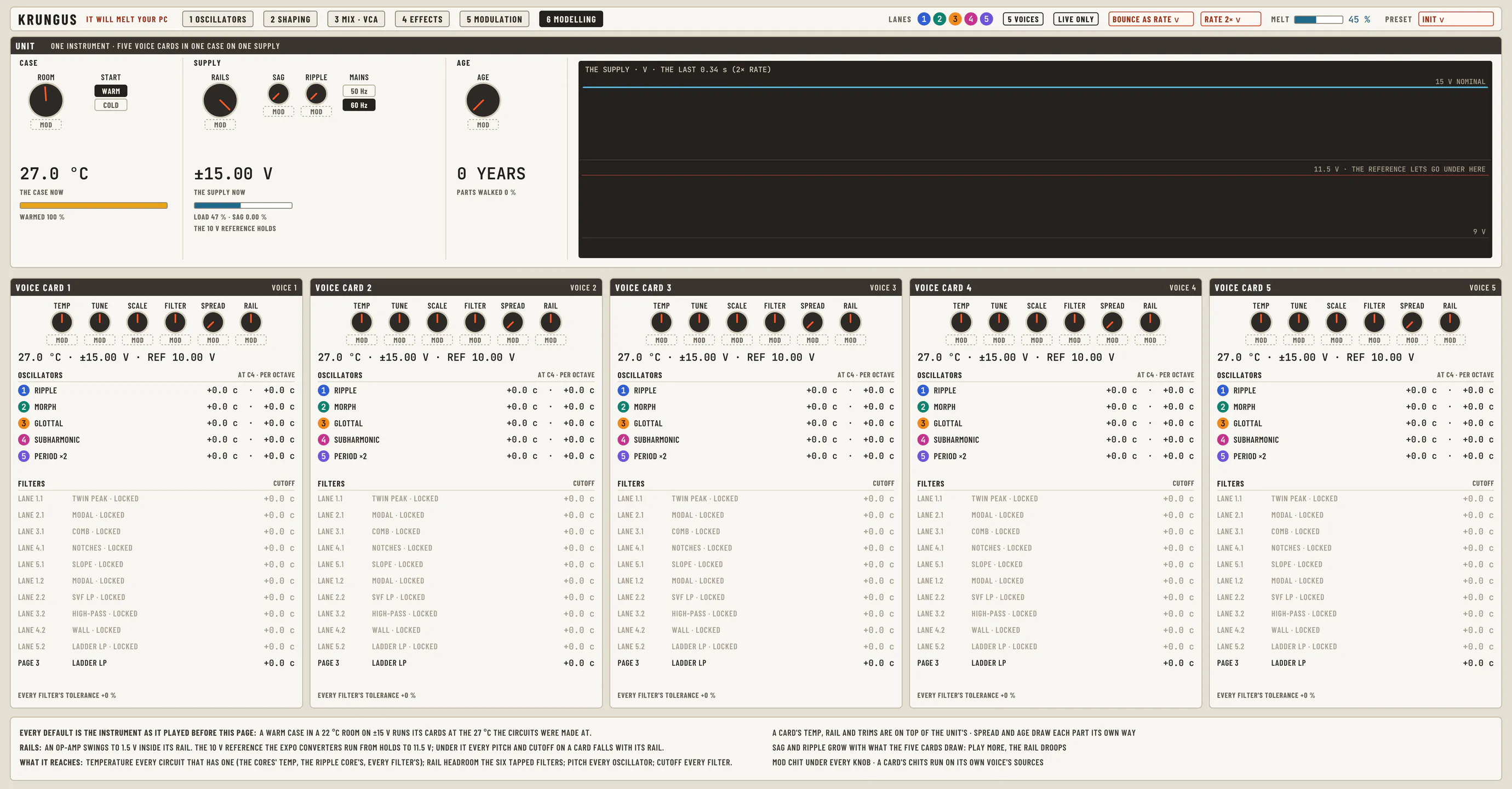
The MODELLING page plays Krungus as one instrument in one case: five voice cards on one power supply, in one room, at one age. Cool the room and every card cools with it. Load the supply and every card's rails sag together. Age the case and its parts drift the way parts drift. Then each card can be set a little apart from the others, as no two cards in a real case are quite alike.
UNIT
- ROOM5 to 40 °C
- The room the case stands in. The case runs 5 °C above it, so a warm case in a 22 °C room holds its cards at 27 °C.
- STARTWARM · COLD
- Started cold, the case climbs to its running temperature over about seven minutes, and everything that has a temperature follows it.
- RAILS±9 to ±15 V
- The supply. An op-amp swings to within 1.5 V of its rail, so lower rails clip sooner. The 10 V reference the exponential converters run from holds down to 11.5 V; under that, every pitch and cutoff on a card falls with the rail, and above it the reference leans a cent for each percent of rail lost.
- SAG0 to 100 %
- The rail droops with what the five cards draw, each drawing harder with its ENV 1 open, through a 30 ms reservoir: up to 6 % with all five flat out.
- RIPPLE0 to 100 %
- The reservoir's sawtooth at twice the mains frequency, up to 0.6 V, deeper with the load.
- MAINS50 Hz · 60 Hz
- Which mains the supply is on, and so where its ripple sits.
- AGE0 to 50 years
- Parts walk on a curve that flattens with time: each oscillator's tuning and tracking its own way, every filter's cutoff upward as its capacitors dry, every filter's TOLERANCE raised.
VOICE CARD 1 to 5
- TEMP±15 °C
- This card's own temperature, on top of the case's.
- TUNE±50 cents
- Every oscillator on the card.
- SCALE±2 %
- The card's tracking, pivoting on A4.
- FILTER±100 cents
- Every filter the card carries.
- SPREAD0 to 100 %
- The scatter of the card's parts: each oscillator and each filter off its own way, every TOLERANCE raised.
- RAIL±1.5 V
- The card's own regulator, on top of the unit's RAILS.
A card's knobs take MOD chits like any other, driven by that card's own voice.
At its defaults, nothing moves
The circuits were drawn at 27 °C on ±15 V, and a warm case in a 22 °C room runs its cards at exactly that. So the page at its defaults is the instrument sample for sample, and every turn of a knob is a departure from the drawing, in the direction the circuit would go.
It shows what it is doing: the case's temperature and warm-up, the supply, its load and sag, whether the reference holds, a scope of the rail; and on each card its temperature, rail and reference, each oscillator's pitch at C4 and per octave, and each filter's cutoff offset.
What it reaches
- Pitch
- Every oscillator, the slot cores and the two fundamentals alike. Temperature drifts it too, once, on the card, as each oscillator's converter would.
- Cutoff
- Every filter: the six tapped filters, the ladder's and the state-variable filter's current, the high-pass's corner.
- Temperature
- Inside every core, the parts that shape its wave, never its pitch; and every filter.
- The supply
- The six tapped filters' summers and cells, the ripple core's zeners, the morph core's comparator, the fundamentals, the WEST COAST's VCA, and the PERIOD DOUBLER where it runs at its swing.
- Scatter and age
- Every core and every filter, inside its own circuit, each slot of each voice with its own set of parts.
Not yetThe VCA, the shapers and the effects still hold their temperature and rails as constants.
And the rest of it
It will melt your PC.
That is the panel's own subtitle, and it means it. Five voices of five cores and up to ten lane filters each, every circuit running at once, the voices side by side on worker threads: that is why the lane filters start locked.
RATE · BOUNCE
2×, the default, runs the voices at twice the host's rate; 1× at the host's, for when the machine needs it. The cores oversample again inside, by their own QUALITY. Set BOUNCE to 4× and an offline render runs the same voices at four times the host's rate, every stage lined up to land where it does live.
SOLO
On every slot, as on a mixing desk. A muted slot still runs, so it can still feed another slot's FM or a filter's inputs, and soloing one slot never changes what another hears from it.
MIX · VCA
The fundamentals' rows, the VCA, a stereo shaper, and two RES SHAPERS in series on the filters' resonance taps, with a RES MIX of their own.
EFFECTS
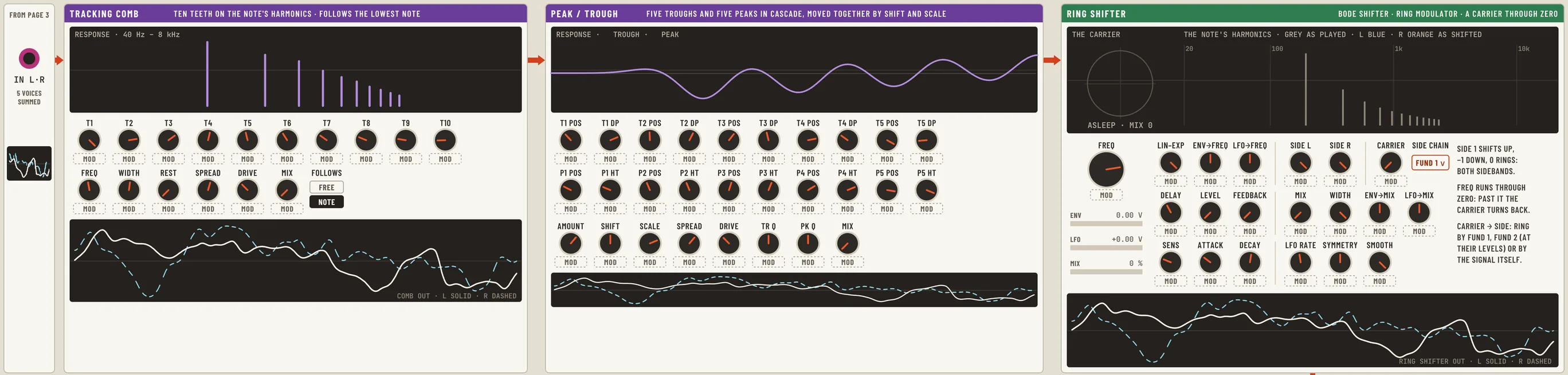
A tracking comb and a peak / trough cascade, both Ramjet's, a ring shifter, a lamp phaser, a flanger of two bucket-brigade decks and a bucket-brigade chorus, every one off or at MIX 0 in INIT.
MODULATION
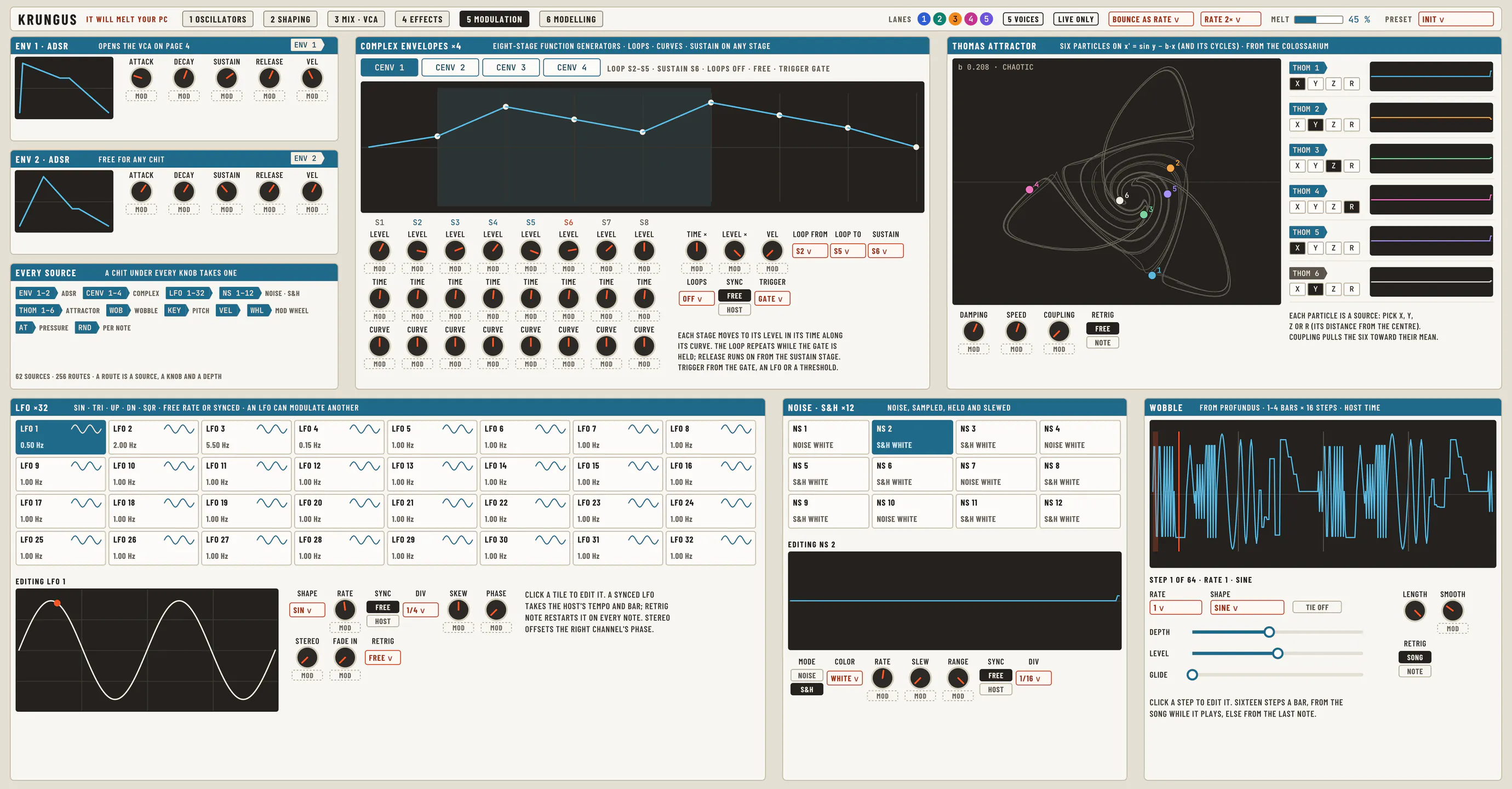
Thirty-two LFOs, twelve noise and S&H sources, two envelopes and four complex envelopes of eight stages, the Thomas attractor's six particles and the WOBBLE, into a pool of 256 routes.
INIT
A true init: every effect and every wave shaper at MIX 0 and the lane filters locked, so what is heard first is five cores through one ladder.
Analog Modeling Synthesizer
Krungus
27 oscillators. 57 filters. We simulated the whole f***ing thing.
Every core and filter in Krungus lives in our circuit library, beside the circuit it models, where the next instrument will find it. Krungus is where they all play at once.
At a glance
Krungus specifications
| Format | VST®3 instrument · Windows 64-bit |
|---|---|
| In development | macOS VST3 and Audio Unit |
| Requires | 64-bit Windows 11, in any version Microsoft still supports. When the Mac version ships: macOS 15 or later, on Apple silicon or Intel. |
| Machine | A 15-inch MacBook Pro with its display set to More Space and an M3 Pro Apple silicon chip or better, or the Windows equivalent, to run comfortably with a few filters turned on at 1x live quality setting. To run at 2x or with many filters we suggest an M5 Max or Ultra. Most users will find 1x and a few filters satisfies the vast majority of use cases. |
| Voices | Five |
| Oscillator slots | Five a voice, each with SOLO · two fundamentals on the voice holding the lowest key |
| Oscillator cores | RIPPLE CORE · MORPH CORE · VARIABLE-SYMMETRY TRIANGLE · PHASE-DISTORTED SINE · PARABOLA · VAN DER POL · GLOTTAL PULSE · VOSIM BURSTS · SUBHARMONIC MIXTURE · PERIOD DOUBLER · WEST COAST |
| Filters | HIGH-PASS · LADDER LP · SVF LP · TWIN PEAK · NOTCHES · COMB · MODAL · SLOPE · WALL |
| Lanes | IN · SHAPER · FILTER · SHAPER · FILTER · OUT, the lane filters LOCKED until opened |
| MIX · VCA | The fundamentals · the VCA · a stereo shaper · a filter · two RES SHAPERS on its resonance tap |
| Effects | A tracking comb · peak / trough · a ring shifter · a lamp phaser · a flanger of two bucket-brigade decks · a bucket-brigade chorus |
| Modelling | UNIT: ROOM, START, RAILS, SAG, RIPPLE, MAINS, AGE · VOICE CARD 1 to 5: TEMP, TUNE, SCALE, FILTER, SPREAD, RAIL |
| Modulation | 32 LFOs · 12 noise and S&H sources · 2 envelopes · 4 complex envelopes · a Thomas attractor of six particles · WOBBLE · 256 routes |
| Rate | 2× or 1× the host's · BOUNCE 4× in an offline render |
| Engine | Every circuit live, in playback and in a bounce · no netlist |
| Validation | Every oscillator core and every filter against its circuit in ngspice |
| The panel | 1840 by 960 |
| Activation | None. No license server, no phone-home |
| Security updates | Until November 2031 |
| License | License agreement · Facts sheet |

VST is a registered trademark of Steinberg Media Technologies GmbH.