
⚠️ Tyrian Blue is unapologetically massive, and needs a screen of 2560 × 1440 (1440p) or higher.
Eight-Voice Component-Modelled Polysynth
Tyrian Blue
Twenty-four circuits. One instrument in royal blue.
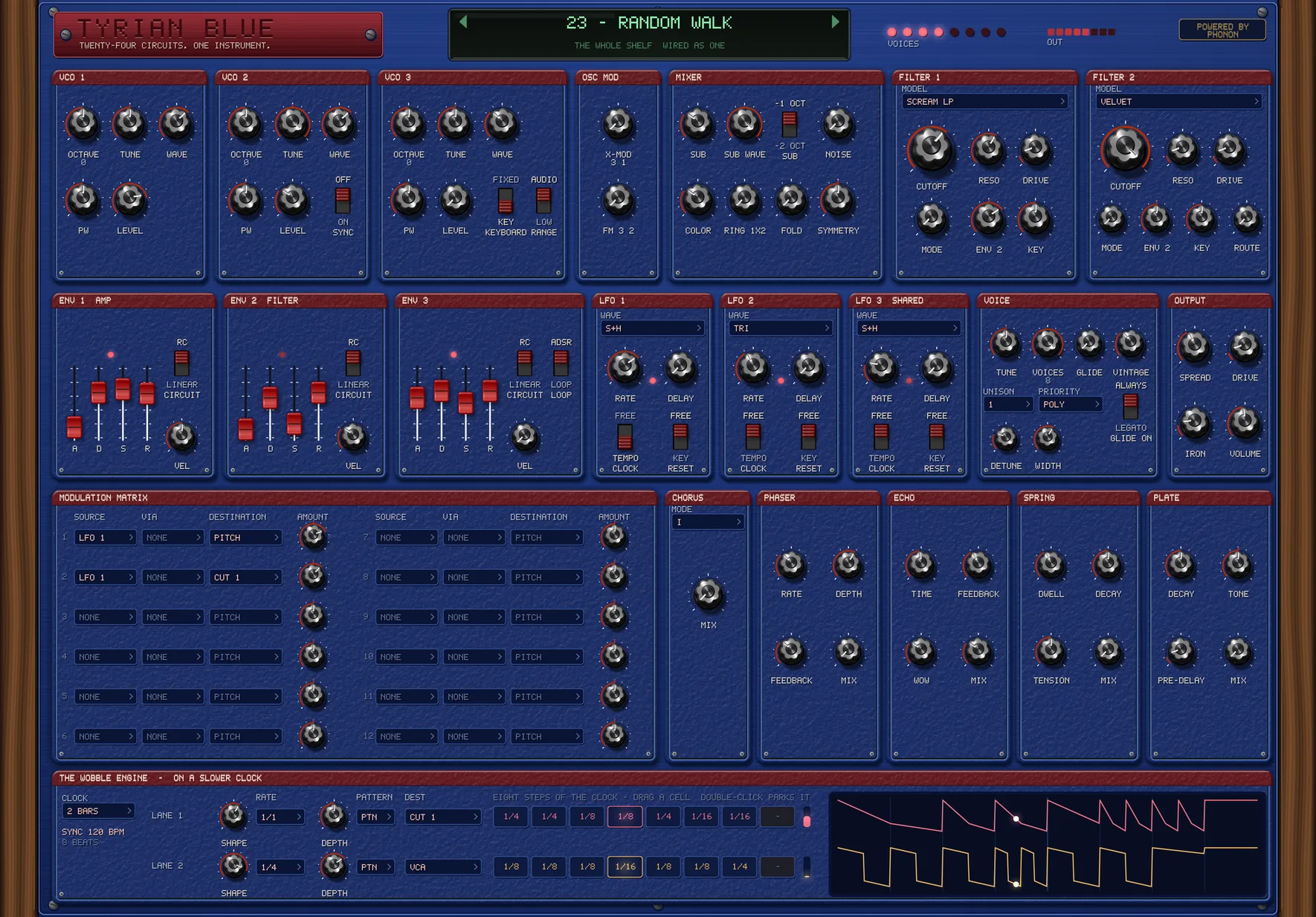
Tyrian Blue is what happens when you take every circuit on the shelf and wire them the way a big polysynth wires them. Three oscillators with real exponential converters. Two filter slots, nine circuits to choose from in each. Three envelopes you can switch between two different envelope circuits. A twelve-slot modulation matrix. Five effects, each a machine rather than an algorithm wearing its name. Eight voices, and a knob that decides how alike they are. Nothing in the signal path is a curve fitted to a sound: every stage is a circuit, solved.
VST3 · Windows 64-bit·No activationmacOS VST3 and Audio Unit are in development.
“It makes noise.”
Three a voice
And the third one does the interesting things
Each is a saw core behind a real exponential converter, with a wave knob that sweeps sine through triangle and saw to pulse. The second locks to the first with SYNC. The third cross-modulates the first through the converter, drives the second through a thru-zero linear FM input, can let go of the keyboard and sit at one pitch, and can drop six octaves to become a fourth LFO. Beside them a sub-oscillator that is a real divider off the first oscillator's core, so it cannot drift against it; a noise source from white to pink; and a wavefolder on the whole mix.
Nine cycles counted in two seconds, which is the arithmetic and the measurement agreeing with each other.
One of two new circuits
A ring of diodes, not a multiply
Every ring modulator worth the name was four diodes between two transformers, and that is not multiplication. The diodes are a switch the carrier steers, so the carrier's LEVEL is a timbre: hot, it chops; around the diodes' knee, it is closer to a clean product; under it, nothing conducts.
And no four diodes match, so a real ring leaks a thin whistle of its inputs under every bell. Turn VINTAGE up and you are turning up exactly that.
220 Hz against a 299 Hz carrier
The sum and the difference
-30 dBFS
Both sidebands, where they should be.
Both inputs, suppressed
-111 dBFS
A matched ring cancels its inputs. This is what matched looks like.
The same inputs, VINTAGE at full
-58 dBFS
The diodes no longer match, so the inputs come back through - 53 dB of leak that was not there a knob-turn ago.
Two slots
Nine filters, and a MODE that means nine things
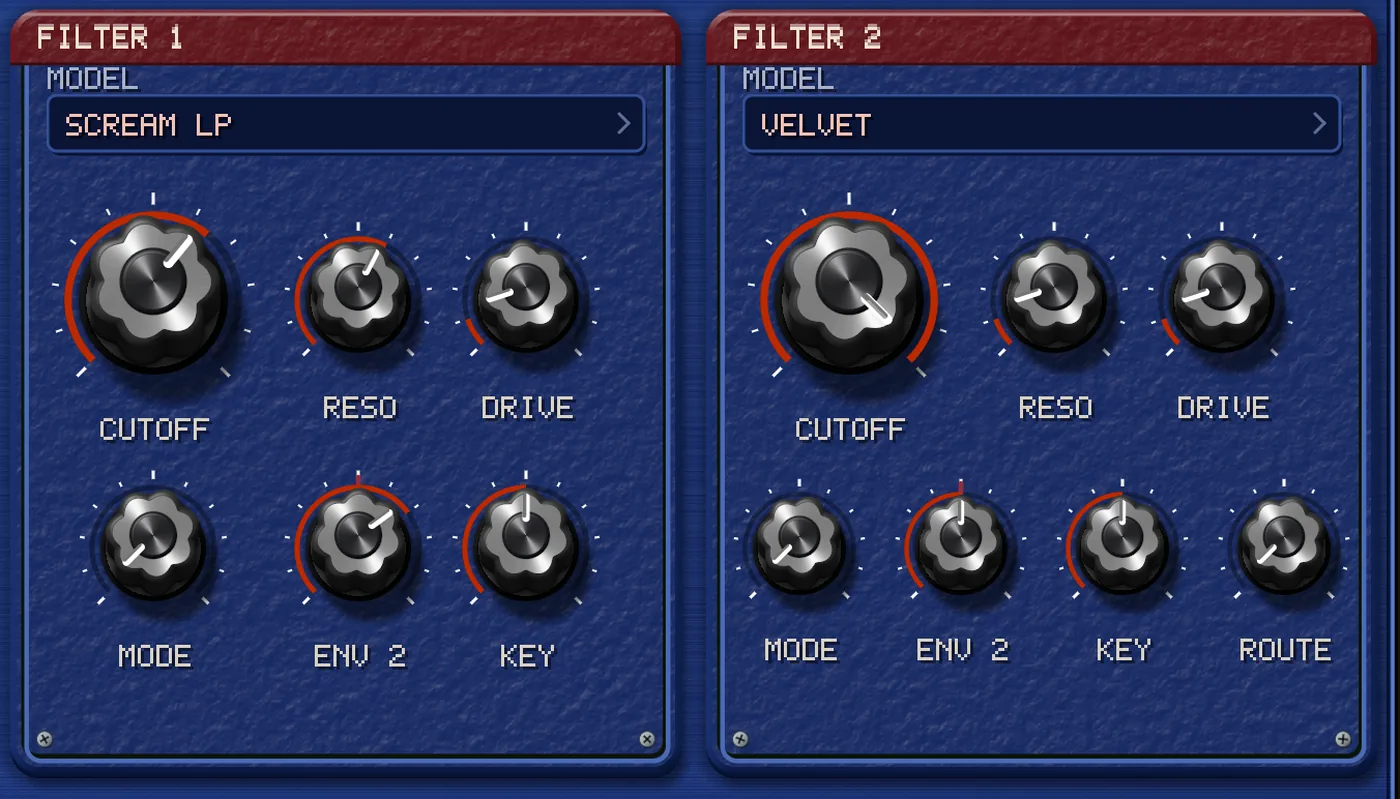
Each slot is one of nine circuits, and the two run in series, in parallel, or anywhere between. Eight of them pass a saw's fundamental within 2.6 dB of each other, so changing circuit changes the character rather than the level.
The four-stage transistor ladder, solved with its feedback loop closed inside the sample.
MODE
A pole switch, 24 down to 6 dB per octave.
At full resonance, on a 1 kHz knob
926 Hz
Its MODE takes the upper harmonics from 80 dB under the fundamental to 31.
A switch on each of the three
Two kinds of envelope
RC is the discrete envelope: a capacitor charged through a resistor toward a rail above the peak, so the attack is convex and pops. LINEAR is the other circuit - the envelope chip, charging the same capacitor from a constant current, so the attack is a straight line that lands.
Both reach the peak at the time the slider says, and they arrive within 5 milliseconds of each other. Halfway there, they are in different places, and that is the entire reason there is a switch. Both run all the time, so it is seamless mid-note.
Twelve slots
612 ways to fill one of them
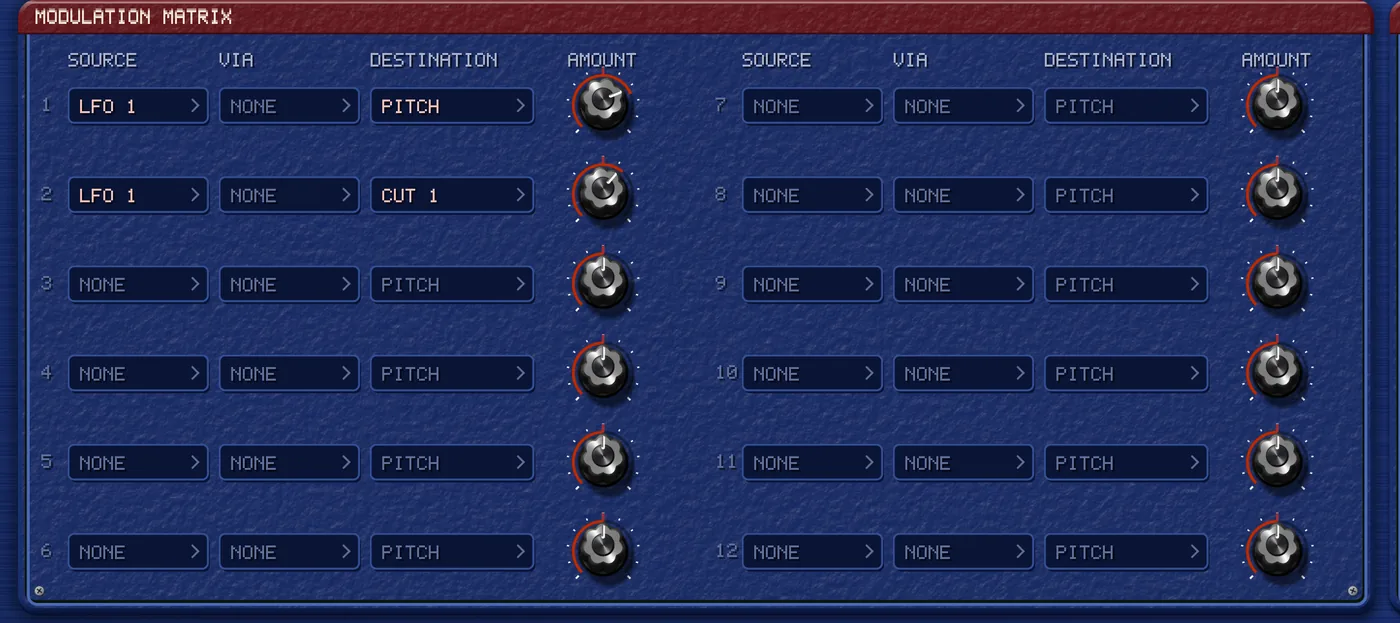
17 sources and 36 destinations, and a VIA on every slot - a second source that scales the first, which is how the wheel brings in vibrato. The matrix is summed per voice, per sample, so the third oscillator and the noise are audio-rate sources and a filter can modulate its own cutoff.
Every one of the 36 destinations was tried, one at a time, against a reference render. Every one audibly moves the sound. None of them breaks it.
Borrowed from the bass synth
The wobble engine, on a slower clock
Along the bottom of the panel is the wobble engine from Hadal Black, Aphelion's bass synth, ported whole and then slowed down. Two lanes. Each has a shape that morphs from sine through triangle and saw to square, a rate from thirteen tempo divisions, a depth, and eight cells that can each pick their own division - or park the lane open for that step. Each lane points at any of the 36 destinations, and both lanes are matrix sources as well.
16seconds a sweep at 120 BPM, locked to the host
The lane into the VCA closes it completely and never swings past closed into the other phase, because what it is closing is a real amplifier rather than a number being multiplied.

After the voices
Five machines, not five algorithms
A bucket-brigade chorus where the LFO modulates the chip's clock rather than the delay. A phaser with six stages ganged to one vactrol, so the sweep rises faster than it falls. A tape echo whose TIME knob is motor speed, so turning it bends everything already on the loop. A three-spring tank that disperses. A plate: eight bending-wave paths across a sheet of steel. Before all of them, a class-A transistor stage and an output transformer that saturates on flux, so the bass barks before the treble notices.
The second harmonic goes up because the transistor is asymmetric and the third because the iron is not. Those are different numbers for the same reason.
One knob over the whole instrument
VINTAGE, and eight circuit boards
Eight voices are eight circuit boards, and no two boards were ever built from identical parts. VINTAGE scales every tolerance at once: the oscillators' tracking and offsets, the filters' cutoffs and cell offsets, the envelope capacitors, the ring's diodes, and a warm-up - the oscillators' die climbing from room temperature over the first ninety seconds after the instrument loads.
At zero, the eight voices are one circuit, exactly. It is also strictly the same instrument every time: two fresh copies differ by nothing, sample for sample.
Eight voices on one note
VINTAGE at zero
0.0 cents
One circuit, eight times over.
VINTAGE at full
15.5 cents
Eight boards that were never going to agree.
The warm-up at full, 22 to 40 degrees
13 cents
A3 moving over the first two minutes. At zero it moves 0.0.
Demos
13 samples, played by us
Straight out of the plugin, no processing on the way here, levels matched so you can move between them without reaching for the volume.
Three Tyrian Blue patches layered together.
The wobble engine gently doing its thing.
People in glass houses...
Modulation and a phaser.
Gentle plinks and plonks.
Arpeggios with a touch of reverb.
The wobble engine, dry as a bone.
The demented organ.
Cross modulation, modulated.
Echo-o-o-o.
A classic filter sweep.
Just plain pretty.
The kitchen sink.
The sheet
What is in the box
Every figure on this page came off the measurement suite: 63 claims, checked under the shipping build. On the machine it was timed on, eight voices on the heaviest preset render about three times faster than realtime - that is one machine, and not a promise about yours.
Powered by Phonon
The whole shelf, wired as one
Tyrian Blue adds two circuits to the Phonon engine - the diode ring modulator and the current-source envelope - and quotes the rest from the catalogue: the ladders, the OTA cells, the vactrol, the bucket brigade, the iron. The plugin and the DAW can never drift apart in sound.
VST3 · Windows 64-bit - macOS VST3 and Audio Unit are in development. No activation, and the plugin never asks who you are.
At a glance
Tyrian Blue specifications
| Format | VST3 instrument · Windows 64-bit |
|---|---|
| In development | macOS VST3 and Audio Unit |
| Voices | 8 · unison of 1, 2 or 4 · poly, mono or legato |
| Per voice | 3 oscillators, divider sub, noise, diode ring, wavefolder |
| Filters | 2 slots × 9 circuits · MODE each · series to parallel |
| Envelopes | 3 · RC or constant-current, switchable mid-note |
| LFOs | 3 · two per voice, one shared by all of them |
| Matrix | 12 slots · 17 sources, 36 destinations, VIA on each |
| Wobble engine | 2 lanes × 8 steps · 13 divisions · 1, 2, 4 or 8 bars |
| Effects | Class-A stage, transformer, chorus, phaser, echo, spring, plate |
| Vintage | Every tolerance and the warm-up, from one knob |
| Controls | 167 · 24 presets · phosphor readout |
| The panel | 1520 by 1060 |
| Measured | 63 claims · validator 47 of 47 |
| Instances | Sample-identical, two fresh copies |
| Activation | None. No license server, no phone-home |
| Engine | Two new circuits in Phonon: the diode ring and the current-source envelope |