
Component-Modelled Hi-Hat
Tin Snips
Finally, it exists. A dedicated hi-hat synth.
Nobody builds a dedicated hi-hat. There is no business case for one: it is the cheapest sound in any drum machine, eight bars of tick-tick-tick, and the last thing anybody would sell on its own. It is also the part you notice the moment it is wrong - the one that decides whether a bar hurries or leans back. So here is one, built the way a synthesizer gets built.
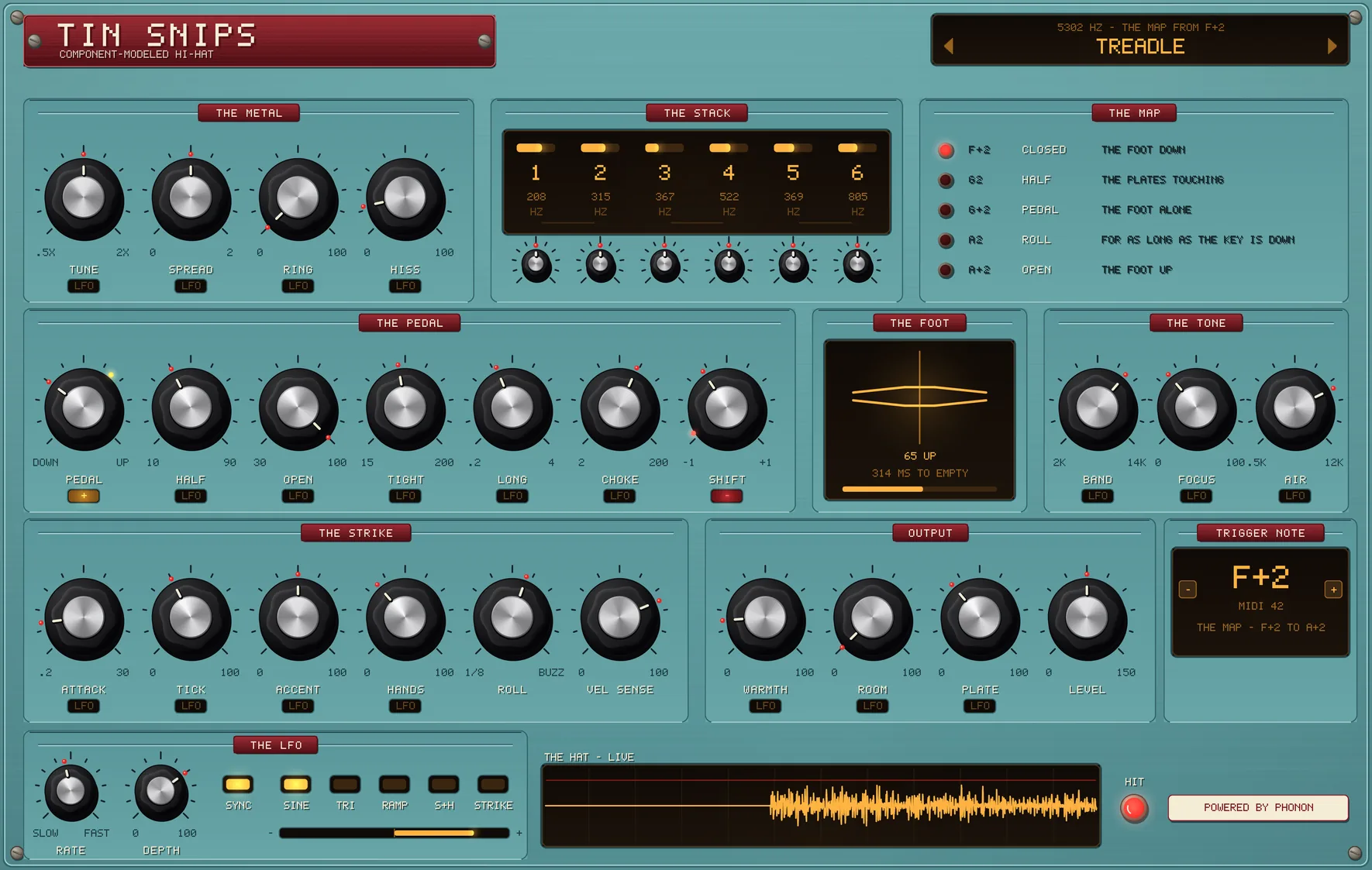
In the classic circuit an open hi-hat and a closed one are the same six oscillators with two different capacitors, and a transistor that dumps one when the other fires. That is why a programmed hat sounds programmed: there are two sounds, and a switch. Tin Snips has one capacitor, and the pedal is the resistor across it - foot down, foot up, and everywhere between. Put the mod wheel under your hand, play sixteenths on one note, and open them.
VST3 · Windows 64-bit·No activationmacOS VST3 and Audio Unit are in development.
One capacitor
Three notes out of one part
TIGHT is the capacitor with the foot down and LONG is the capacitor with it up - the same capacitor, a different resistor across it. Nothing is switched in when the hat opens, which is why the space between closed and open is playable rather than a pair of samples with a crossfade.
51ms to empty
The foot down. TIGHT is the capacitor it empties through.
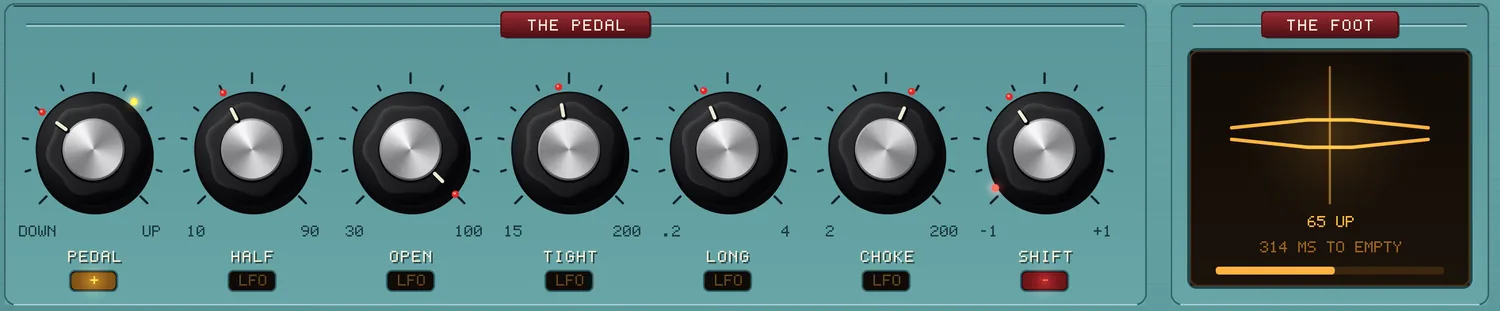
THE FOOT draws it while you play: two plates edge on, as far apart as the foot has them, over the time the capacitor would take to empty from there. CHOKE is how fast the foot comes down - a closed hit shortens a ringing open hat rather than muting it. Sixty to a hundred milliseconds after a soft closed stroke lands on an open hat, the hat reads -87.7 dBFS with CHOKE at 4 ms and -39.5 at 180, against -29.2 left alone.
A new core in the engine
Edges that land between samples
A square wave stepped to the sample can only flip on a sample, so every half cycle is rounded up to the next one. A hi-hat is six squares with everything under five kilohertz thrown away - which is exactly the part that goes wrong. This one is solved instead: between flips the capacitor is an exponential, so the instant it meets the threshold is a logarithm, and the flip happens there, a fraction of a sample in.
Asked for
1567.3 Hz
At 48 kHz.
A square stepped to the sample
1500.0 Hz
76 cents flat, and everything it folds back is a harmonic of the wrong pitch.
This one, counted over a second
1567.300 Hz
The edges are then drawn band-limited, at four times the sample rate.
The filters, the VCA, the germanium, the class-A stage and the output rail all run up there with it, so nothing nonlinear folds either.
Six of them, free-running
The metal is lines, not noise
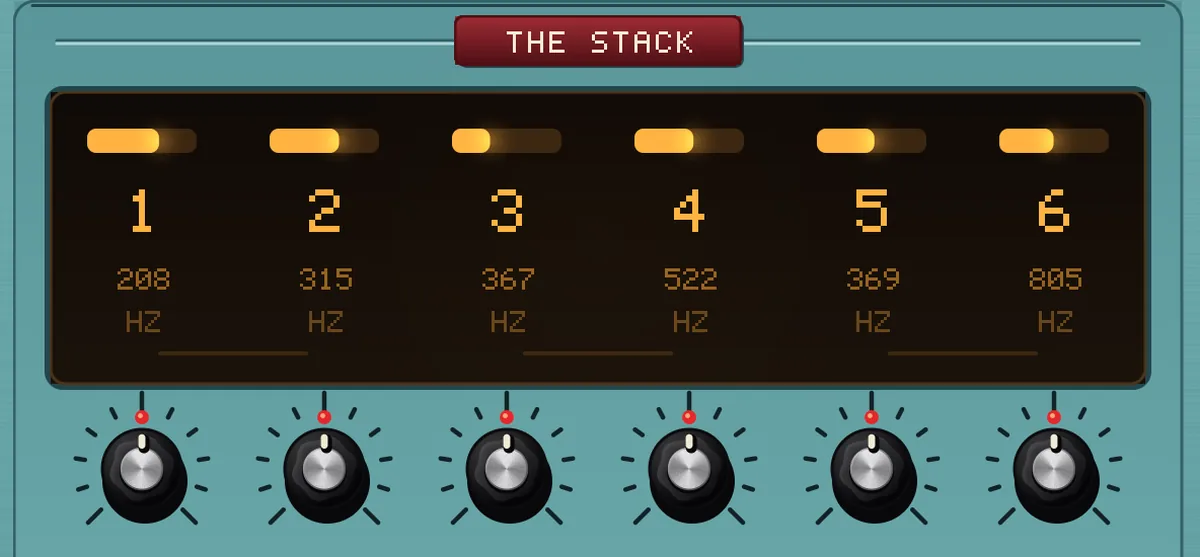
Six oscillators on parts with their own tolerances, none more than 3.5 per cent from where the designer put it and none exactly on it. In an open hat the top oscillator's seventh harmonic stands at -25.9 dBFS with -72.3 sixty hertz beside it - that is what a stack of lines looks like next to noise. HISS is noise beside the metal, for the gaps between them.
Nothing resets
No two strikes the same
The six oscillators free-run, and nothing resets them when a note arrives - so every strike catches them wherever they happen to be. That is the whole mechanism. There is no table of variations behind it and no round robin: it is six oscillators that were never stopped.
ACCENT decides how much of the hand reaches the circuit rather than only the VCA, TICK is a germanium burst on the front, and HANDS makes every other stroke of a run the other hand, 2.8 dB under and a little darker.
Sixteen sixteenths, one velocity
With the accent, the hands and the LFO all off
15 of 16
different hats, spanning 1.89 dB, because the stack is never where it was.
ACCENT at 0, velocity 1 against 0.4
8.0 dB
Louder, and nothing else.
ACCENT at 100, the same two strokes
10.1 dB
Louder, 2541 Hz brighter, and ringing 51 ms longer: the band and the capacitor, not just the VCA.
TICK, standing the first 3 ms over the body
16.1 dB
Against 11.7 dB without it.
One hat, five notes
Where your patterns already keep them
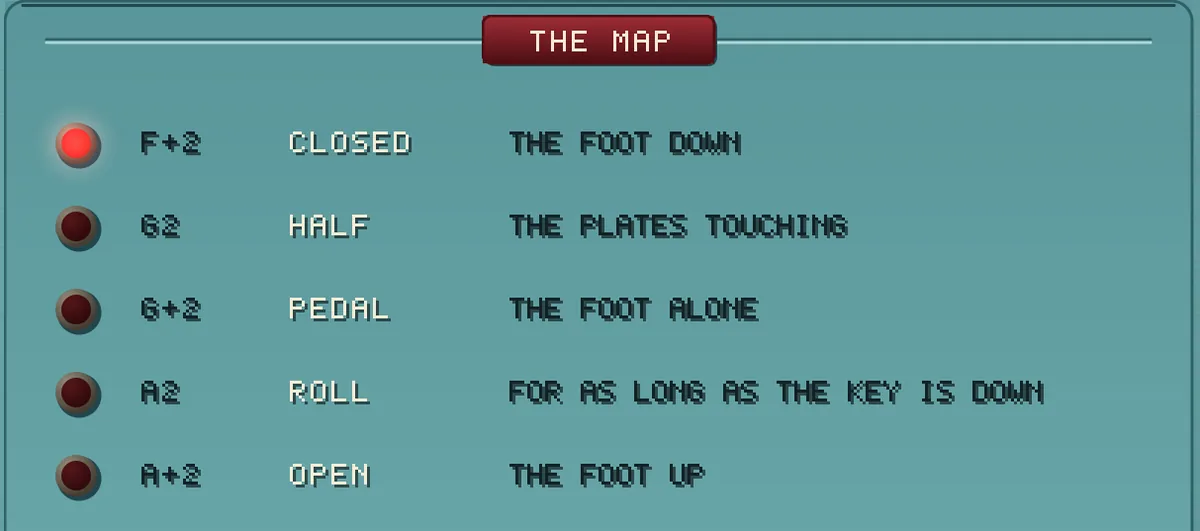
Five notes up from the trigger note, and every other note on the keyboard is someone else's drum. Move the trigger note and the map moves with it, exactly as the panel prints it.
Trigger note
F#2MIDI 42
Twenty-one switches
The LFO out of Rivet Gun
One oscillator, and a three-way switch under each of the twenty-one knobs it can reach: dark, amber for plus, red for minus. A lit knob swings a share of its own travel either side of where it stands, with a bead on its rim showing where the LFO has it now.
STRIKE is the shape that is not an oscillator: it throws the dice once per strike and holds them. With the transport running the dice are read off the song position, so the same eight strokes played from the top and from bar 2 differ by 0.00 ms. The bounce is the playback.
Light PEDAL and the foot rides on its own, which is the one that sounds least like a modulated parameter and most like somebody playing.
After the hat
The tone, and what is under it
A band-pass and a highpass, as the circuit has them. BAND runs 2 to 14 kHz, FOCUS narrows it until the hat is pitched and nasal, and AIR is the highpass. WARMTH is a class-A stage, and what a class-A stage does to a hi-hat is put difference tones underneath it.
Demos
11 takes, played by us
Straight out of the plugin, no processing on the way here. The hat is in a pattern, over Pile Driver and Rivet Gun, which is the whole chassis playing at once.
The sheet
What is in the box
Sixteen presets from the sheet-metal shop, all striking between -3.7 and -0.3 dBFS. Two copies built one after the other differ by exactly nothing, sample for sample, and it runs at about nineteen times faster than realtime with a 1/64 roll through the ring into the plate - on the machine it was timed on, which is not a promise about yours.
Powered by Phonon
The third coat of the same chassis
Tin Snips added one core to the Phonon engine - the oscillator, solved rather than stepped - and every instrument built on it from here gets that for free. The rest is the library: the band-pass, the OTA, the germanium, the class-A stage, the plate. It is Pile Driver's and Rivet Gun's sibling.
VST3 · Windows 64-bit - macOS VST3 and Audio Unit are in development. No activation, and the plugin never asks who you are.
At a glance
Tin Snips specifications
| Format | VST3 instrument · Windows 64-bit |
|---|---|
| In development | macOS VST3 and Audio Unit |
| The hat | One hi-hat · six relaxation oscillators, one capacitor |
| The oscillator | Edges solved between samples, band-limited at 4× |
| Asked 1567.3 Hz | 1567.300 counted · a stepped square lands on 1500.0 |
| Inharmonic floor | -117.8 dB · -41.1 with the edges rounded to a sample |
| The stack | 208.1 · 315.1 · 367.2 · 521.5 · 369.5 · 805.3 Hz |
| Spread | 0 holds them inside 386.6 to 402.9 Hz · 2 is twice the classic set |
| The pedal | 51 ms closed · 153 half · 834 open, from one capacitor |
| Choke | 2 to 200 ms · a closed hit shortens an open hat, it does not mute it |
| The tone | Band 2 to 14 kHz · focus · air 500 Hz to 12 kHz |
| The hand | Accent reaches the band and the capacitor, not just the VCA |
| Sixteen sixteenths | 1.89 dB apart · 15 different hats out of 16 |
| The map | Closed, half, pedal, roll, open · five notes from one trigger |
| The LFO | 0.05 to 30 Hz or 12 divisions · a switch under 21 knobs |
| Switched off | Bit-identical to the unmodulated hat |
| Presets | 16 from the sheet-metal shop · -3.7 to -0.3 dBFS |
| The panel | 1280 by 812 · it fits a laptop |
| Instances | Sample-identical, strike for strike |
| Activation | None. No license server, no phone-home |
| Engine | One new core in Phonon: the oscillator |