KICK
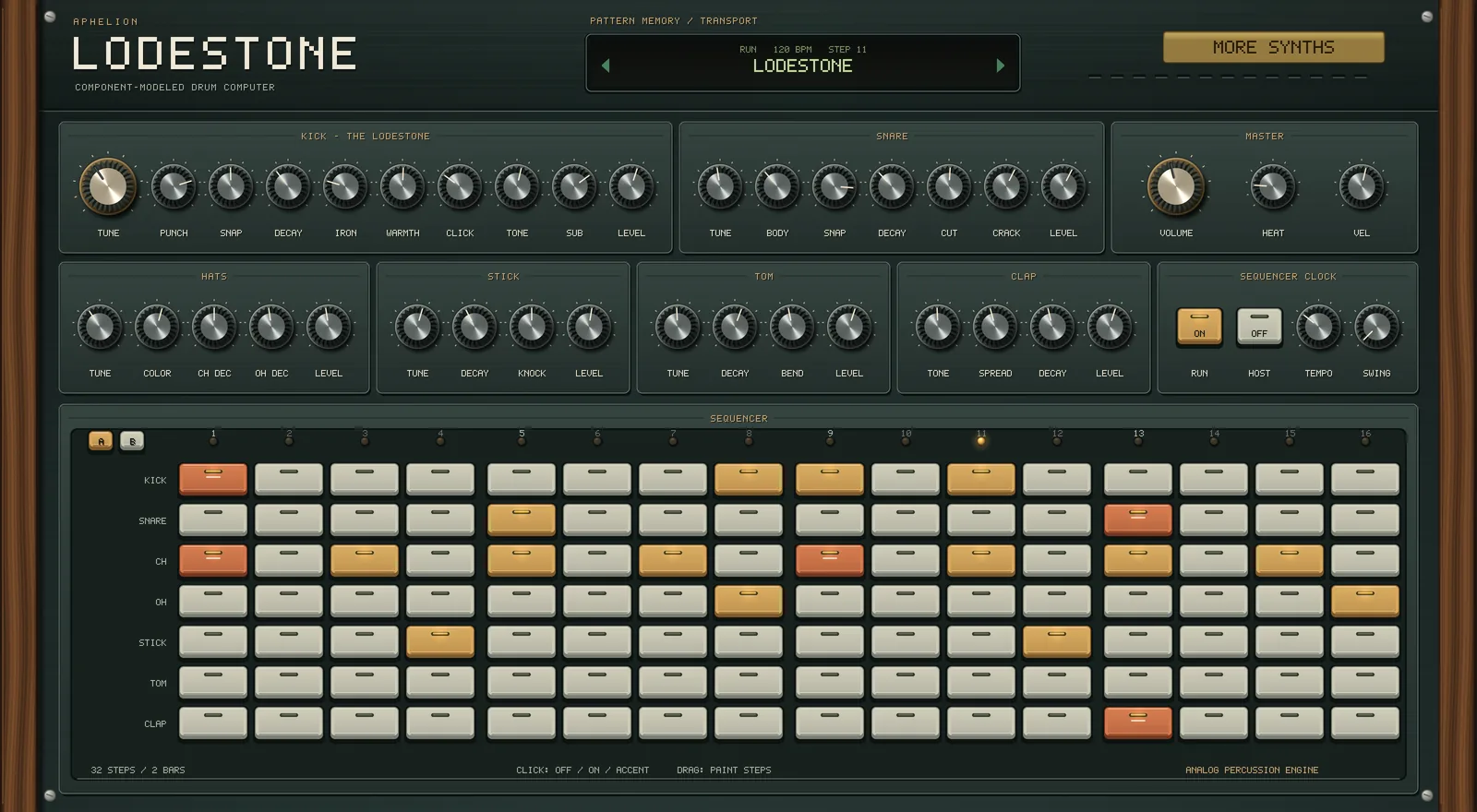
A swept oscillator under a real pitch capacitor - the other family from the pinged-resonator kicks. It strikes at 380 Hz and lands at 45, three octaves inside one note, and on the way down it passes through a modelled output transformer. The punch curve is not chosen, it is the capacitor's: it charges toward a rail above the peak and a comparator switches at the crossing.
SNARE
Two bridged-T resonator shells tuned to an inharmonic pair, the second at 1.63× the first, so the body beats the way two drumhead modes do instead of ringing like a test tone. A hot hit rides the shells into the rail: they compress and bloom rather than simply getting louder. Crack is a separate four-millisecond burst of noise through germanium.
HATS
Six actual Schmitt-trigger relaxation oscillators - real square waves with real hysteresis, each with its own component tolerances, so the stack never quite agrees with itself. That disagreement is the sizzle. They share one output amplifier, which is the whole reason the closed hat chokes the open one.
STICK
A bridged-T ping at 1.7 kHz with a lower knock resonator underneath, both summed through germanium - the transient softens the way wood on a rim does rather than clipping square.
TOM
One bridged-T resonator with the strike bend turned up, where the bend is amplitude coupling in the circuit itself. A slammed fill bends and growls; a ghost note does not. Six tom zones pitch the same circuit across two octaves, the way one voice card once served a whole row of pads.
CLAP
Noise through a resonant bandpass, with repeats that are not a delay line: a slow relaxation clock re-strikes the burst capacitor four times before the tail capacitor takes over, which is how the original burst circuits worked. The clock free-runs, so the spacing breathes instead of landing grid-perfect.
Hit any of them harder and they do not just get louder. The shells ride into the rail and bloom, the transconductance amps compress, the germanium softens. Velocity reaches the physics rather than a volume knob.