
Two-Filter Component-Modelled Monosynth
Scheele Green
Louder is a different sound.
Scheele Green is a monosynth built on two filters that do opposite things when you hit them harder. The first is tuned by diodes, and a diode conducts more the more voltage you put across it: drive it and it opens up and tears. The second is built from logic chips pressed into service as amplifiers, and their gain falls away toward the rails: drive it and it blunts, fizzes, and its resonance sags. One feeds the other. There is a knob for how hard you hit each. And your velocity arrives before both of them, so a hard note is not a louder copy of a soft one. It is a different sound.
VST3 · Windows 64-bit·No activationmacOS VST3 and Audio Unit are in development.
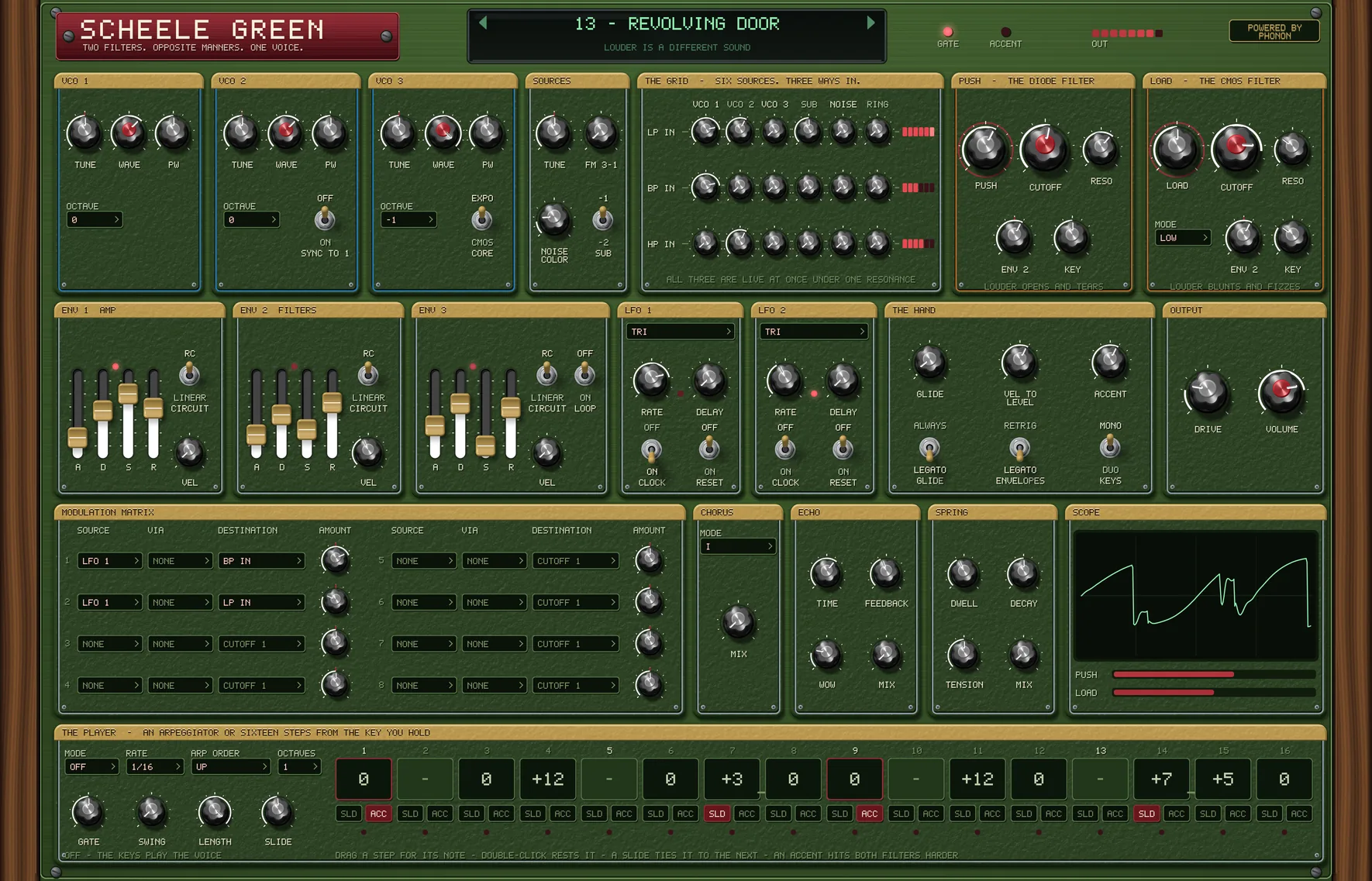
“It’s loud.”
Six sources, three ways in
The mixer is the filter
Most synths have a mixer, then a filter with a mode switch. This has neither. The diode filter needs no mode switch because it has a lowpass input, a band-pass input and a highpass input, and all three are live at once - so the mixer is those three inputs. Six sources across, three ways in down the side, a knob at every crossing and a meter on every input.
Send a saw in at the lowpass while a square an octave up goes in at the highpass and the sub goes in at the band-pass: one filter, one cutoff, one resonance, three different things happening to three different sounds.
The lowpass door. The fundamental stands over the 30th harmonic by a distance you could park a bus in.
+45.0dB, the fundamental against the 30th harmonic
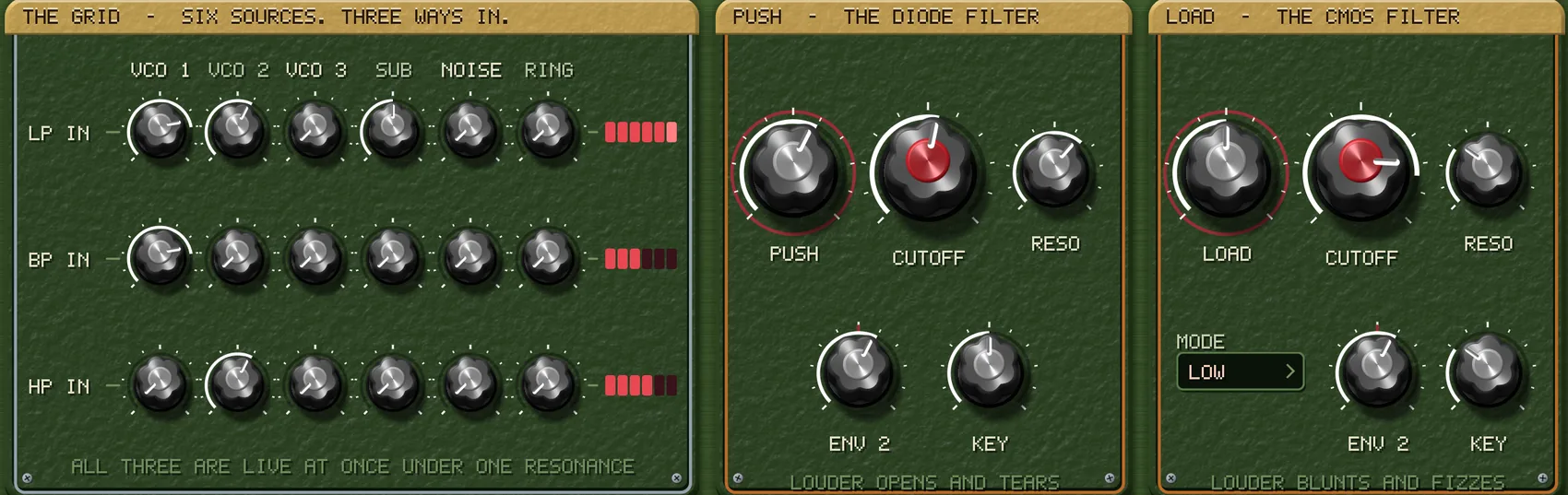
With the sub into LP IN and a saw two octaves above it into HP IN at the same time, the sub's 110 Hz reads -14.4 dBFS while the saw's own 440 Hz fundamental is down at -43.3 and its 3.5 kHz at -41.2. The filter kept the bottom of one and the top of the other.
The same knob, twice
Two filters, opposite manners
PUSH and LOAD are the level going into each filter, taken back out again afterwards - most of the way - so they are tone controls rather than volume controls. The two circuits answer that gesture in opposite directions, which is the whole instrument.
PUSH
The diode filter
Louder opens, and tears
Its tuning elements are diodes, and a diode conducts more the more voltage you put across it - so every loud moment in the wave briefly opens the filter.
36.9dB under the fundamental
Tearing. The diodes are opening on every loud moment in the wave.
A saw at A2 through a 500 Hz corner: where its 30th harmonic sits. 25.3 dB between the ends of the knob, while the output level moves 5.0 dB.
LOAD
The CMOS filter
Louder blunts, and fizzes
Its amplifiers are logic inverters biased into their linear region and asked to be op-amps. They are not good at it, and their gain falls away toward the rails.
22.3dB under the fundamental
The filter has given up: the harmonic is now further down than a plain saw would leave it.
At full resonance, with the corner sitting on a saw's 8th harmonic. 21.7 dB between the ends of the knob, where a plain saw's 8th harmonic sits 18 dB under. So at LOAD 5 the resonance is lifting that harmonic 17.4 dB above where a plain saw leaves it, and at LOAD 100 the filter is taking 4.3 dB off it.
One stranger thing
The door that rebuilds what it filtered
Put a sound in at the highpass, where its fundamental is filtered away, and then drive it. The diodes rebuild the missing fundamental out of the harmonics that are left - so the note comes back out of a door that had just removed it.
And with the keyboard on its corner, the first filter sings on its own and plays well enough to be the oscillator.
The fundamental, against its 30th
Through HP IN
-11.3 dB
Under its own 30th harmonic.
The same note at PUSH 80
+11 dB
Over it. The diodes put back 22.3 dB of a fundamental the filter had taken out.
Singing on its own, C4 and C5
302.8 · 605.8 Hz
Sharp of the corner, and an octave apart to within 0.6 of a cent.
Before both filters, not after
A hard note is a different sound
Velocity and ACCENT are level before both filters. Play softly and both circuits stay in their linear manners; dig in and the first one opens while the second one chokes. Measured with the envelope taken out of it and PUSH at 80, on the 30th harmonic:
GLIDE is a capacitor, so it starts fast and lands slowly. DUO is duophonic - two keys through the one filter path - which is a different thing from a second voice, and this instrument does not have one.
What goes in
Three oscillators, and a logic gate
Each is a saw core behind a real exponential converter, with a wave knob that sweeps sine through triangle and saw to pulse. The second syncs to the first. The third can frequency-modulate the first through zero - or flip its CORE switch and become something else entirely: a Schmitt-trigger oscillator, a logic gate charging a capacitor, the rawest square there is. Beside them a sub that is a real divider off the first oscillator's core, so it cannot drift against it; noise from white to pink; and a ring modulator made of four unmatched diodes.
The oscillators' parts have tolerances, and they are the same tolerances every time you open it.
Eight slots, and three doors
The matrix can open a door
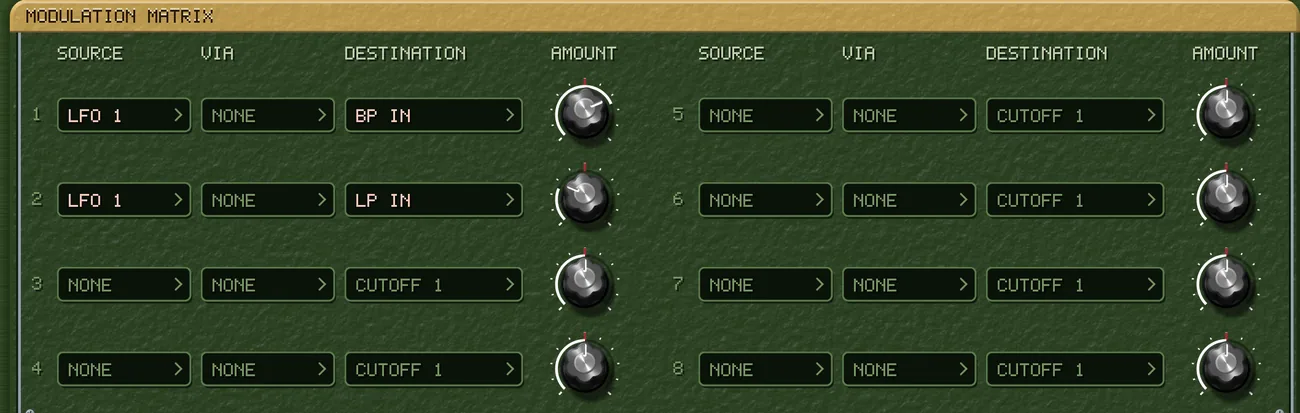
Three envelopes, each switchable between RC and constant-current. Two LFOs with tempo sync, delay and key reset. And an eight-slot matrix of source, VIA, destination and amount - where the destinations include the grid's three columns. An LFO can fade the band-pass input up while it fades the lowpass input down. An envelope can let a note's attack in through one door and its body through another.
Measured: an envelope on HP IN through the matrix takes a note that came in at the highpass from -34.0 dBFS to under -140. The door shuts.
Sixteen steps from the key you hold
The player
Off, an arpeggiator, or a line. The arpeggiator goes up, down, up and down, as played, or by dice, over one to three octaves. The line is sixteen steps of offsets from whatever key you hold: each step a note or a rest, with a slide and an accent. A slide is the glide capacitor with the line's own resistor. An accent is more level into both filters - which by now you know is not the same as louder.

With the host running the line sits where the song says, so a bounce is the playback; with the host stopped it runs free from the key. The line is saved with your session.
Demos
14 takes, played by us
Straight out of the plugin, no processing on the way here, levels matched so you can move between them without reaching for the volume.
The sheet
What is in the box
Everything nonlinear in the voice runs at twice the sample rate, and both filters are solved implicitly, every sample, as circuits. On the machine it was timed on it runs about twelve times faster than realtime with all three effects in - that is one machine, and not a promise about yours.
Powered by Phonon
A green too good to be safe
In 1775 a chemist made a green so vivid that everyone put it on their walls, and it was made of arsenic. We liked the name. Both filters here are new circuits in the Phonon engine, written for this instrument; everything around them is Phonon's shelf. It is the monosynth beside Tyrian Blue's polysynth.
VST3 · Windows 64-bit - macOS VST3 and Audio Unit are in development. No activation, and the plugin never asks who you are.
At a glance
Scheele Green specifications
| Format | VST3 instrument · Windows 64-bit |
|---|---|
| In development | macOS VST3 and Audio Unit |
| Voice | Monophonic · last-note priority · legato or retrigger |
| Duo | Two keys, two pitches, one filter path |
| Sources | 3 oscillators, divider sub, noise, diode ring modulator |
| The grid | 6 sources × 3 filter inputs, all live at once |
| First filter | Diode-tuned, three inputs, self-oscillating and tracking |
| Second filter | CMOS-inverter state-variable: low, band, high, notch |
| Push | 25 dB of brightness out of a level knob, 5.0 dB of level |
| Load | Resonance that sags instead of singing |
| The hand | 15 dB of brightness between velocity 20 and 100 |
| Envelopes | 3 · RC or constant-current · loop on the third |
| Matrix | 8 slots · 14 sources, 27 destinations, VIA on each |
| Player | Arpeggiator, or 16 steps with rest, slide and accent |
| After the filters | Class-A drive, chorus, tape echo, spring tank |
| Controls | 134 · 16 presets · phosphor readout and scope |
| The panel | 1520 by 976 |
| Measured | 31 claims · validator 47 of 47 |
| Instances | Sample-identical, two fresh copies |
| Activation | None. No license server, no phone-home |
| Engine | Two new circuits in Phonon: both filters |