
Component-Modeled Kick Drum
Pile Driver
The unbridled joy of THUNK THUNKA THONK BWAM THUNK
Pile Driver is the kick from Drum Honker, lifted out whole and put on its own plate. It is the same circuit the drum machines run - one expo-converter oscillator swept by a real pitch capacitor, through an OTA with the velocity on its control port, a class-A stage, a wavefolder before a transformer, and a tone lowpass, with a sub tapped off the same oscillator so it can never beat against the body. And it has every knob the module has, sixteen of them, each a brass wedge swinging under a lit bead and a white arc that fills as you turn it. Give it a MIDI note. It answers that one, and no other.
VST3 · Windows 64-bit·No activationmacOS VST3 and Audio Unit are in development.
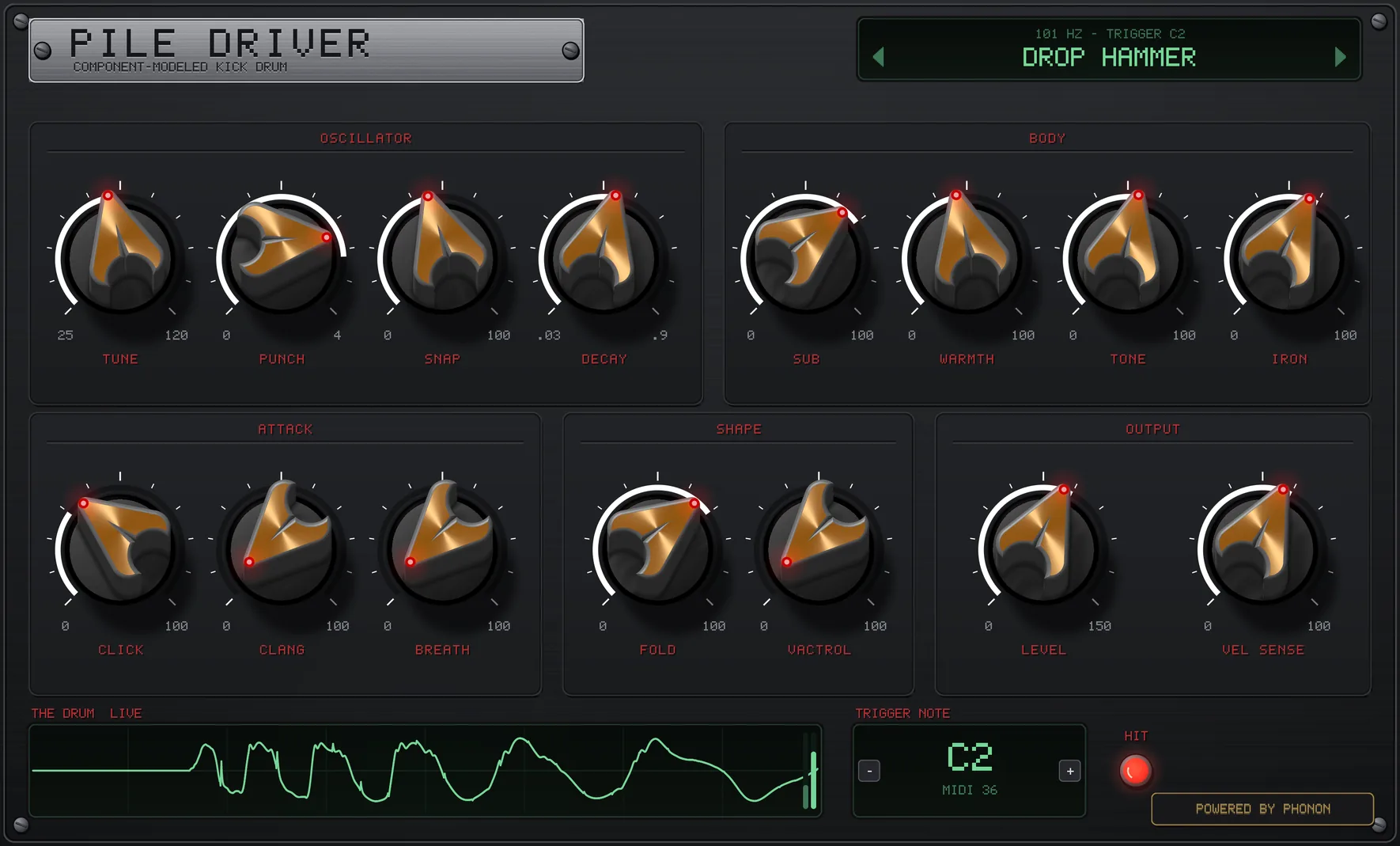
The kick, on its own
One drum. Every knob it has.
The drum machines in the catalogue - Lodestone, Drum Honker, Triphammer and The Lost Kit - all run the same kick module. Pile Driver is that module with its whole panel: every parameter the circuit has is a knob, and every knob is measured below. It adds nothing to the engine; it puts every part of that kick under your hand at once.
The numbers are the marketing
Sixteen knobs, measured
Every figure here comes from the measurement suite the shipping plugin is checked against. Where a knob moves something, you get both ends of the move.
OSCILLATOR
- TUNE
Where the drum lands, 25 to 120 Hz.
where the body settlesset 4545.0 Hz→set 8080.0 Hz
- PUNCH
How far above that it strikes, in octaves.
strongest line, first 4 msat 030 Hz→at 3.08404 Hz
- SNAP
The pitch capacitor itself. Half its travel sits where a drum lives, in the bottom eighth of the range.
pitch, 40 ms infast94 Hz→slow306 Hz
- DECAY
The amplitude capacitor, 0.03 to 0.9 seconds.
level, 300 ms inshortest-65 dB→longest-9 dB
BODY
- SUB
A tap off the same oscillator before the amplifier, on its own longer capacitor, summed after TONE so nothing downstream can darken it.
30 to 70 Hz, late in the notedown-59 dB→up-40 dB
- WARMTH
Drives a class-A stage.
2nd harmonic, under the fundamentaldown42 dB→up15 dB
- TONE
The lowpass after everything but the sub.
of the top15 dB
- IRON
Drives a transformer, and a transformer works hardest at the bottom.
3rd harmonic, under the fundamentaldown30 dB→up20 dB
ATTACK
- CLICK
A burst through a germanium diode.
2 to 10 kHz, first 5 ms+22 dB
- CLANG
A second expo converter riding the same pitch capacitor, frequency-modulating the body - so the bell sweeps down with the drum.
150 Hz to 2 kHz, landed note+17 dB
- BREATH
Noise through its own germanium, gated by the drum's amp envelope and summed before TONE, so the same knob darkens it.
of air, 3 to 12 kHz+36 dB
SHAPE
- FOLD
Folds the body before the iron, so the fold products go through the flux like everything else.
400 Hz to 4 kHz+17 dB
- VACTROL
Crossfades the OTA against a photocell gate.
rounder, first 3 ms5 dB
OUTPUT
- LEVEL
How much of the drum leaves the plugin.
scale on the panel0 to 150
- VEL SENSE
How much of the velocity on the OTA's control port you want.
a full hit against a soft oneat 0identical→shipped3 dB apart
Eleven of them
Eight seconds each
Straight out of the plugin, no processing on the way here.
The hand
One note, answered
Velocity rides the OTA's control port, so a hard hit is not only louder - it arrives hotter at the iron. VEL SENSE is how much of that you want.
TRIGGER NOTE is the one note the drum answers, anywhere from 0 to 127 and shipped at 36. The panel prints its name and its number and has a button either side, and every other note is ignored. The wheel bends the tune.
TRIGGER NOTE
As shipped. Every other note is ignored.
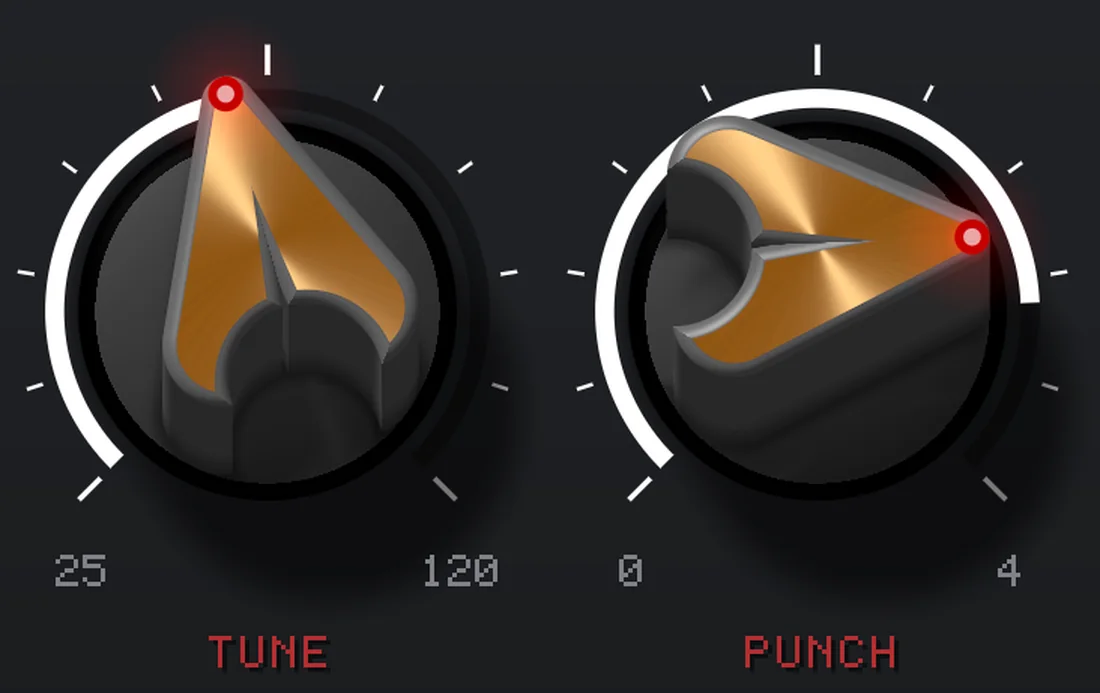
A panel you want to touch
Drawn as circuits are
Anodised charcoal, a brushed nameplate, oxblood silk. The knobs are drawn from the geometry rather than a photograph, and they are nobody else's knob: a dark barrel with a broad brass wedge across its face, drawn as a solid with a lit edge, running from the spindle out to a red bead that rides the rim. Outside it a white arc fills as the value climbs, with eleven ticks and the scale printed under it.
The drum's own output runs live on a scope along the bottom, beside the trigger window and a hit lamp. Drag, shift-drag for fine, wheel, double-click to reset, and the display reads out whatever knob is under your hand. The panel is 1060 by 640, so it fits a laptop.
Sample for sample
The same drum, every time
Two copies of Pile Driver built one after the other differ by exactly nothing, sample for sample. It runs at 85 times realtime with a kick every half second, so it costs nothing to leave on every track. Twelve presets, and every one of them strikes within 3 dB of the others - so you can change the drum without riding the fader.
- BEDROCK
- CAISSON
- DEADBLOW
- REBAR
- TAMPER
- FOOTING
- GRAVEL BED
- DROP HAMMER
- SHEET PILE
- SUBSIDENCE
- SLAB
- LOAD TEST
The sheet
What is in the box
Powered by Phonon
Drop the hammer
The kick is compiled from the Phonon engine's own source - the same module the drum machines run - so the plugin and the DAW can never drift apart in sound.
VST3 · Windows 64-bit - macOS VST3 and Audio Unit are in development. No activation, and the plugin never asks who you are.
At a glance
Pile Driver specifications
| Format | VST3 · Windows 64-bit |
|---|---|
| In development | macOS VST3 and Audio Unit |
| The drum | One kick · one oscillator · one MIDI note |
| Knobs | 16, every parameter the module has |
| Tune | 25 to 120 Hz · set 45, lands at 45.0 |
| Punch | 0 to 4 octaves · 404 Hz at 3.08, 30 Hz at 0 |
| Snap | 94 Hz against 306 Hz, 40 ms in |
| Decay | 0.03 to 0.9 s · -65 dB against -9 at 300 ms |
| The body | Sub, class-A warmth, iron, tone |
| The attack | Click +22 dB · breath +36 · clang +17 · fold +17 |
| Trigger note | 0 to 127, shipped at 36 · the wheel bends the tune |
| Instances | Sample-identical, one to the next |
| Presets | 12 · every one within 3 dB of the others |
| The panel | 1060 by 640 · it fits a laptop |
| Performance | 85 times realtime, a kick every half second |
| Activation | None. No license server, no phone-home |