
68.8% distortion at 60 Hz
The low end barks. This is the part everybody wants from a slammed console channel, and it is the part a plugin usually delivers by putting a filter in front of a curve and hoping.
Component-Modeled Distortion
Accept no substitutes.
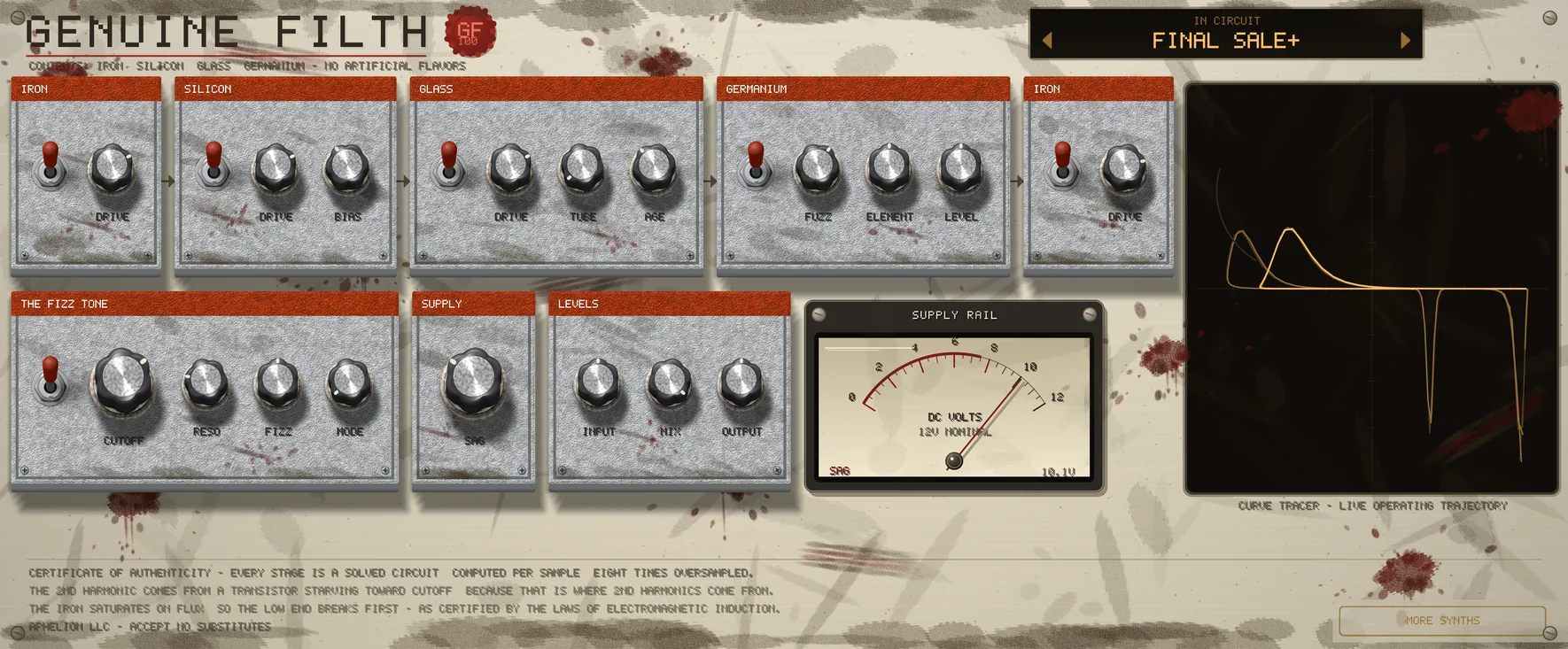
Every distortion plugin promises filth. Almost all of them are a lookup table wearing a costume: one curve, applied to every sample, deaf to frequency, deaf to history, deaf to how hard you have been pushing it. Genuine Filth is five circuits in series, each solved per sample, sharing one power supply that genuinely sags.
VST3 effect · Windows 64-bit·No activationmacOS VST3 and Audio Unit are in development.
The proof is the first knob
The input transformer saturates on magnetic flux - the integral of voltage - so for the same signal the core works harder the lower the note. At one setting of one knob:
The low end barks. This is the part everybody wants from a slammed console channel, and it is the part a plugin usually delivers by putting a filter in front of a curve and hoping.
The top stays glassy at the same instant, on the same setting, with nothing filtering anything. Two orders of magnitude apart because the physics is frequency-dependent and a lookup table is not.
Not because ours is cleverer, but because a waveshaper maps a sample to a sample. It has no way to know whether the sample it is looking at came from a low note or a high one. Flux does.
Of electromagnetic induction, specifically. The core integrates voltage over time, so time is in the equation, so frequency is in the answer.
Hear it
Each group starts with the untreated take. One player runs at a time, so clicking the dry one and then a treated one is a real A/B rather than a wall of sound. No processing anywhere except the plugin itself.
The drum bus, untreated.
The synth, untreated.
Five stages in series
The nameplates on the panel are the power switches. A plate stamps red when its stage is in circuit; click one and that stage drops out of the signal path entirely.
The input transformer saturates on magnetic flux, which is the integral of voltage - so for the same signal the core works harder the lower the note. The low end barks while the top stays glassy, on one setting of one knob. That is the sound of a slammed console channel, and it is the one thing a static curve provably cannot do, because a curve cannot tell 60 Hz from 5 kHz.
68.8% at 60 Hz · 0.02% at 5 kHz
A single-ended class-A transistor stage with its emitter current solved from the real loop equation every sample. Its distortion is asymmetric the way a transistor is asymmetric: thickness rather than fuzz. BIAS drags the operating point off centre until quiet notes gate and sputter - a signal at -30 dBFS drops by another 19 dB at full starve. That is not a gate. It is a misbiased transistor doing what misbiased transistors do.
2nd harmonic leads the 3rd by 14 dB · -19 dB at full starve
A triode gain stage with four real tube types, each biased halfway to its own cutoff, each overdriving in its own way, with grid conduction squashing the positive peaks the way the physics says. AGE wears the cathode: shifted cutoff, weakened emission. The stage was calibrated once at the factory for a fresh tube, so a worn one audibly changes the sound - because nobody recalibrates a channel for a dying tube. They just play it.
6.6% fresh · 2.1% worn, at the same drive
An antiparallel diode pair behind a series resistor, solved from the node equation with junction capacitance included - which is what keeps a clipped edge from being infinitely fast. The ELEMENT switch swaps the physics rather than the curve: germanium breaks first, silicon breaks harder and later, LED breaks last and loudest. FUZZ runs to 60 dB of gain, and at the top it is a wall.
2.57% where silicon and LED still read 0.00%
An output transformer to finish, with interstage coupling capacitors between every stage, the way the schematic would have them. The second core hears everything the first four did to the signal, which is why the chain does not simply get louder as you add stages.
and again on the way out
One supply, shared
Both channels hang off a single power supply, and SAG gives it real source impedance. Play hard and the rail droops to 0.67 of nominal - and a drooping rail drags every bias point down with it.
Not a decaying envelope: the circuit is running out of voltage while you hold the note, and coming back when you stop asking.
Because that is what sharing a supply means. It is the second thing a lookup table cannot do, and the reason a real channel strip has a character on a mix that it does not have on a soloed track.
Each stage sees the rail through its own RC network, so the droop chokes the circuit without the ripple whining into your audio. That is how the hardware does it, for exactly that reason.
The SUPPLY RAIL needle reads the modelled rail, live. Watch it dip when you dig in.
The fine print
Certificate of authenticity
The whole wet path runs eight times oversampled with a purpose-built final decimator: at the nastiest setting we could construct, sixty decibels of fuzz on a 5 kHz tone, the folded images stay below -46 dB. The dry path is delayed to the wet path's measured group delay, so the MIX knob never combs - half mix at 10 kHz measures 0.7 dB from ideal - and the fifty samples of latency, about a millisecond, are reported to your host, which compensates for them. Worst case, every stage in circuit, it runs 3.9 times faster than realtime.
The scope on the right of the panel is a curve tracer and it is honest: it plots live input and output pairs from the audio passing through, which is the real operating trajectory of the whole chain rather than a drawing of a transfer function. When the iron's magnetic history opens the curve into a loop, you see the loop. When the bias sputters, you see it sputter.
Aphelion LLC · As certified by the laws of electromagnetic induction
After the dirt
The tone section is the discrete two-pole fizz filter from Oxbow - the same circuit from the same source files - sitting after the distortion the way an amp's tone stack sits after its gain stages. A hot resonance that weakens its own damping is a useful thing to have on the end of five stages of dirt.
The panel
Sixteen presets, written as inspection reports, from FACTORY SPEC to CLEAN RECEIPT. Twenty-four parameters, all automatable. And a contents line along the top, because the point of the whole instrument is that the list is true.
No activation
There is no activation step, no license file, no dongle and no server dependency. Activation is friction aimed at paying customers; the people who were never going to pay do not see it.
Your purchase lives at the store so you can re-download it. The plugin never asks who you are. It works offline forever, reinstalls without ceremony, and keeps working no matter what happens to us.
Coming soon · no activation
Genuine Filth compiles the same component-modeling source files as Phonon, our DAW - the class-A stage, the diode elements and the transformer core are the ones the DAW ships. It is the first thing we have made that goes on a track you already have rather than making one.
macOS VST3 and Audio Unit are in development.
At a glance
| Format | VST3 effect · Windows 64-bit |
|---|---|
| In development | macOS VST3 and Audio Unit |
| Stages | 5 in series, each solved per sample |
| Supply | One rail, shared, with real source impedance |
| Elements | Germanium, silicon and LED |
| Tone stack | The discrete two-pole from Oxbow |
| Oversampling | 8× wet path · folded images below -46 dB |
| Latency | 50 samples, reported to the host |
| Presets | 16 inspection reports |
| Parameters | 24, all automatable |
| Activation | None. No license server, no phone-home |