
10 ms
to brighten
Component-Modeled Vactrol Phaser
Ooey. Gooey. Oh so analog.
Every phaser sweeps. Almost all of them sweep the same way up as down, because underneath they are an oscillator wiggling a number, and a number has no memory. Slow Light is built the way the old units were: six allpass stages ganged on one photocell, swept by one lamp.
VST3 effect · Windows 64-bit·No activationmacOS VST3 and Audio Unit are in development.
Why it feels like that
“I can't explain why, but it just sounds better than other phasers. Gooier.”
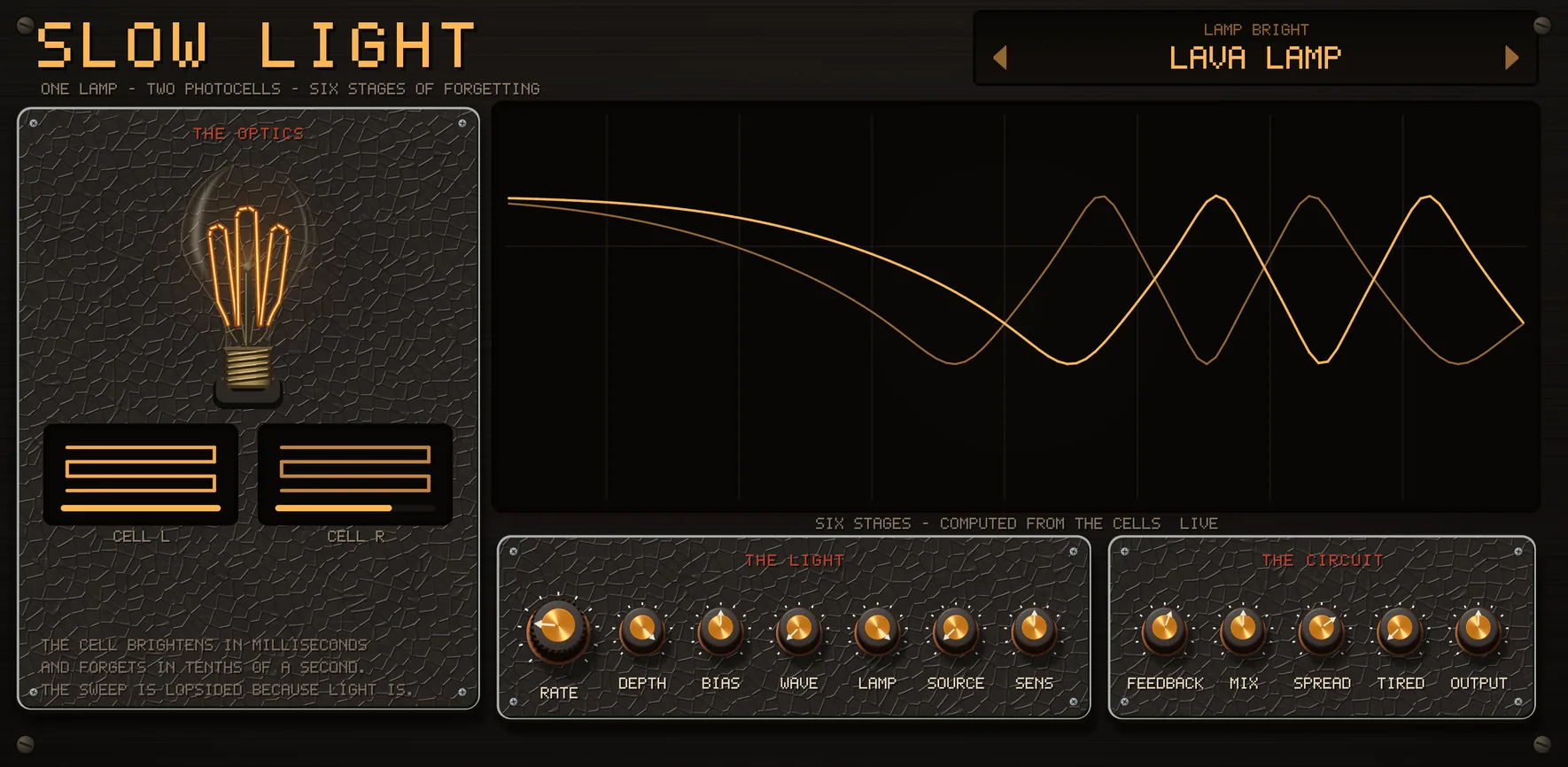
We can explain why. The cell brightens in 10 milliseconds and takes 107 to forget, with a tail that stretches as it goes dark - so the sweep never retraces its own path, and nothing in the control path has a corner in it. Play another phaser's sweep backwards and it is identical. Play this one backwards and it is obviously wrong. The lopsidedness is the sound, and gooier is the correct technical term.
10 ms
to brighten
107 ms
to forget
11×
slower coming down
Hear it
Straight out of the plugin, no processing. Listen for the shape of the movement rather than its speed: the way each sweep leaves faster than it comes back.
Six stages, one cell
And travelling the cell's full throw, 120 Hz to 4200 Hz. These are not a shelf and a wobble standing in for a comb.
Then turn the lamp up and that same hole fills to 3.8 dB, because every notch has moved up past it. The measurement is of one frequency at two settings, which is the only honest way to show a comb moving.
FEEDBACK wraps the last stage back into the first through the amplifier's modelled headroom. Full regeneration on a hot signal peaks at 0.4 dB below full scale: it saturates the way the circuit does rather than the way a limiter does.
Nothing here needs oversampling, because everything nonlinear in this box is already slow - light, heat and photoresistance. It renders 190 times faster than realtime.
The lamp is a component too
Morphs the drive from sine to square. A square arrives at the lamp as a square and leaves the cell as the classic bounce, because a photocell cannot snap. You are not choosing a waveform so much as choosing how hard to ask the cell for one.
the cell rounds the corner off
Swaps the LED for an incandescent filament with real thermal mass. It heats in tens of milliseconds, cools slower than it heats, and never quite reaches black - so the same sweep arrives twice as slowly and never fully closes.
56 ms against 25 ms for the same sweep
Hands the light to an envelope follower instead of the oscillator, so the notches chase what you play: sweeping to the top of the range while you dig in, sinking back down when you leave it alone.
sinks back to 124 Hz when you stop
Ages the cells. A worn photocell forgets slowly and the lamp runs dim, which is a different sound from simply slowing the rate down - the shape of the fall changes, not just its length.
forgets in 666 ms
Two cells, never matched
True-stereo vactrol units had two cells, and no two photocells ever matched. SPREAD gives the right channel its own: the lamp a quarter-turn behind, and a different specimen of cell with its own attack and its own decay.
Measured, channel correlation falls from 1.000 - which is one cell moving both sides, and is mono movement however wide it sounds - to 0.623, which is two cells politely disagreeing. The panel shows it happening: two photocell windows, two comb curves, drifting apart in real time.
The panel
The lamp on the faceplate is the modelled lamp: it breathes with the drive, glows warmer as the filament heats, and dims when the cells are tired. The two photocell windows meter the real cell conductances, and the big display draws the six-stage comb computed live from both cells' corner frequencies. Nothing on this panel is an animation.
No activation
There is no activation step, no license file, no dongle and no server dependency. Activation is friction aimed at paying customers; the people who were never going to pay do not see it.
Your purchase lives at the store so you can re-download it. The plugin never asks who you are. It works offline forever, reinstalls without ceremony, and keeps working no matter what happens to us.
Coming soon · no activation
Slow Light compiles the same component-modeling source file that Phonon, our DAW, ships for its own vactrol phaser. Not a port of it and not a version of it: the same file, which is why the pedal and the DAW cannot disagree about what a photocell does.
macOS VST3 and Audio Unit are in development.
At a glance
| Format | VST3 effect · Windows 64-bit |
|---|---|
| In development | macOS VST3 and Audio Unit |
| Stages | 6 allpass, ganged on one cell |
| The cell | 10 ms rise · 107 ms fall · 120 Hz to 4200 Hz |
| Lamp | LED or incandescent filament |
| Stereo | A second, tolerance-mismatched cell |
| Latency | None. Nothing here needs oversampling |
| Presets | 16 lights |
| Parameters | 12, all automatable |
| Activation | None. No license server, no phone-home |