
Four cores, every sample
Four of Batholith's circuits run Newton-Raphson every sample on the real nonlinear system, including the instantaneous feedback path. The result is self-oscillation at cutoff rather than near it.
Component-Modeled Synthesizer · Free Plugin
You had me at Free Synth.
Batholith is not an emulation of a sound. Every stage of it is built from modelled components - transistors solved with the real device equation, diodes with theirs, a filter's feedback loop solved implicitly rather than delayed.
VST3 · Windows 64-bit·Free · no accountmacOS VST3 and Audio Unit are in development.
Hear it
Straight out of the plugin. Whatever grit is in these is the circuit doing it.
Modelled down to the component
A filter's resonance path feeds back instantaneously. The usual shortcut is to insert a one-sample delay so the maths gets easier - and that delay is exactly what detunes resonance.
Four of Batholith's circuits run Newton-Raphson every sample on the real nonlinear system, including the instantaneous feedback path. The result is self-oscillation at cutoff rather than near it.
Transistor stages are the Ebers-Moll large-signal solution at a physical thermal voltage of 25.85 mV. Shockley diodes. Koren triodes. Not curve-fitted saturators wearing the names.
Every oscillator gets its own V/oct scale error and pitch offset, because two oscillators from one schematic never track identically. The exponential converter's scale really is q/kT, so it depends on die temperature.
The saw core's reset discharge takes real microseconds, added to every period, so the top octaves play flat - exactly as they do in hardware.
The instrument
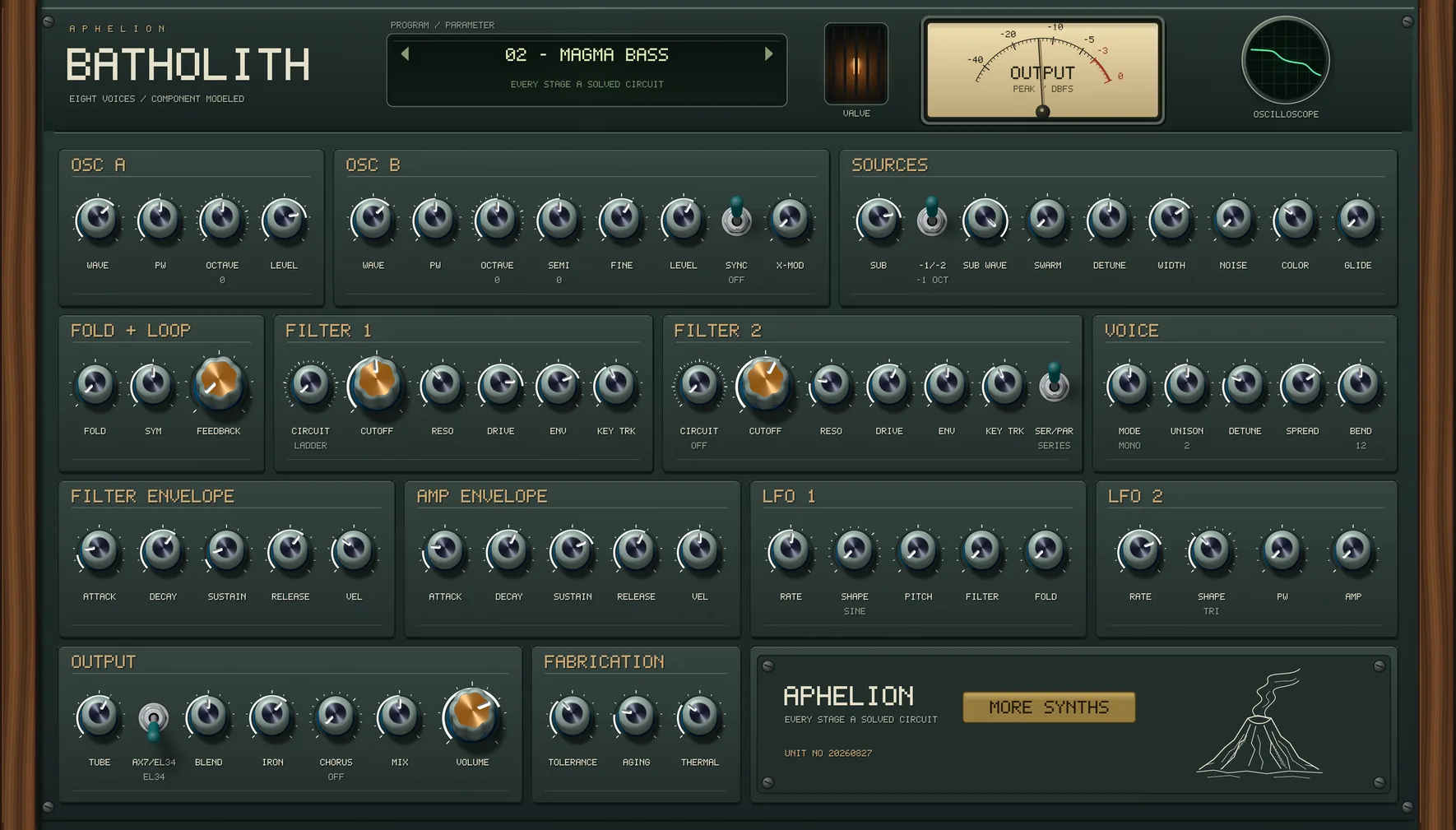
Each card is a complete analog signal chain, and each is a slightly different circuit.
Two saw-core oscillators with sync and linear FM, a divider sub locked to oscillator A's own resets, seven more physical oscillators in the Swarm, and a shared noise junction.
Five diode folding cells with staggered thresholds. Instead of removing harmonics from a bright wave it adds them to a dull one, and SYMMETRY brings in the evens.
Six circuits each, in series or parallel, with a germanium clipper wrapped around the whole section so the filters chew on their own output.
A triode stage with two bottles on a switch - 12AX7 preamp glass or EL34 power glass - into an output transformer modelled in the flux domain, then a bucket-brigade chorus. Eight cards summed at 2× oversampling.
Two slots, six circuits
Four cascaded, buffered differential-pair stages, each solved from the large-signal transistor equation. The resonance loop is solved implicitly every sample, including the instantaneous feedback path. It self-oscillates just past the top of the knob, and the passband compresses as resonance rises.
The rungs are bare diode pairs, unbuffered, so current flows both ways between the capacitor nodes and the ladder becomes a diffusion chain. The poles spread across a 30:1 range instead of stacking - that spread is the sound. Resonance quacks rather than whistles, and self-oscillation needs five times the loop gain a transistor ladder does.
Two RC sections buffered by discrete transistor pairs, with resonance fed back through an amplifier that clips - and the clipper is the personality. Below threshold it thickens the resonance with harmonics; past it, the loop bounds into a scream that intermodulates with whatever you play. The bass ducks when the peak bites.
Op-amp integrators around a damping path, essentially linear at musical levels: the smoothness is the absence of per-stage saturation. What the op-amps do add when pushed is modelled - slew-rate limiting at 0.5 V/µs puts a subtle grit on the top when driven hot. Rings hard at maximum, and by design never runs away.
A resonant highpass into a resonant lowpass in series, each with gentle input saturation from transconductance amps that run out of linear range early. The damping floor sits well above self-oscillation: this one sings, never screams. Sweep the two peaks toward each other and it carves the vocal band.
Fabrication
They can exist because the instrument is built from components. Because the draws are per card, an eight-voice chord is eight slightly different circuits - voice-to-voice variation like a vintage poly, not a detune knob.
The spread of every component draw. Each of the eight voice cards rolled its own resistor and transistor values once, at fabrication, and this scales how far from nominal they sit. Zero is a mil-spec build. Full is the Friday-afternoon unit.
Decades on the shelf. Reset discharge stretches and envelope timing drifts.
How well the tempco resistor was trimmed, and how far the die temperature wanders. At zero the tuning is rock solid; turned up, the instrument warms, drifts and disagrees with itself.
The honest part
The filter and folder cores ship with a physics test suite. These are assertions that run in CI, not adjectives:
SmallSignal_FourPoleRolloffFour-pole rolloff.SelfOscillation_RingsAtCutoffFrequencySelf-oscillation at cutoff, not near it.Knee_IsLazierThanTheTransistorLadderA diode ladder with a lazier knee than a transistor ladder.Symmetry_BringsInTheEvensA wavefolder whose evens arrive only with asymmetry.The panel
No bitmaps and no theme engine, so it is pixel-identical in every host and renders at any resolution. Every knob prints its setting underneath it, so a patch can be read off the panel without touching anything. And everything alive on it is real: an oscilloscope tracing the actual output with auto-gain, an output meter reading peak level in dBFS, and a valve window whose filament idles warm while the plate glow breathes with signal and drive.
Free · no account
Batholith compiles the same component-modeling source files as Phonon, our DAW - not a copy of them, the same files - so the plugin and the DAW can never drift apart in sound. Every device equation, every Newton solution and every physics test behind Batholith is the engine Phonon is built on. Batholith is one instrument that engine can make.
macOS VST3 and Audio Unit are in development.
At a glance
| Format | VST3 · Windows 64-bit |
|---|---|
| In development | macOS VST3 and Audio Unit |
| Voices | 8 cards · Poly, Mono, Mono Legato |
| Parameters | 71, all automatable |
| Processing | 2× oversampled nonlinear path |
| Engine | Compiled from Phonon's own source |
| Presets | 35 factory patches |
| Price | Free |