
Cables carry their own attenuverters
Level and offset live on the wire rather than taking up panel space, so inverting an envelope is part of patching it rather than a module you have to go and find.
Semi-Modular Drum Machine
A kick so profound it has a degree. In kicking.
Every drum machine since the beginning has hidden its wiring. The sequencer fires the voices, the voices feed the mix, and none of it is your business. Triphammer puts the wiring on the panel: nine circuit voices, a utility row and a two-bar sequencer, across sixty-seven jacks with every input normalled. Plug nothing in and it is simply a very good drum machine. Then you patch one cable and it stops being simple.
VST3 · Windows 64-bit·No activationmacOS VST3 and Audio Unit are in development.
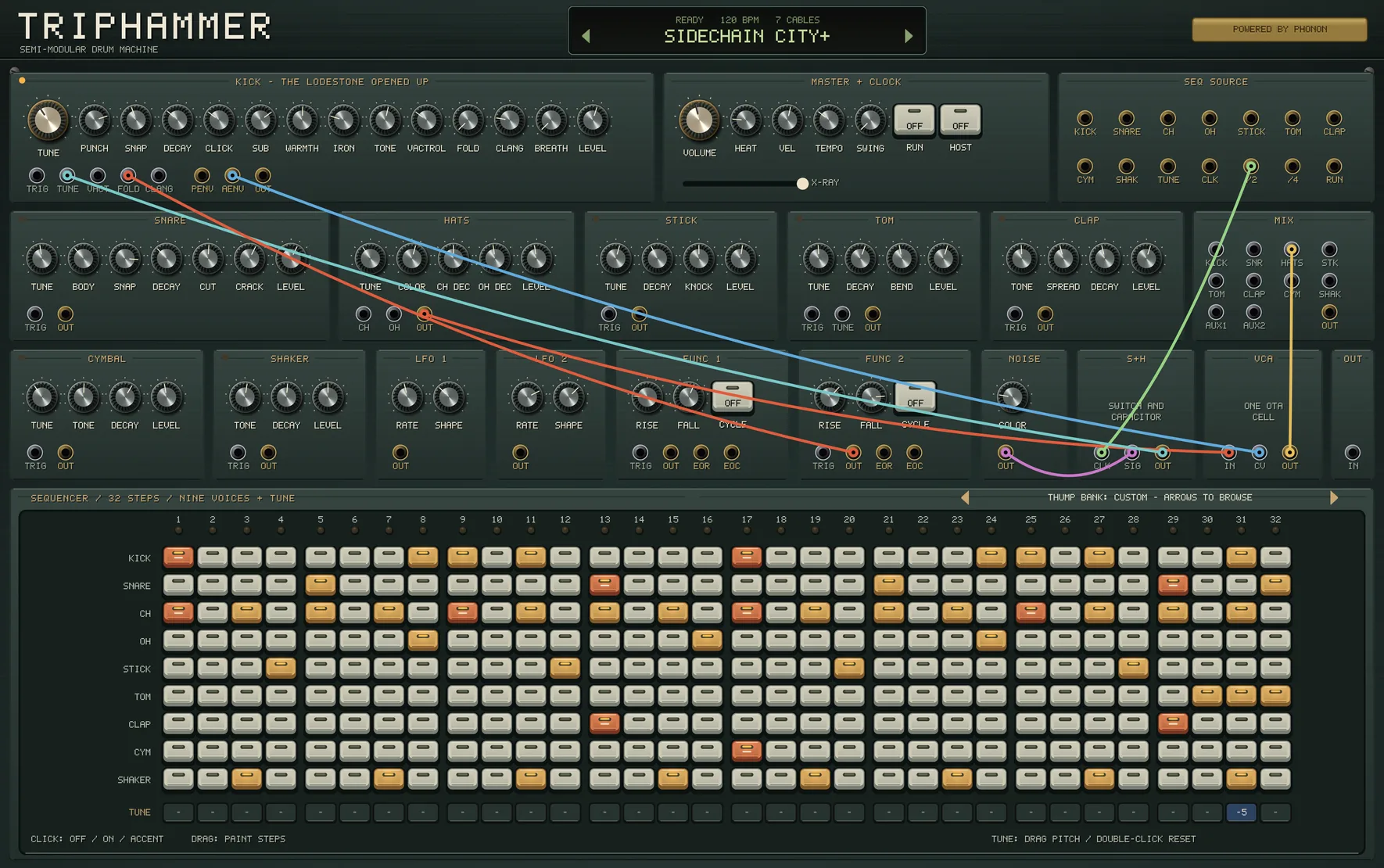
Sixty-seven jacks
A patchbay usually asks you to build the machine before you can play it. This one is already wired: the printed normals are the drum machine, and inserting a cable breaks that jack's normal, exactly like the semi-modular tradition that invented the idea. Nothing here is a blank slate demanding a diagram.
Level and offset live on the wire rather than taking up panel space, so inverting an envelope is part of patching it rather than a module you have to go and find.
Loops closed through the patchbay are scheduled with exactly one sample of seam. Everything acyclic runs at full speed, and modules you have not patched cost nothing at all.
Not a copy of the envelope, not a follower reconstructing it: the voltage that is already shaping the hit, available on a jack. That is why the sidechain patch needs no compressor.
Your pattern, the tune lane and every cable go into the project file. Reopen it a year later and the patch is still hanging on the panel.
Nine of seventeen presets
You do not have to learn modular to have any of this. You click a preset. Every figure below is a meter reading from the render tour, which audits each of these on every build.
hats duck 23 dB
The kick's amplitude envelope - the actual voltage on the actual capacitor that shapes every hit - is an output jack. Run it through the attenuverter inverted, into the VCA's control port, and put the hats through that VCA. Every kick strike closes the hats down and lets them swell back, with no compressor anywhere in the instrument.
4 distinct pitches in 8 strikes
A sample-and-hold clocked by the sequencer's own eighth-note jack deals the kick a new pitch on every hit. The sequencer is not driving a hidden parameter here; it is a gate on the panel going into a module on the panel.
17.6 dB swing in brightness
A cycling function generator leans on the kick's wavefolder across two bars, so the drop builds itself rather than being drawn in an automation lane. Set the cycle to the bar and it repeats forever without a single breakpoint.
bounded, indefinitely
The mix feeds itself back through an LFO-driven VCA, because feedback through the patchbay is legal here. The scheduler closes the loop with exactly one sample of seam, and the patch stays bounded for as long as you care to leave it running.
Hear it
Straight out of the plugin, no processing. Every sound in them is a circuit being solved, and several of them are cables doing the work a plugin would usually be doing.
The kick bench
The kick is Phonon's Lodestone module. Not a port and not a remake: the same source file the DAW compiles, linked whole. A real RC capacitor for the pitch sweep, a real expo converter under it, an OTA for the gate, a class-A stage for the warmth, and an output transformer whose flux saturation grits the body of the hit while leaving the attack and the tail clean - because flux is the integral of voltage, and a kick sweeps three octaves through it.
Here it has fourteen knobs, including four stages the free machine keeps parked at zero. All four are also CV inputs on the patchbay, and the drum's two envelopes are outputs.
Crossfades the gate element from the OTA to a vactrol lowpass gate. The photoresistor's own memory rounds the strike and blooms the tail - and it blooms a quiet hit more than a loud one, because a vactrol compresses dynamics the way only a slow part can.
+2.8 dB tail on a full hit · +5.5 dB on a soft one
Puts a wavefolder before the transformer, so the folded harmonics then pass through the iron rather than being added after it. Order matters here: the same fold after the transformer is a different sound and a less interesting one.
+17.3 dB of brightness wide open
Patches a second expo converter into the oscillator's FM input at a ratio that follows the pitch sweep down. The knob's lower half is a bell on the strike; the top of it is the full metal.
a fixed inharmonic ratio, tracking the sweep
A noise layer through its own germanium diodes, opened by the envelope that is already shaping the hit rather than by one of its own.
gated by the drum's own envelope
Nine voices
The five cards from the free machine come across whole - the bridged-T snare shells with their germanium crack, the six-oscillator metal stack behind the hats, the stick, the tom, the clap. Same circuits, same source files, not re-tuned for the paid one.
The same six-oscillator metal, through two band paths racing separate envelopes: a strike that speaks first and dies, and a wash that carries. Short decay is a ride and long is a crash, on one knob, because that is genuinely the difference.
The maraca circuit: noise through a bandpass into an OTA under a real attack capacitor, so the grain leads and the body follows it rather than arriving together.
The sequencer is a module
It does everything you expect - two bars on screen, accents, swing, host sync - and then does the thing no drum machine sequencer does: it appears on the patchbay. Nine row gates, the clock with its divisions, a run gate, and the kick's TUNE lane as a CV output, one signed semitone per step, sampled at the strike like a hardware CV row.
Measured: a step set to +7 rings a fifth above its neighbours, at a period ratio of 1.49 against an ideal 1.50. Patch that lane into the TOM instead and the fill tracks your bassline. Patch a row's gate at a different drum and you have rewired the groove without touching the pattern.
The groove catalogue, complete
Lodestone ships the same catalogue across seven lanes. Nine lanes recovers the hundred and six cymbal- and shaker-family percussion parts that a seven-voice machine had no honest voice for - so these are not more grooves, they are the same grooves, whole.
If you already have the free one
The panel
Nine voices, a utility row of two LFOs, two function generators, noise, sample-and-hold, a VCA and the output, and the sequencer underneath them all. The display counts your cables. The jacks are drawn where the circuit actually connects, which is why the panel can be read as a diagram of itself.
No activation
There is no activation step, no license file, no dongle and no server dependency. Activation is friction aimed at paying customers; the people who were never going to pay do not see it.
Your purchase lives at the store so you can re-download it. The plugin never asks who you are. It works offline forever, reinstalls without ceremony, and keeps working no matter what happens to us.
Coming soon · no activation
Triphammer compiles the same component-modeling source files as Phonon, our DAW - and its kick is not a copy of the DAW's Lodestone module, it is that module, linked whole. That is the strongest version of a claim the whole catalogue makes: the plugin and the DAW cannot drift apart in sound, because in this case there is only one of them.
macOS VST3 and Audio Unit are in development.
At a glance
| Format | VST3 · Windows 64-bit |
|---|---|
| In development | macOS VST3 and Audio Unit |
| Voices | 9 · the kick is Phonon's own module |
| Patch fabric | 18 modules · 67 jacks, every input normalled |
| Sequencer | 9 × 32 · tune lane ± 24 semitones |
| Grooves | 237, across all nine lanes |
| Presets | 17 · 9 with cables already in them |
| Parameters | 63, all automatable |
| Activation | None. No license server, no phone-home |