
Component-Modelled Snare Drum
Rivet Gun
A snare is two things. This is the knob between them.
A kick is one circuit. A snare is two - a body, and the wires lying against it - and what makes it a snare is how the one drives the other. Every classic snare circuit is one fixed answer to that question. Rivet Gun makes it a knob. Around that: three bridged-T resonators behind a real pitch capacitor and an op-amp's rail, a germanium crack, five notes that play it the way a drummer does, a class-A stage, the iron, a gated steel plate - and an LFO with a switch under every knob, because a real snare is never the same drum twice.
VST3 · Windows 64-bit·No activationmacOS VST3 and Audio Unit are in development.
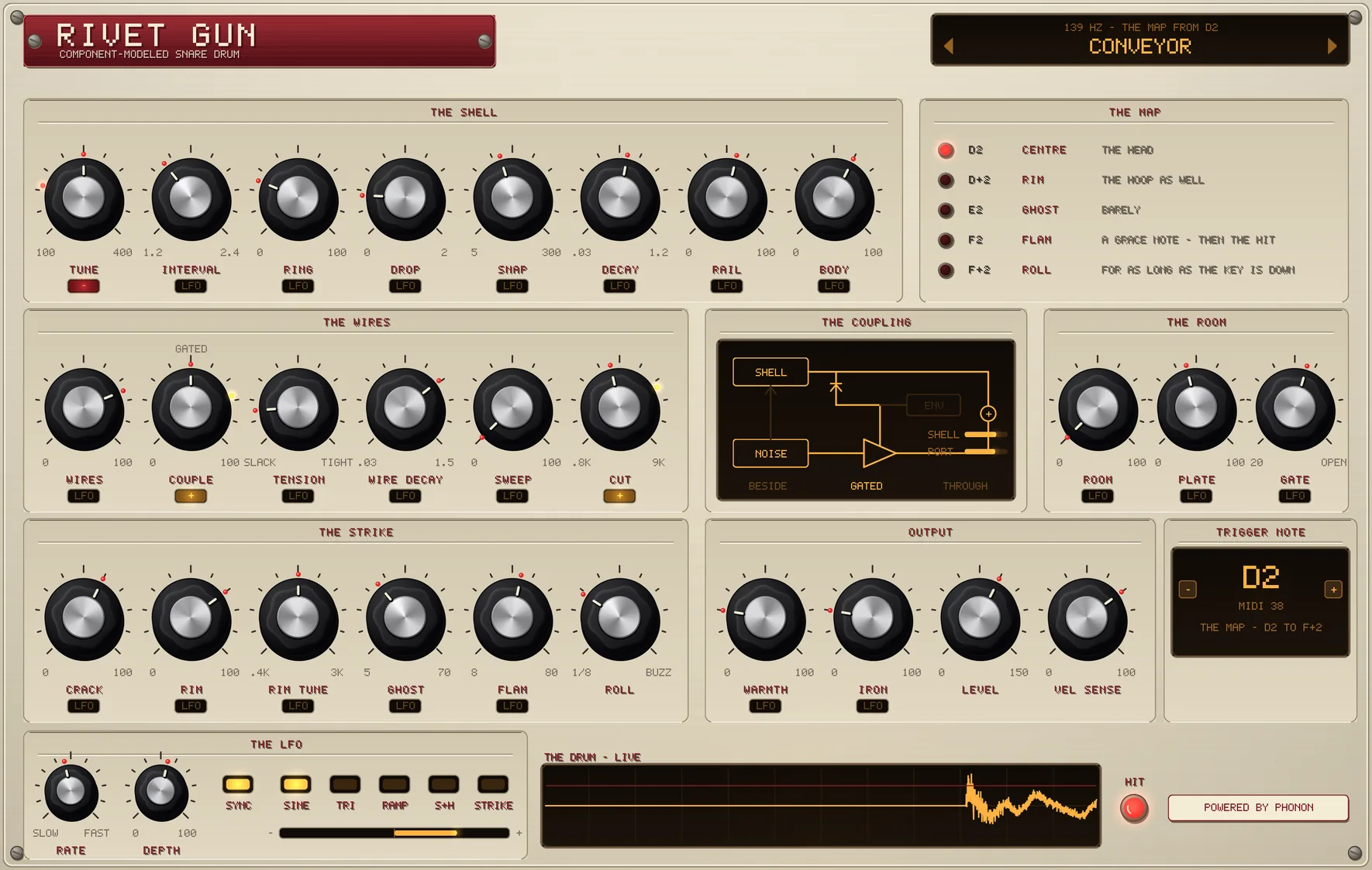
The knob between them
A snare is two things
A body, and the wires lying against it. What makes it a snare is how the one drives the other, and every classic snare circuit is one fixed answer to that question. Here it is a knob, and it does not click between three settings - it runs. Measured a quarter second after the strike, on a 60 millisecond body under 600 millisecond wires:
The rectified shell holds the wires open, so they speak while the head moves and stop when it stops.
The wires, a quarter second in
below -120
The shell's 186 Hz line
Not measured here
The head stopped, so they did. This is the one thing that is only true here.
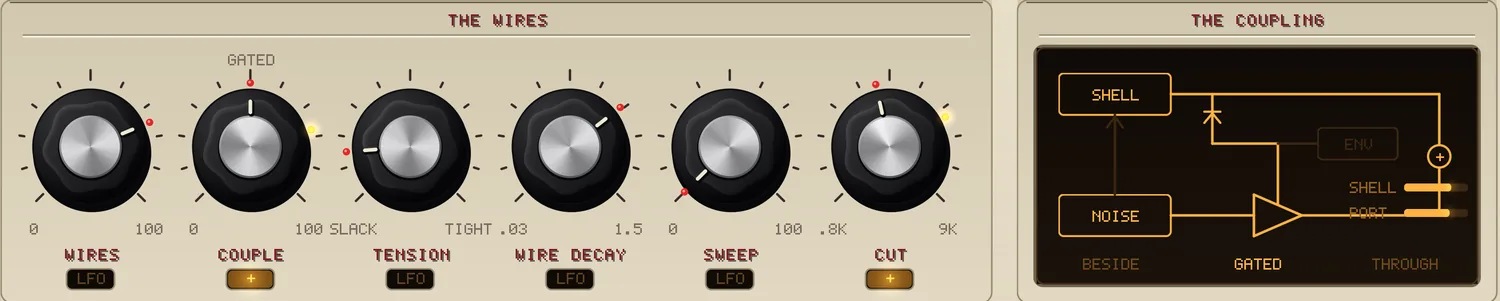
The schematic on the panel is not a picture of the idea. Its three paths light by where COUPLE stands, and the two meters beside it - the rectified shell, and the amplifier's control port - are read off the engine while it plays.
A threshold, not a gate
What makes a ghost a ghost
TENSION is a threshold on the wires' control, whoever is holding it. Slack wires answer anything and tight ones only crack: the wires alone fall 40 dB in 318 milliseconds slack, and in 36 tight.
It is also the reason a ghost note sounds like one. Going from a full hit to a ghost, the drum does not simply get quieter - the wires leave faster than the hand does, and that is TENSION doing it rather than any gate.
SWEEP swells them in after the strike, a brush rather than a stick, and it reaches them whoever holds their port: gated, the wires' first 8 milliseconds against 60 milliseconds in read +16.6 dB struck and -3.7 swept. CUT is their colour, 800 Hz to 9 kHz.
Centre hit to ghost, what falls
The body
14 dB
The hand's own arithmetic: a softer hit is a smaller hit.
The wires, slack
11 dB
They follow the hand and nothing else, so they fall with it.
The wires, at the shipped TENSION
19 dB
Beside the body. The threshold is already taking them off the soft hit.
The wires, gated by the body
23 dB
And the body's own envelope takes them the rest of the way.
Three resonators and a capacitor
The shell
TUNE is where the drum lands, INTERVAL is the second mode, and RING is the third - the one nobody taped down. DROP and SNAP are a pitch capacitor, and RAIL is how early the op-amp runs out of swing, so a hard hit ducks and blooms instead of just getting louder.
The exciter is scaled against the tuning, so the drum is as loud at 110 Hz as it is at 400.
Velocity reaches the circuit
The hand
Not just the level. A soft hand is a rounder pulse, so it lights the shell differently: its upper modes sit 13.3 dB under the fundamental under a hard hit, and 16.3 under a soft one. The same hand sets how far the wires open, how far into the rail the shell goes, and how hot the germanium CRACK runs.
Rivet Gun is voiced loud, and only a full-velocity hit ever meets the output rail.
One drum, five notes
Played the way a drummer plays it
Five notes up from the trigger note, and every other note on the keyboard is someone else's drum. Move the trigger note and the map moves with it, exactly as the panel prints it.
Trigger note
D2MIDI 38
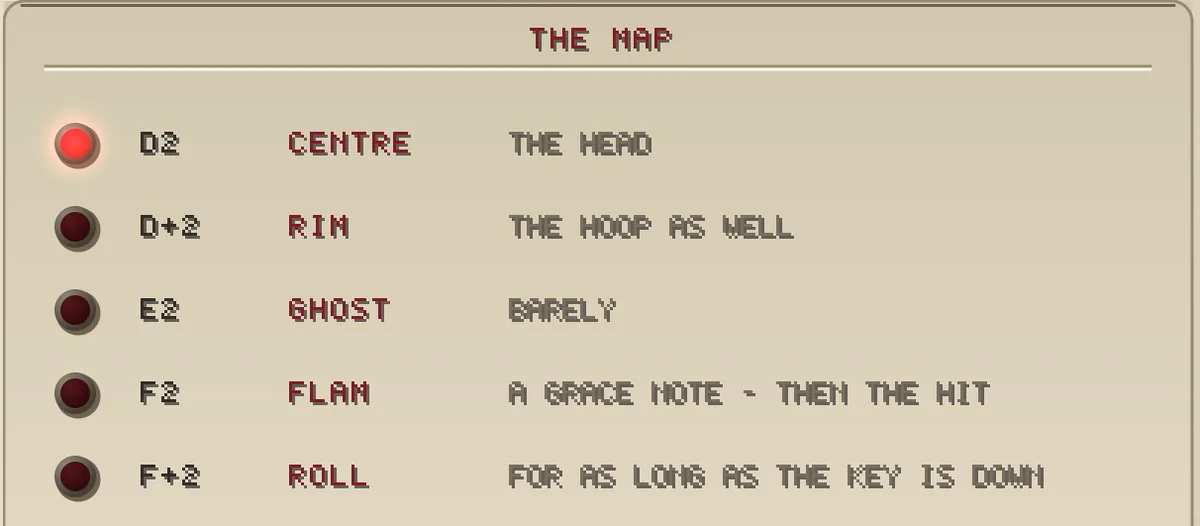
Nothing here resets. A flam lands on a body that is still ringing, because every capacitor charges from where it sits rather than from zero.
Twenty-four switches
Never the same drum twice
A snare is over in a fifth of a second, so a slow LFO does not wobble it - it makes every backbeat a slightly different drum. One oscillator, and a three-way switch under each of the twenty-four knobs it can reach: dark, amber for plus, red for minus. A lit knob swings a share of its own travel either side of where it stands, and carries a bead on its rim showing where the LFO has it now.
STRIKE is the shape that is not an oscillator: it throws the dice once per strike and holds them. With the transport running the dice are read off the song position, so the same hit in the same bar is the same drum - played from the top or from bar 3, the difference is 0.0 Hz. The bounce is the playback.
RATE syncs to twelve divisions from 8 bars to 1/32, three of them chosen because they do not divide the bar. And with every switch off the LFO touches nothing at all: the drum is the unmodulated drum to the last bit.

After the drum
The room and the iron
WARMTH drives a class-A stage and IRON drives a transformer, so the two thicken the drum from different ends. ROOM is a steel plate, and GATE shuts it.
Demos
20 takes, played by us
Straight out of the plugin, no processing on the way here. The first six are the drum on its own; the rest sit in a pattern, over Pile Driver and a hi-hat out of Phonon, because there was no reason to borrow anybody else's.
The drum alone
In a pattern
With the LFO lit
Sixteen from the shop floor
The same drum, every time
Two copies of Rivet Gun built one after the other differ by exactly nothing, sample for sample, flams and rolls included. It runs at about twenty times faster than realtime with a 1/64 roll into the plate, and nearly that with every LFO switch lit - on the machine it was timed on, which is not a promise about yours.
The sheet
What is in the box
Powered by Phonon
One drum, wired two ways at once
Rivet Gun adds no new core to the Phonon engine. The bridged-T resonators, the OTA, the rectifier, the class-A stage and the plate were all already there - the drum is in how they are coupled. It is Pile Driver's sibling, in another coat.
VST3 · Windows 64-bit - macOS VST3 and Audio Unit are in development. No activation, and the plugin never asks who you are.
At a glance
Rivet Gun specifications
| Format | VST3 instrument · Windows 64-bit |
|---|---|
| In development | macOS VST3 and Audio Unit |
| The drum | One snare · three bridged-T shells, noise wires, one rectifier |
| Couple | BESIDE / GATED / THROUGH, continuous |
| At a quarter second | Wires -77 dBFS beside · below -120 gated |
| Through | The shell's line at -55 dBFS, against -95 beside |
| Tension | Wires fall 40 dB in 318 ms slack · 36 ms tight |
| The ghost | Body falls 14 dB · wires 19 beside, 23 gated |
| Tune | 100 to 400 Hz · interval 1.2 to 2.4× · drop 0 to 2 octaves |
| Rail | 10.6 dB of dynamics wide open · 8.0 with it up |
| The map | Centre, rim, ghost, flam, roll · five notes, one trigger |
| Flam | 28.0 ms as it ships · 8 to 80 on the knob |
| Roll | 1/8 to 1/64, triplets, and a free buzz |
| The LFO | 0.05 to 30 Hz or 12 divisions · a switch under 24 knobs |
| Switched off | Bit-identical to the unmodulated drum |
| The room | Steel plate · gated, below -120 at half a second |
| Presets | 16 from the shop floor |
| The panel | 1280 by 812 · it fits a laptop |
| Instances | Sample-identical, flams and rolls included |
| Activation | None. No license server, no phone-home |
| Engine | No new core in Phonon: the drum is in the coupling |