
Nine-Voice Board-Fitted Component-Modeled Polysynth
Realgar Red
Uncompromising. Exceptional. Yours.
Realgar Red is not one synthesizer. It is the factory and the workbench one comes from. There is one signal path, and every position on it is an empty bay: three for oscillators, two for filters, one for the amplifier, three for envelopes, three for modulators. You choose which circuit stands in each. It never rewires; the parts move.
Then it builds you a unit. Every resistor and capacitor in it is a little off its nominal value, and those values are drawn from a serial number that is yours. Your nine voices are not alike, and they are not like anyone else's. It warms up. Its power supply sags under a big chord. Its parts walk with age, each kind its own way. There are no tuning pots: one CALIBRATE button brings it back into tune, as it stands at that moment.
And then it plays itself, three ways, and every one of them is frozen to the song: an arpeggiator that is a flock, eight patterns that move any control, and sixty-four steps of everything a step can be.
It is not a quick instrument. It asks for your time and your patience, and every voice in it is a full circuit model running at twice the sample rate. If that sounds like an argument against it, this is probably not your synthesizer.
VST3 · Windows 64-bit·No activationmacOS VST3 and Audio Unit are in development.
Demos
28 takes, and nobody designed the patches
A script fitted each one: three oscillator boards, two filters and the rack drawn by lot, two to four automata lanes on whatever they landed on, and every other take through the arpeggiator or the sequencer. Then it held a chord progression through the patch for half a minute. We made a hundred and kept the twenty-eight we liked, and each says what it was fitted with. Straight out of the plugin, no processing on the way here, levels matched so you can move between them without reaching for the volume.
Oscillators TRIANGLE CORE, TRIANGLE CORE, LOGIC. Filters CMOS into DIODE.
Oscillators DIODE SHAPER, DIVIDE-DOWN, LOGIC. Filters SLEW into CMOS.
Oscillators TRIANGLE CORE, TRIANGLE CORE, DIODE SHAPER. Filters GATE into LADDER.
Oscillators DIVIDE-DOWN, TRIANGLE CORE, DIVIDE-DOWN. Filters CASCADE into FIZZ.
Oscillators LOGIC, DIVIDE-DOWN, DIODE SHAPER. Filters TWIN into GATE.
Oscillators DCO, DIVIDE-DOWN, DIVIDE-DOWN. Filters VELVET into FOUR-POLE OP-AMP.
Oscillators DIVIDE-DOWN, TRIANGLE CORE, LOGIC. Filters GATE into SLEW.
Oscillators SAW CORE, DCO, DIODE SHAPER. Filters GATE into SCREAM.
Oscillators SAW CORE, LOGIC, SAW CORE. Filters FOUR-POLE OP-AMP into CASCADE.
fourteen more takes
The Gnarly Side
Drawn by lot the same way, but every one of these puts the WAVE WRAPPER or the RESONANCE FOLDER to work, and most of them both: filters pushed until they ring, the ring folded back on itself, oscillators wrapped over several times a cycle. That is a great deal of distortion, and it still does not turn brittle or digital. Every edge the wrapper cuts and every knee the folder turns is placed at its instant between two samples and drawn band-limited, so almost none of what they throw above the audible range comes back down as the fizz that gives most digital distortion away. The folder folds only the filter's ring and leaves the note beneath it whole, so the fundamental and the body stay intact under the grit. And the grit itself is circuitry: filters solved as the circuits they are, loops and all, the ones that need it running at up to four times your session's sample rate, pushed into their own saturation so it moves with the note the way a circuit's does. Straight out of the plugin like the rest, levels matched.
Oscillators DIODE SHAPER, DIODE SHAPER, SAW CORE. Filters TWIN into VELVET. Wrapper on A, folder on filter A.
Oscillators DIODE SHAPER, SAW CORE. Filters FOUR-POLE OP-AMP into DIODE. Wrapper on A, folder on filter A.
Oscillators LOGIC, LOGIC. Filters TWIN into SCREAM. Wrapper on A and B, folder on filter A.
Oscillators DCO, DIGITAL WAVETABLE, TRIANGLE CORE. Filters SLEW into FIZZ. Wrapper on A and C, folder on filter A.
Oscillators DIGITAL SUPER SAW, DIGITAL SUPER SAW, DIGITAL WAVETABLE. Filters LADDER into CMOS. Wrapper on A and B, folder on filter B.
Oscillators WEST COAST, DCO. Filters DIODE LADDER into FIZZ. Wrapper on A and B, folder on filter A.
The short answer
So what is it?
Most analog-modeled instruments take a circuit, measure what it does, and fit a curve to the answer. Realgar Red never takes that shortcut. A resistor in here holds a value of its own; a transistor is solved from the equation that describes one; the loop that makes a filter resonate is solved outright every sample rather than handed a delay to keep the arithmetic cheap; and every edge, corner and diode knee an oscillator makes is found at its exact instant between two samples and drawn band-limited, so that at A7 the loudest thing any oscillator board makes that is not a harmonic stands between 64 and 118 dB under the note. Everything else follows from that. And because the parts are real, you get to choose them: every oscillator, filter, envelope and amplifier in the signal path is a board you fit yourself, and you can pull one out and stand a different circuit in its place whenever you like. 10 oscillator designs, 12 filters, 3 envelopes, 2 amplifiers. That is not a mode switch and it is not a different curve over the same circuit: it is a different circuit, with its own manner, its own faults and its own knobs, and the panel re-letters itself around whatever you fitted. The values inside your unit are drawn from a serial number that is yours, so your nine voices disagree with each other, and with everybody else's. It warms up, its supply sags under a big chord, and its parts walk with age. None of that is laid over the sound. It is what the sound is made of, and it is why the instrument asks for a real share of your processor instead of pretending not to.
Exactly what the claim covers, and where it stops: What does component-modeled mean?
The arithmetic
972,000,000 synthesizers
Three oscillator bays, each taking any of ten boards, is 1,000 ways to make the sound. Two filter bays, each taking any of twelve, is 144 more. Then two amplifiers for the one amplifier bay, three envelope boards in each of three bays (27), and five modulation boards in each of three (125). Which bay a board stands in matters: the sub and the sync follow oscillator A, and filter A is the one that can feed filter B. Multiplied out, that is 972,000,000 ways to fit the card, and every one of them is a different circuit, not a different setting of the same one, before a single knob has been turned. Then there is the serial number. There are 90,000 of them, each a unit built from its own parts, so the same fitting on two units is two instruments: 87,480,000,000,000 in all.
Five pages
One instrument, seen five ways
The panel has five pages and the tabs are where you would expect them. THE CARD is one voice end to end, with the matrix and the rack along its foot. THE CAGE is all nine cards at once, what each one has become, and the button that brings them back. The last three are the instrument playing itself: the ARPEGGIATOR, the AUTOMATA and the SEQUENCER.
Thirty-two boards, five kinds of bay
Fit a board and the panel letters itself
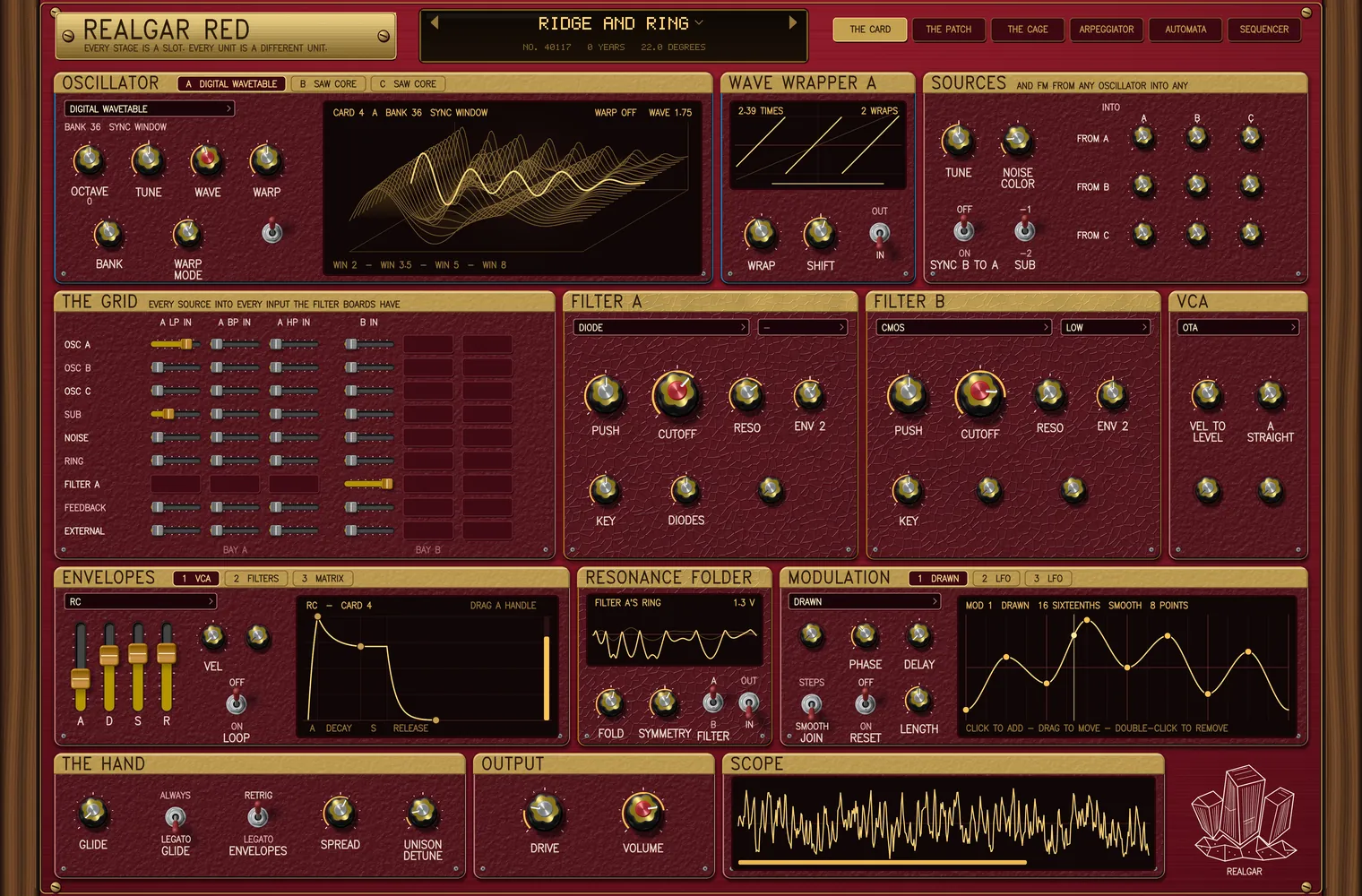
These two pictures are the same page of the same instrument. On the left, RIDGE AND RING: the digital wavetable, its knobs lettered BANK and WARP MODE and its scope become the whole bank, a diode filter, an OTA, a loop drawn in the first modulation bay, and the wave wrapper and the resonance folder both switched in. On the right, LAMP AND CELL: a triangle core whose knobs now read SINE PURITY and SAW STEP, a vactrol in the amplifier bay that says LET GO, a function generator as the first envelope, and a grid with only two live columns because the fitted boards have only two inputs between them.
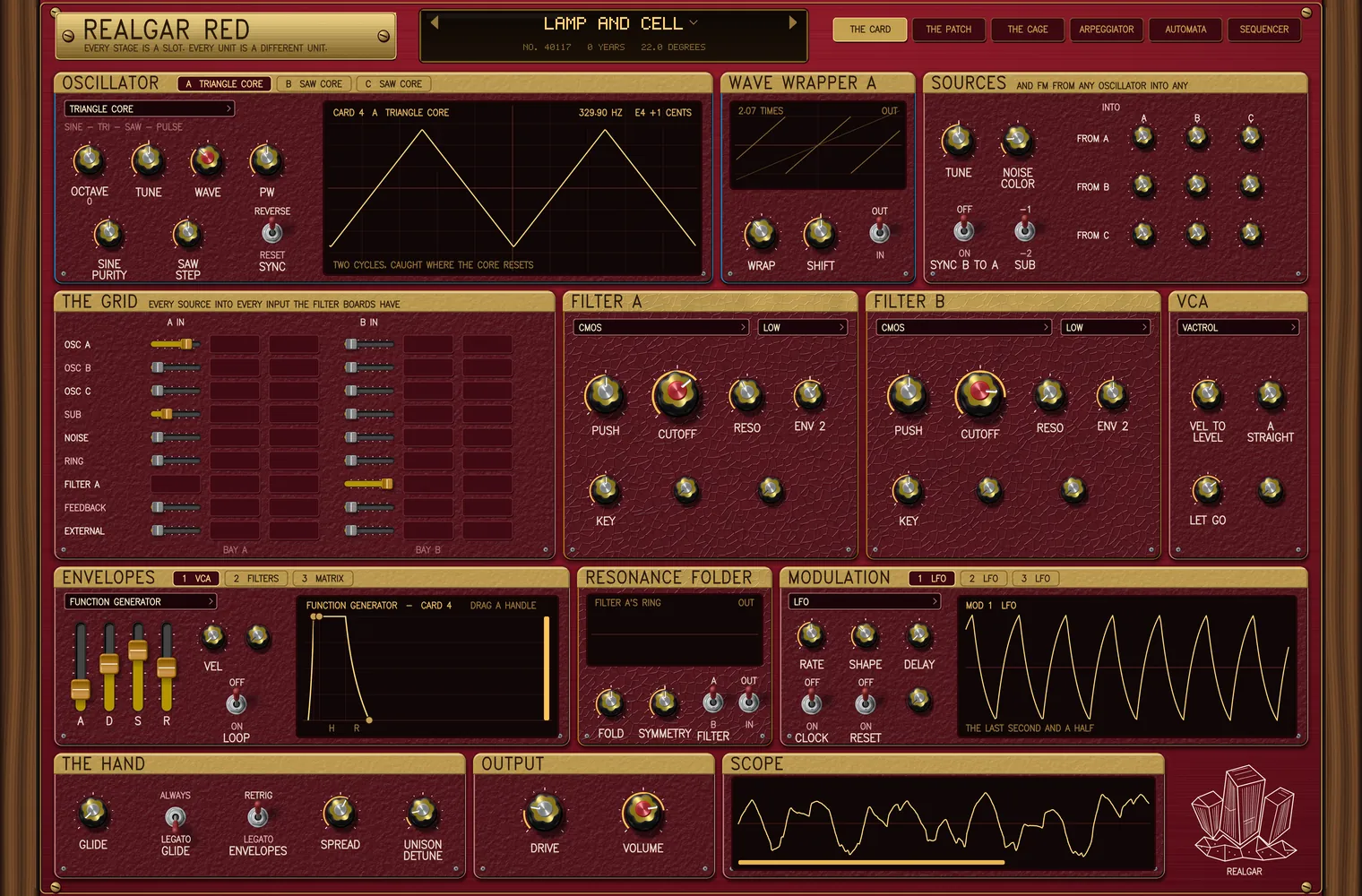
Thirty-two boards across five kinds of bay: ten oscillators, twelve filters, two amplifiers, three envelopes and five modulators. The two small knobs under a bay belong to whichever board is in it and reach inside the circuit - and at their centres, a board is exactly as your unit built it. Measured: every board, knobs centred against untouched, differs by 0.0000 cents and 0.0000000 of output.
What you can put in a bay
Thirty-two boards
Ten oscillators, twelve filters, two amplifiers, three envelopes and five modulators. Each is called what the panel calls it, and each is a different idea about how to do the same job rather than a different setting of one.
Oscillator3 bays · 10 boards
Filter2 bays · 12 boards
Amplifier1 bay · 2 boards
Envelope3 bays · 3 boards
Modulation3 bays · 5 boards
Measured: the DIODE SHAPER's sixty-four shapes are fitted to its ladder to -71.6 dB of error on average and -20.6 dB at worst - a vertical edge is only as sharp as a diode's knee - and a sine through it reads -92.9 dB of second harmonic. DRIVE runs the ramp off the end of the shape and in again at the other; KNEE is the diodes' capacitance rounding the corners as the pitch climbs.
Not a mixer
The grid
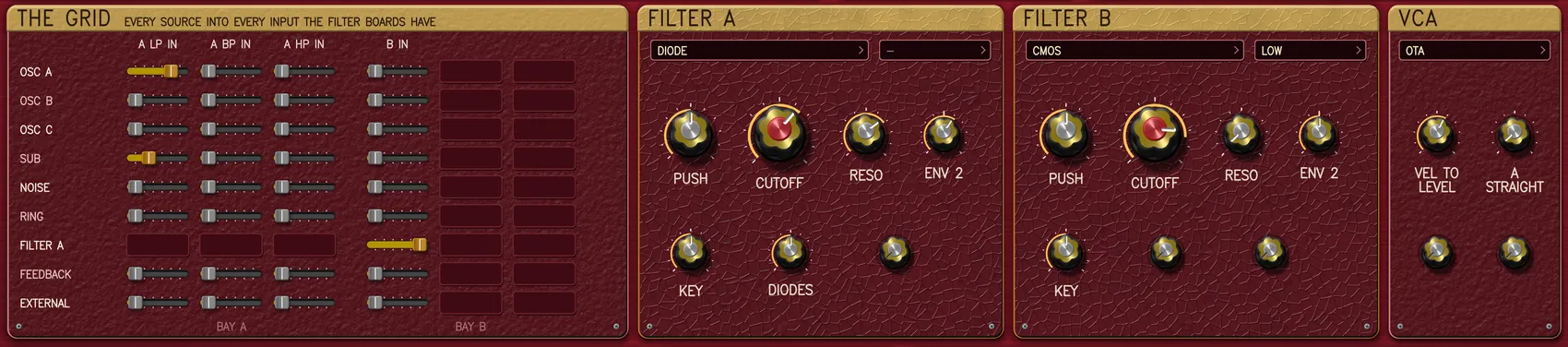
Nine sources down the side, and across the top the inputs the fitted filter boards physically have - the diode filter has three and lights three columns; a ladder has one. Three of the rows exist so that three features need not: FILTER A is the first filter's output, so sending it to the second is series and leaving it out is parallel; FEEDBACK is the voice's own output; EXTERNAL is whatever you plug in.
One knob, twelve answers
PUSH
Every analog filter was designed to see a certain level, and every one of them changes character when it is fed more. How it changes is the most recognisable thing about it. PUSH is the level going in, with most of it taken back out afterwards, centred on the level each board was designed for - so the same knob position is the same amount of misbehaviour on every board, and the boards disagree about what misbehaving means.
PUSH from 10 to 95: the change in a saw's 20th harmonic against its fundamental
And one for the bass players: a one-volt 55 Hz tone goes through the op-amp four-pole at -0.01 dB with -90.1 dB of distortion, and through the cascade at -0.01 dB with -84.5. Four transconductance cells wired the obvious way, each end of a stage through its own curve, return it 1.90 dB down with -11.0. The cascade's cells are wired as the chip wires them, each saturating on what the feedback leaves it, so it keeps its bottom too.
Two stages, not boards
Wrapped, and folded where it rings
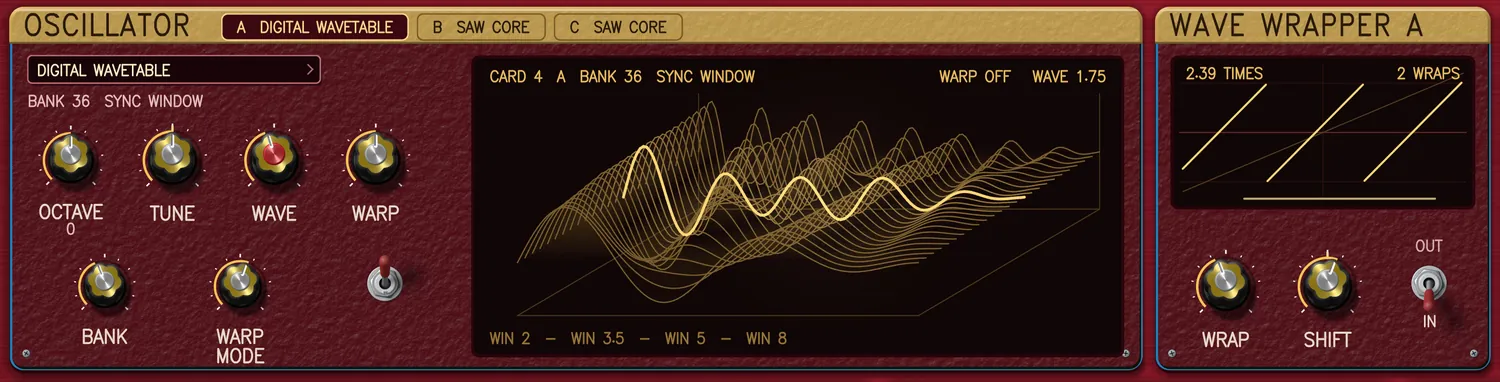
Every oscillator bay ends in a WAVE WRAPPER, in its own card beside the oscillators and lettered with the bay you are looking at. A wavefolder turns a wave back at its limit; a wrapper carries it over to the opposite edge and on, so a wave driven past the window comes out in pieces, each dropped or lifted by the window's height. It is a ladder of comparators and a switched offset. WRAP is the gain in front of it, one to eight times, and SHIFT moves the wave in the window so the wraps go lopsided. Every threshold and every step is a resistor your unit drew, every wrap is drawn band-limited at its instant, and everything that listens to the bay hears it wrapped: the grid, the ring modulator, FM and the scope.
The resonance folder
The RESONANCE FOLDER is a wavefolder that folds one thing only: a filter's resonance, A or B. To find it, the card runs a twin of that filter - the same board, built from the same parts and fed the same, with no resonance - and what the resonance adds about the filter's own cutoff is the ring. Only the ring goes through the folding cells, WEST COAST's five, and back; the body of the sound and its bass go through untouched. FOLD is how hard the ring drives the cells, and SYMMETRY offsets it. It does not need the filter to self-oscillate: a resonant filter rings on every note, and the folder hears it. Switched OUT, either stage is no stage at all, so every patch sounds as it did.

Drawn from a serial number that is yours
Every unit is a different unit
None of this is a drift knob. Six separate mechanisms, each with its own control, each opening at half of its physical extreme. The first time the instrument is opened it draws a five-digit serial and keeps it in a text file beside your other application data. It is not a licence, it identifies nobody, and it is never sent anywhere - delete the file and you have a different instrument.
The tolerance of the parts: 0.1, 1, 5 or 10 percent. A unit of any grade leaves the factory in tune, because pitch can be trimmed - what cannot be trimmed is a capacitor.
Nine envelopes' fall times spread 2.5% with 1% parts, and 37.7% with 10%
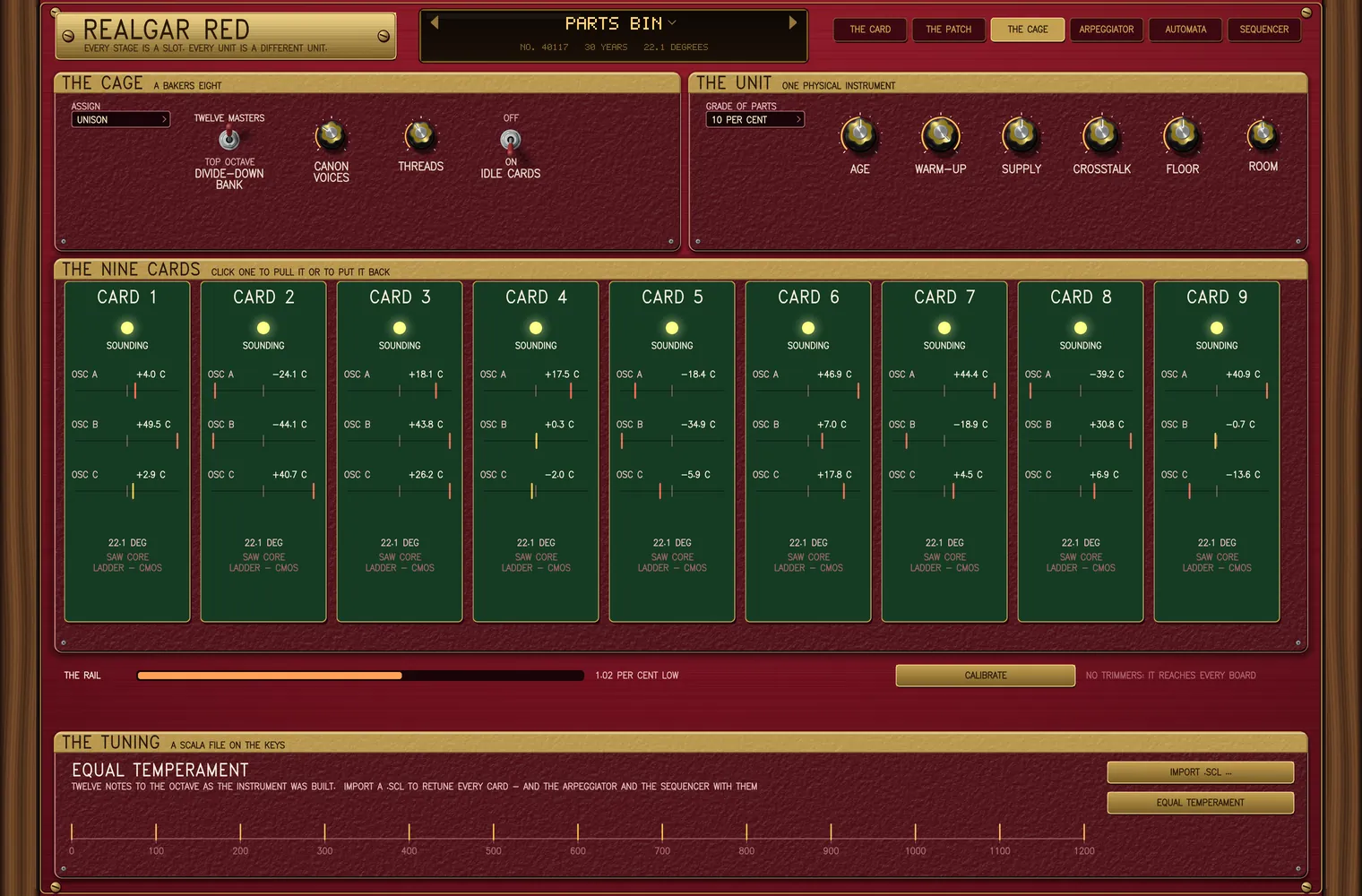
THE CAGE, wearing PARTS BIN: nine voices in unison with no detune at all, built from 10 percent parts, thirty years old and never recalibrated. Every number on it is one oscillator's distance from true. The spread is the unit.
No tuning pots
One CALIBRATE, and what it cannot reach
There are no trimmers on the panel. CALIBRATE, on THE CAGE, sets the unit again as it stands at that moment: a real autotune, through a converter with a real converter's finite step, and for the one board that has no converter, the tune that a technician's screwdriver used to do. What it cannot reach is honest too - a sine shaper that has wandered, a capacitor that has dried out - and the Service Manual says which is which, with a data sheet for every board.
Measured: calibrating a unit cold moves one oscillator's scale adjustment from +305 to -515 parts in a million, because a temperature error is a scale error. Three LOGIC oscillators on every card, forty years on with nobody touching them, read 44 cents out at worst; after CALIBRATE, 0.00. A session saves its calibration, its patterns and the serial it was made on - opened on somebody else's copy, the instrument becomes that unit, the display reads A VISITOR, and the session sounds as it was saved.
Service Manual · 4.1 Adjustments provided
One: CALIBRATE, on THE CAGE page. The instrument has no tuning pots and no service page. Inside, each card still carries ten adjustments (SCALE and OFFSET for each of the three oscillator bays and each of the two filter bays, ninety in all), but nobody turns them by hand: the factory sets them, CALIBRATE sets them again, and where it left them is saved with the session.
Service Manual · 1.3 Notice concerning derived values
The following values were derived from the physics of the circuit and not calibrated against a hardware specimen: the SLEW filter's knee and rail (and therefore the pitch at which it sings); the FOUR-POLE OP-AMP filter's resonance behaviour; the ageing coefficients of section 3.2. They behave correctly in kind. Their magnitudes are engineering estimates and are marked where they appear.
Nine cards, a baker's eight
Dealt round, not first-free
Round-robin is how you hear that the voices are not alike: strike one key nine times and you have heard nine instruments. UNISON fans all nine. MONO keeps the keys you are still holding. CANON passes your line down an analog shift register, each voice playing the note the one before it played last, and each hand-off landing a little short. Pull a card out of the cage and it is dealt round, as if it had gone for repair.
Measured on a cold 5 percent unit
One key struck nine times
16.9 cents
End to end, across the nine cards.
CANON, after a line ending 64, 67, 69, 72
72.00 · 68.97 · 66.92 · 63.88
Each hand-off lands a little short of the note it is copying.
Worked on four threads, or on one
identical
To the sample, at any block size.
THE TUNING
Any scale on the keys, and the players follow it
THE CAGE takes a Scala file, the form tunings are shared in: up to 256 notes, key 60 its first, each key up the next degree. Every card plays in it, and so do the players. The arpeggiator finds its octaves and its ninth in the tuning; the sequencer's steps are intervals found in it, so a step of +7 is the tuning's nearest fifth, and its scale is read at the tuning's nearest pitches. The tuning is saved with the session, a preset leaves it alone, and EQUAL TEMPERAMENT puts the instrument back as it was built.
It plays itself, three ways
Frozen to the song
An arpeggiator, eight automata lanes and a sixty-four-step sequencer - and all three draw every choice they make, chance, variation, order and the grain of humanising, from the step's place in the song and a seed, never from the moment. The same bar is the same music every time you come back to it, at any buffer size, and a bounce is the playback. There is no random number generator in any of the three.
ARPEGGIATOR
The flock that rises off a chord
Hold a chord. The arpeggiator is a transformer, not a composer: the held notes over one to four octaves are the ladder, and the CONTOUR is the path across the rungs - up, down, pendulum, converging, diverging, as played, weaving, CASCADE (short falling runs whose start climbs), wander, or a lane of sixteen steps you draw. Pitch resolves the moment each note sounds, so change the chord mid-run and the run bends into the new harmony on its very next note.
COLOR weaves the ringing 9th and 13th between the rungs. DRIFT walks the whole pattern along the ladder and home. Eleven rates, through quintuplets and septuplets, and a pattern five steps long phases against the bar and meets it again five bars on. SWING, BREATH, HESITATE, CURVE and RUBATO bend its time. THE CANON adds two more voices reading the same path late, an octave apart and quieter, so it is always in harmony. IMPROVISE plays hand-written moves: a rest, an octave pop, a double, a turn, a grace note.
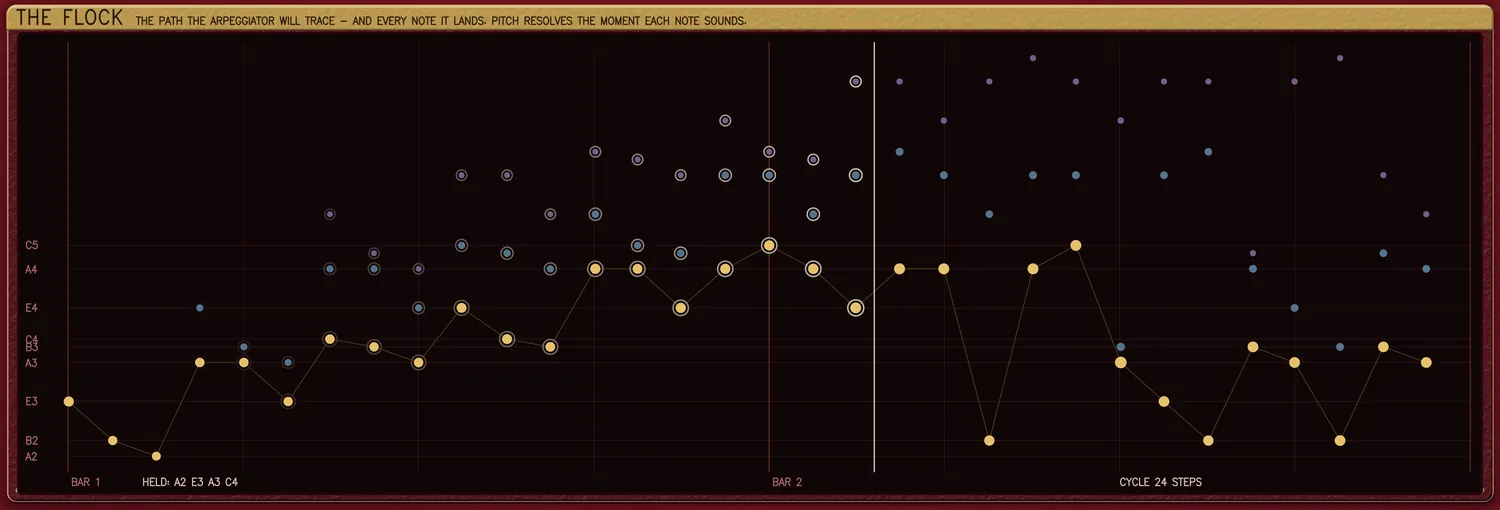
THE FLOCK draws the path it is about to trace two bars ahead, and rings each note as it lands. Its dots are the notes.
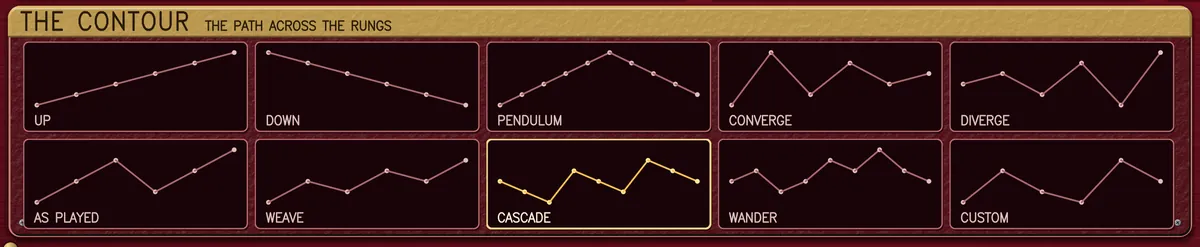
AUTOMATA
Eight patterns, any control
Eight lanes. Each is a generative pattern that has hold of one control, and the control is anything on the instrument that has a meaning: press IT MOVES, then touch the knob, on whatever page it lives - a cutoff, a cell of the grid, an FM amount, a knob of the arpeggiator, a machine in the rack. A pattern repeats every one to sixty-four sixteenth notes, or runs free and never comes round. The control SNAPs to each value, GLIDEs to the next, or EASEs there. While a lane holds a control, the knob shows where the lane has it and wears a ring; your own setting is never touched, and switching the lane off puts the knob back where you left it.

Twelve algorithms, each drawn by itself on its tile and each naming its own two knobs: RANDOM, DRUNK, FRACTAL, ORBIT (three sines in the golden and silver ratios, which never line up the same way twice), WAVE, BOUNCE, EUCLID, SIEVE, HALTON (every value as far from the others as it can get), LOGISTIC (the smallest equation with chaos in it), CELLS (a ring of nineteen cells, each made from its neighbours) and REGISTER.

SEQUENCER
Sixty-four steps of everything a step can be
Four bars of sixteen, and every key held plays the sequence from its own pitch, so a held triad is the sequence in three-part harmony, dealt round the cage like any other notes. A step is a note or a rest, put through a SCALE rooted on the key you hold, so the sequence is the same tune in any key. It can TIE into the next - the same voice carries on through its glide capacitor, its envelopes not started again - be ACCENTED, which is harder into both filters rather than louder, RATCHET two to four times, speak by CHANCE, have its own VELOCITY, LENGTH and NUDGE, play only on certain passes, and carry two LOCKS: values two controls of your choosing take for that step alone. A rest can carry a lock, so a filter can open on a step where nothing is struck.
Or stand it in front of the arpeggiator. Then it strikes nothing: each step moves the chord the flock rises off. Four slow steps are a chord progression under a held chord; sixteen fast ones are a second mind inside the first.
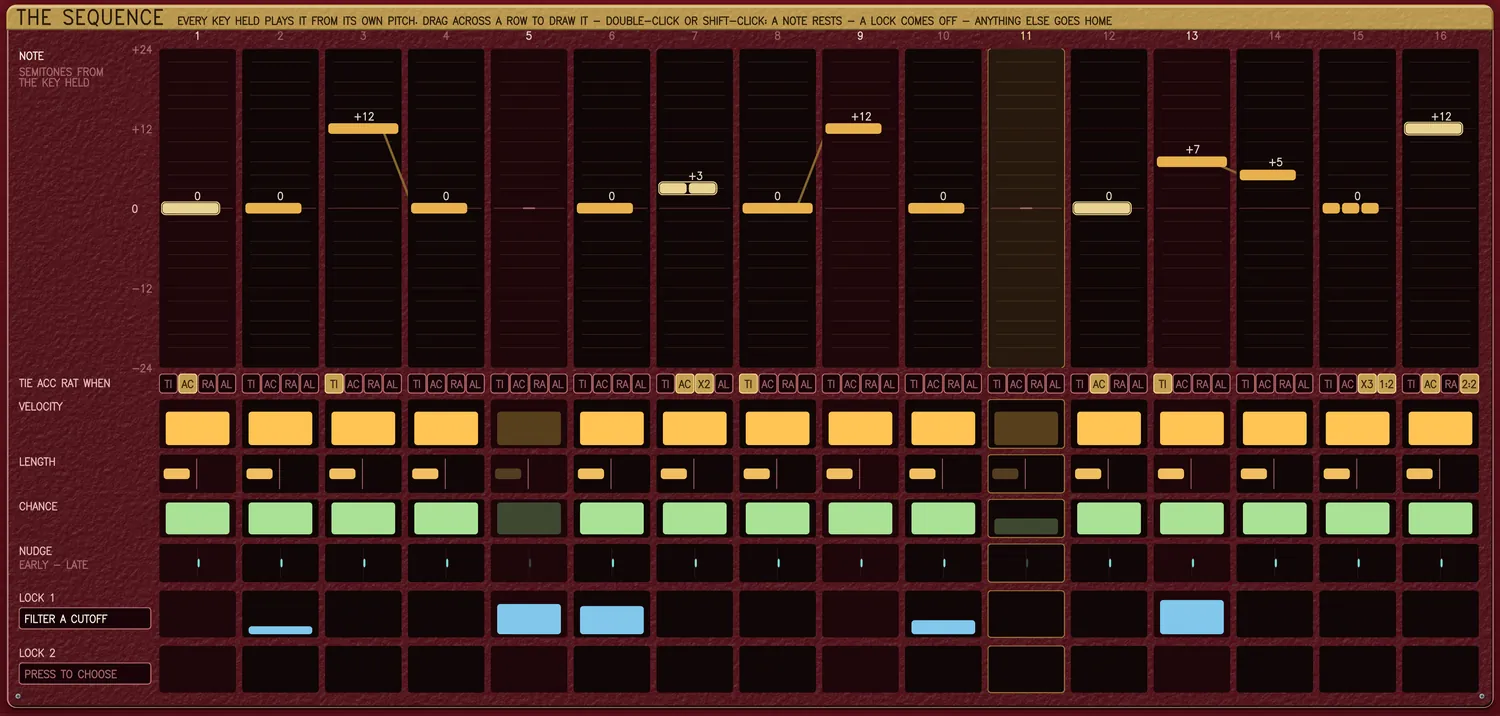
The matrix and the rack
Sixteen slots, and a rack
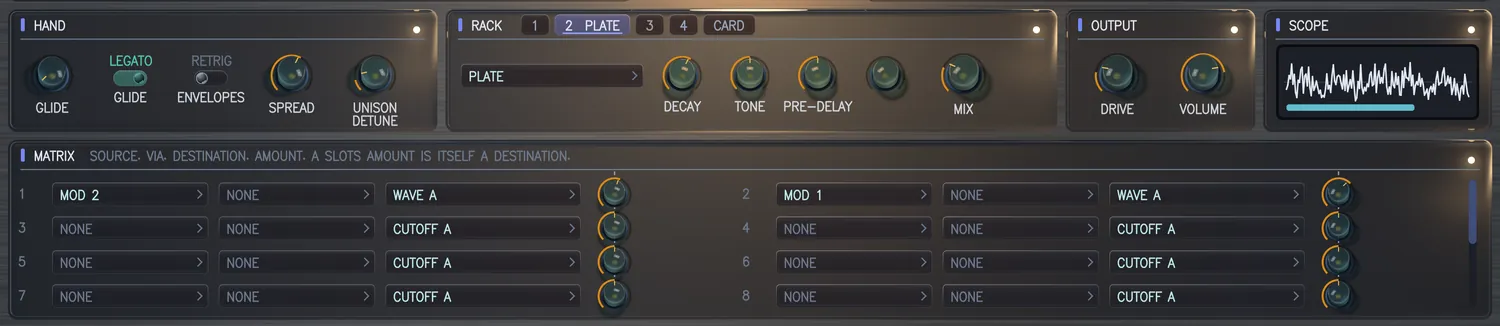
Sixteen slots of source, VIA, destination and amount, on every voice, every sample. The destinations include the grid's six columns - a VCA on a filter input - and the other slots' amounts, so one slot can play another, and the wave wrapper's WRAP and SHIFT on each bay and the resonance folder's FOLD and SYMMETRY. Seven machines in a four-slot rack, and a fifth slot that puts one machine inside every voice: three notes through one distortion intermodulate, and three notes through three do not.
For the person who reads this far
Built to be added to
The parameter table was designed once. Fixed-size blocks with room held in reserve, and every board selector declared at its ceiling - sixteen oscillator boards, thirty-two filter boards - so a board we add next year never moves a board that is already there. Three whole pages have been added to this instrument since, and not one saved session moved: the arpeggiator took the block the old sixteen-step player had, the sequencer's controls came out of one block's reserve, and the automata live in the session rather than the parameter list. The wave wrapper and the resonance folder came the same way: their thirteen controls out of the oscillator and filter blocks' reserves, their eight matrix destinations added after the last. A session you save today opens unchanged, and so does one saved by any earlier build.
The LADDER board is saved as 0.161290 of its selector. A seventh filter board would be saved as 0.193548, and the LADDER would still be 0.161290.
The parameter table
336with a meaning today
131 of 467 held in reserve, which is 28 percent of the table kept empty on purpose.
The sheet
What is in the box
Every voice is a full circuit model running at twice the sample rate, and this instrument is heavy on purpose. Nine voices run a little over twice realtime on one thread of a current desktop processor, about six times on four - on the machine it was timed on, which is not a promise about yours.
Powered by Phonon
A red that does not stay where it was put
Realgar is the painters' old orange-red: a mineral, for centuries the only pure orange-red there was, and an arsenic sulfide - which makes it Scheele Green's sibling on this shelf. It is also famously unstable. Left in the light it walks toward yellow, so old paintings have reds that are no longer where the painter put them. An instrument whose parts walk with age seemed to want that name. Several of its circuits were written for it and now live in the Phonon engine, where everything we build next can use them - and its arpeggiator is Phonon's own, moved in whole.
VST3 · Windows 64-bit - macOS VST3 and Audio Unit are in development. No activation, and the plugin never asks who you are.
At a glance
Realgar Red specifications
| Format | VST3 instrument · Windows 64-bit |
|---|---|
| In development | macOS VST3 and Audio Unit |
| Voices | 9, a baker's eight · poly, unison, mono, canon |
| Oscillator boards | 10 · saw core, triangle core, DCO, logic, divide-down, diode shaper, west coast, digital wavetable, digital super saw, digital karplus-strong |
| Filter boards | 12 · diode, CMOS, slew, four-pole op-amp, cascade, ladder, diode ladder, scream, velvet, fizz, twin, gate |
| VCA boards | 2 · OTA, vactrol |
| Envelope boards | 3 · RC, current source, function generator |
| Modulation boards | 5 · LFO, function generator, sample and hold, shift register, drawn |
| The grid | 9 sources × the inputs the fitted boards have, up to 6 |
| Push | +21.5 dB on the diode board, -27.9 on the slew |
| Wave wrapper | On every oscillator bay · a comparator ladder, WRAP one to eight times |
| Resonance folder | Folds filter A's or filter B's ring, and nothing else |
| The unit | Serial-drawn parts · grade, age, warm-up, supply, crosstalk, floor, room |
| Calibration | No tuning pots · one CALIBRATE that reaches every board |
| Tuning | Any Scala (.scl) file, up to 256 notes · the arpeggiator and the sequencer follow it |
| Matrix | 16 slots × 15 sources, 62 destinations, VIA on each |
| Arpeggiator | 10 contours, one a lane you draw · 1 to 4 octaves · 11 rates · a three-voice canon |
| Automata | 8 lanes, each moving any one control · 12 algorithms |
| Sequencer | 64 steps in four bars · polyphonic · two parameter locks a step |
| Frozen | All three drawn from the song position and a seed · a bounce is the playback |
| Rack | 4 bus slots and one machine inside every voice · 7 machines |
| Audio in | One auxiliary stereo input, to the grid and a follower |
| Parameters | 336 automatable · 467 slots, 131 held for what comes next |
| The panel | 1160 by 892 · five pages that letter themselves · PANEL SIZE 50 to 200 percent |
| Measured | 230 claims · 196 figures held to their numbers · validator 47 of 47 |
| Manuals | Owner's Manual and Service Manual, both shipped |
| Activation | None. No license server, no phone-home |