
Eight-Voice Spectral Field Synthesizer
Opal Blue
Every note is a place on a map of sounds.
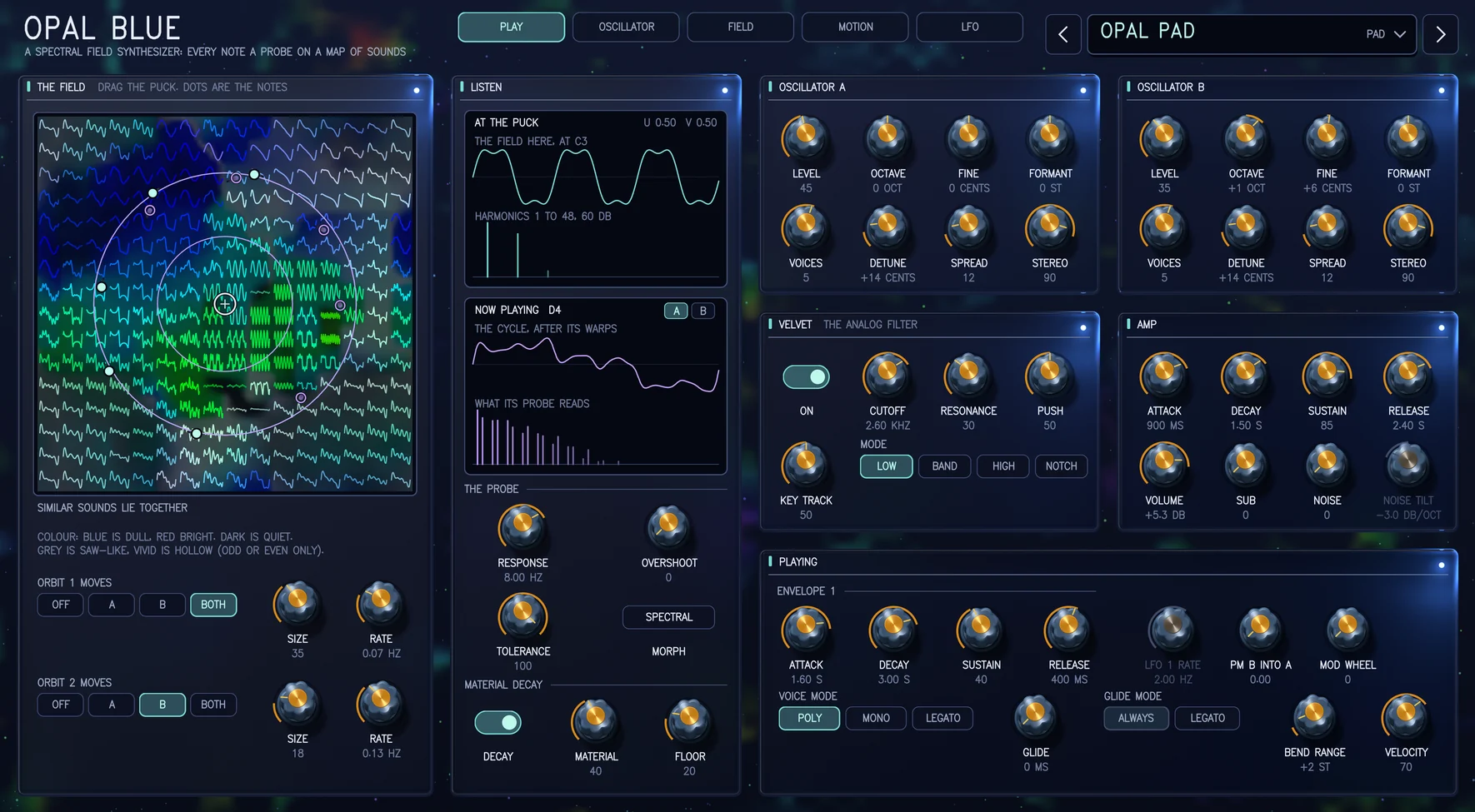
Opal Blue is a spectral field synthesizer. Where a wavetable synth has a row of waves, it has a map: a field of sounds where every place has its own spectrum and nearby places sound alike. Every note you play is a probe on that map, and what you hear is whatever lies beneath it. The map can be as plain as four points, each one any of sixty waveforms, from saws and sung vowels to plucked strings and organ stops, with every place between them a blend of all four. Or it can be an atlas of two thousand generated sounds, sorted so that like lies beside like. The notes travel across it on orbits and on paths you draw, so a held chord drifts and blooms instead of sitting still, and the panel draws the whole map as a grid of its own waveforms, so you can see where the sounds are before you go there.
VST3 · Windows 64-bit·No activationmacOS VST3 and Audio Unit are not built yet.
Not a row of wavetables
A map, and every note is a probe on it
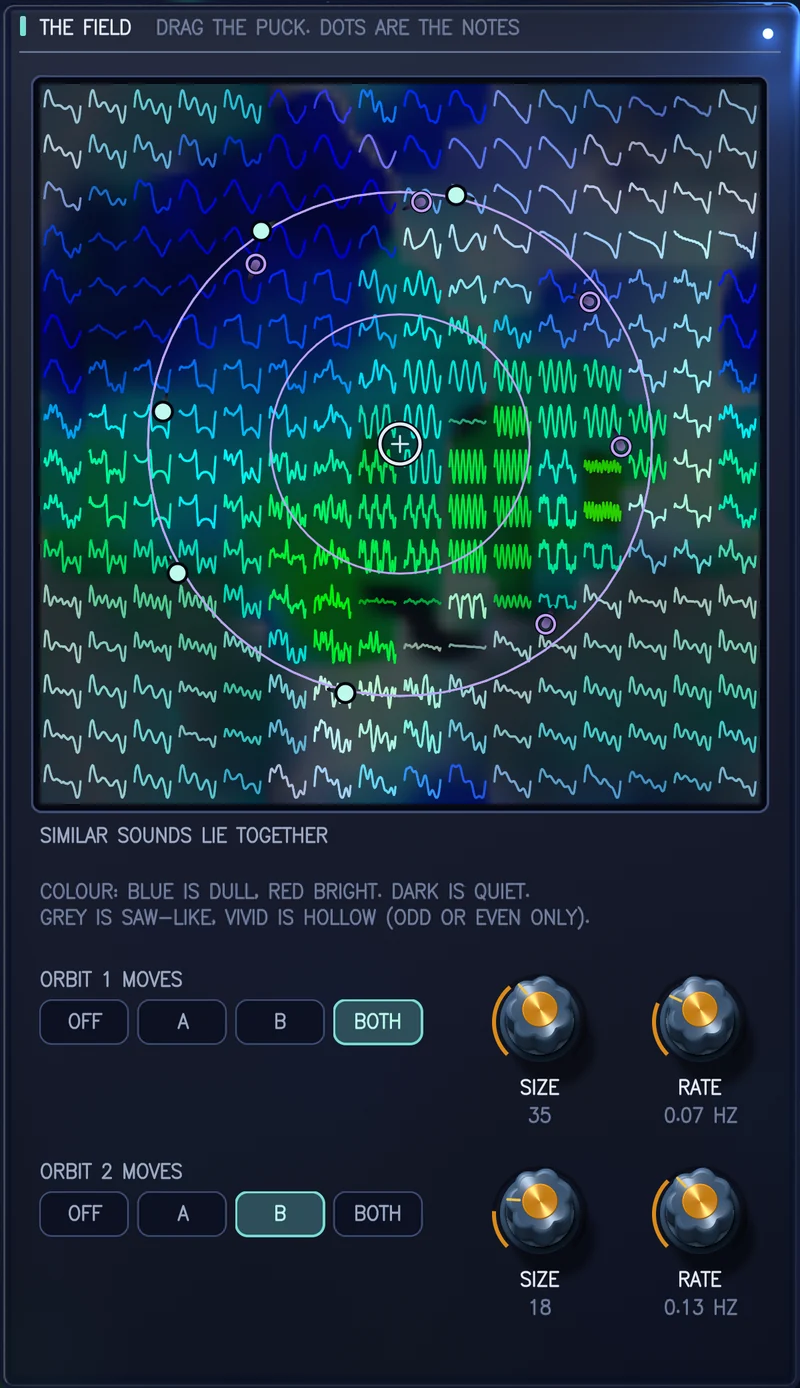
A wavetable synth reads along a line of waves. Opal Blue reads a plane: a field of sounds where every place has its own spectrum and nearby places sound alike. Each note you play is a probe standing somewhere on it, and the sound of the note is whatever is under the probe at that moment.
Drag the puck and every note goes with it. Set an orbit running and the notes circle the puck, each at its own place around the loop. Two oscillators read the map, and each can stand somewhere different on it.
The panel draws the map as a grid of its own waveforms, colored by what is there: blue where the sound is dull and red where it is bright, dark where it is quiet, grey where it is like a saw and vivid where it is hollow. You can see where the sounds are before you go there.
The field
Four points, and every place between them
The plainest map is four points. Put each one anywhere, and make each one any of sixty waveforms in ten families of six: BASIC, VOWELS, HOLLOW, BRIGHT, FM, STRINGS, SHAPES, FOLDED, NOISE and ORGAN. Every one of them is generated, not sampled, so each has knobs of its own, and you can put a sung vowel on any of them or draw a cycle by hand.
Every place on the map is a blend of all four, each weighted by one over its distance cubed: the nearer the more, and on a point, that point exactly. Move the puck below and read the weights.
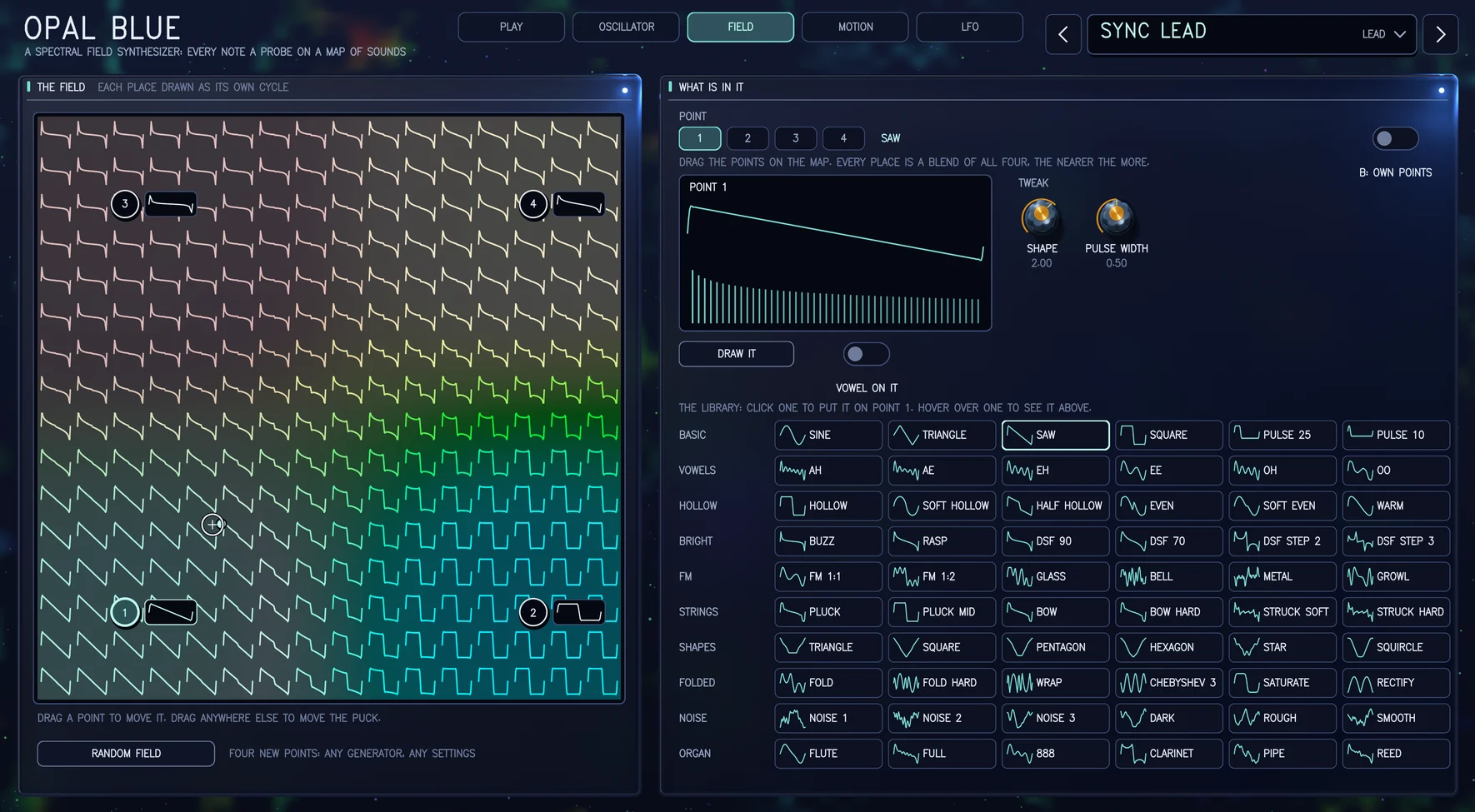
RANDOM FIELD throws four new points, one in each quarter of the map, each a generator picked at random with every setting drawn across its whole range, and now and then a vowel on top. It is random: press it twice and you get two different fields, and the patch keeps whichever one you stop on. And one factory patch, Opal Pad, stands on something bigger: an atlas of 2,048 generated sounds, sorted onto a 16 by 16 map so that like lies beside like.
Motion
Notes that travel
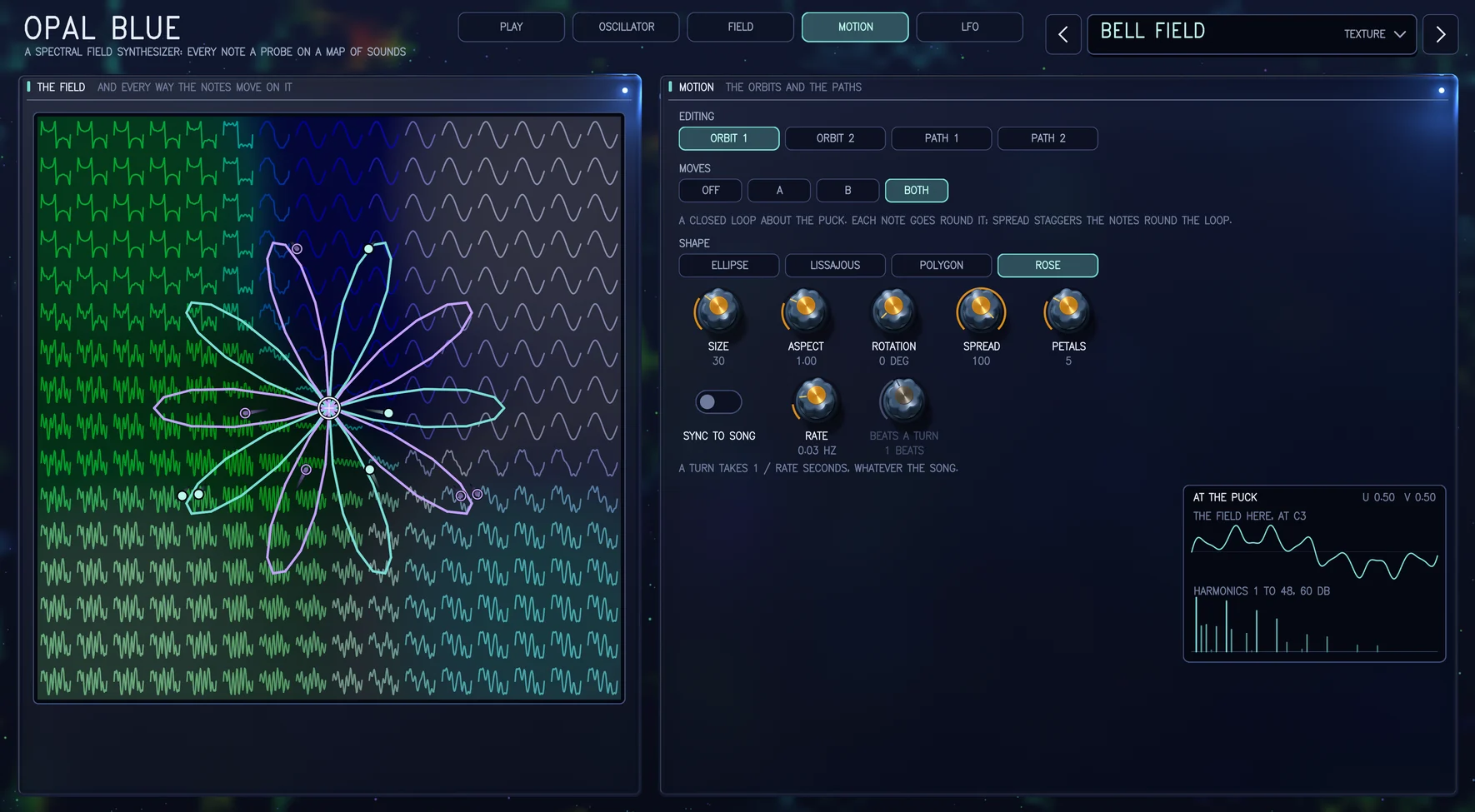
Two orbits, each an ellipse, a Lissajous figure, a polygon or a rose, with the notes spread around the loop so a chord becomes a ring of places rather than one. They run at their own rate or lock to the song, so a jump in the song is a jump in the orbit. And two paths you draw on the map with the mouse, walked at an even speed by an envelope or by anything in the matrix.
The probe follows where it is sent like a weight on a spring. RESPONSE is how quickly; OVERSHOOT is how far past it swings before it settles. A held chord drifts and blooms instead of sitting still, and every note leaves its own trail.
Petals, from r = cos kθ. An even k draws twice k petals; an odd k draws k, twice over in one turn, so notes half a turn apart meet.
What it does to what it finds
Two oscillators, and a workshop each
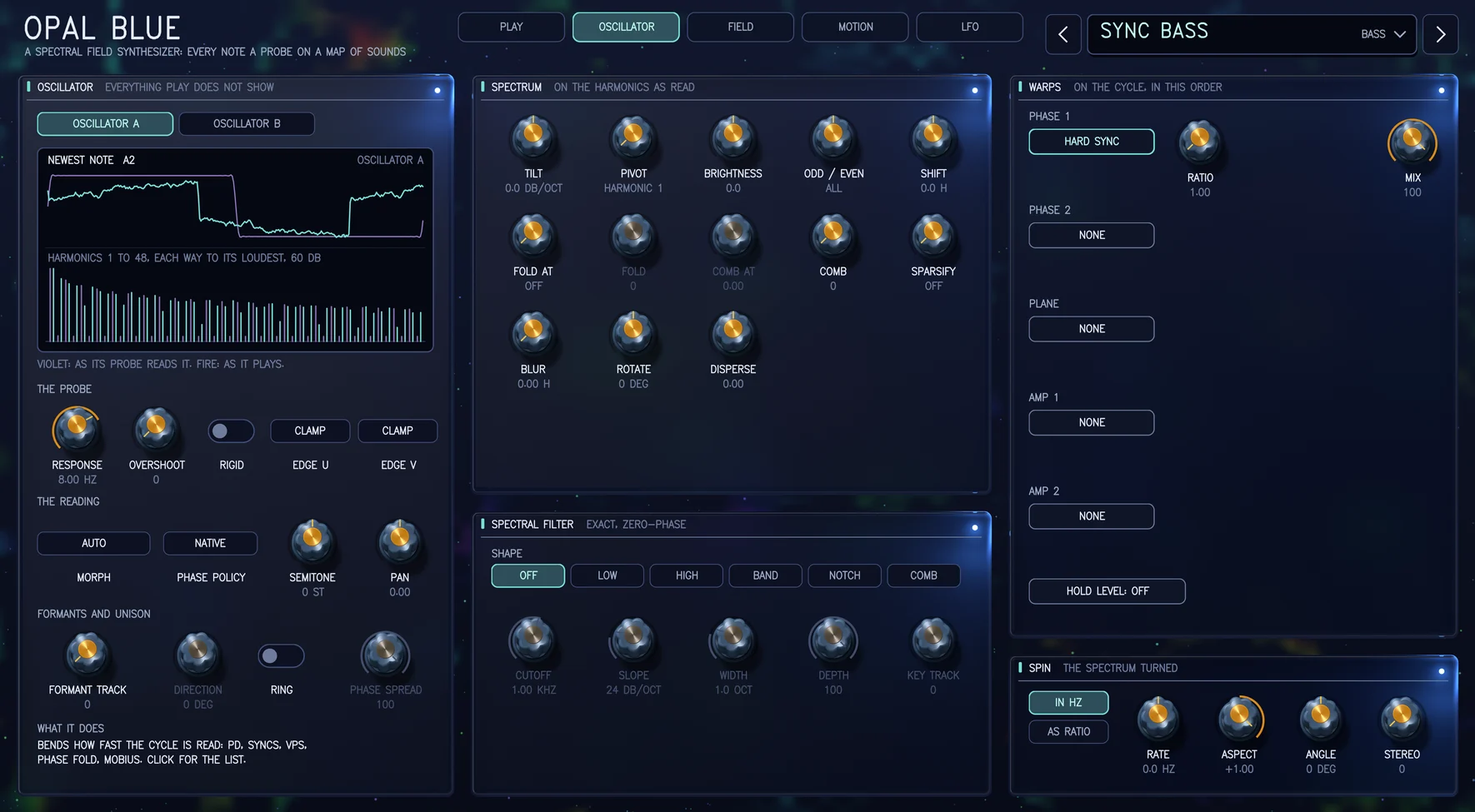
Whatever a probe reads, its oscillator can rework before you hear it. The OSCILLATOR page holds all of it, for A and for B.
SPECTRUM
Works on the harmonics as they were read: tilts them about a pivot, keeps the odd or the even, shifts them, folds the top back down, combs them the way a pluck along a string would, keeps only the strongest, blurs them together and turns their phases. Exact on every harmonic, and smooth in every knob.
SPECTRAL FILTER
Exact and zero-phase: each harmonic's level is scaled and its phase left alone, so there is no resonance to it. Low and high pass at any slope from 6 to 96 dB an octave, a band, a notch down to 60 dB and a comb, each able to follow the keyboard.
WARPS
Five slots on the cycle, in order. PHASE 1 and PHASE 2 bend how fast it is read: PD, HARD SYNC, VPS, FOLD SYNC, WINDOW SYNC, PHASE FOLD and MÖBIUS. PLANE bends it as a point circling a plane: RADIAL, POWER and CREASE. AMP 1 and AMP 2 shape its level: FOLD, WRAP, CHEBYSHEV, SATURATE and RECTIFY. Each has a MIX.
SPIN
Turns the whole spectrum. With ASPECT at +1 every harmonic moves up by the same number of hertz, at -1 down, and at 0 it is a ring modulator. Set it in hertz, or as a ratio of the note, where whole ratios keep it harmonic.
UNISON
Up to eight voices on each oscillator, detuned and spread across the stereo field, each able to read its own place on the map: along a line, or round a ring.
MORPH
How the places between points are blended: as a crossfade, by averaging the spectra in decibels, or by moving one spectrum's shape into the next. AUTO chooses, and between two settings of one generator it blends the settings themselves.
Every note its own
Eight voices, and no two alike
Poly, mono or legato, with glide. Each voice is a probe of its own, and each carries its own small departures from the others.
TOLERANCE
Each voice a little off in level, phase, formant and place on the map, and voice 3 always off in voice 3's way, whatever note it is playing.
MATERIAL DECAY
Every harmonic dies away at its own rate from the start of the note, the highs first, as felt, wood, glass or metal would.
RIGID
Takes the spring away. The probe jumps straight to where it is sent, with no glide across the map and no overshoot.
MATERIAL DECAY will not make a bell. A bell's partials are not harmonics of one note, and what it decays are harmonics.
Around it
Two LFOs, and Realgar Red's filter
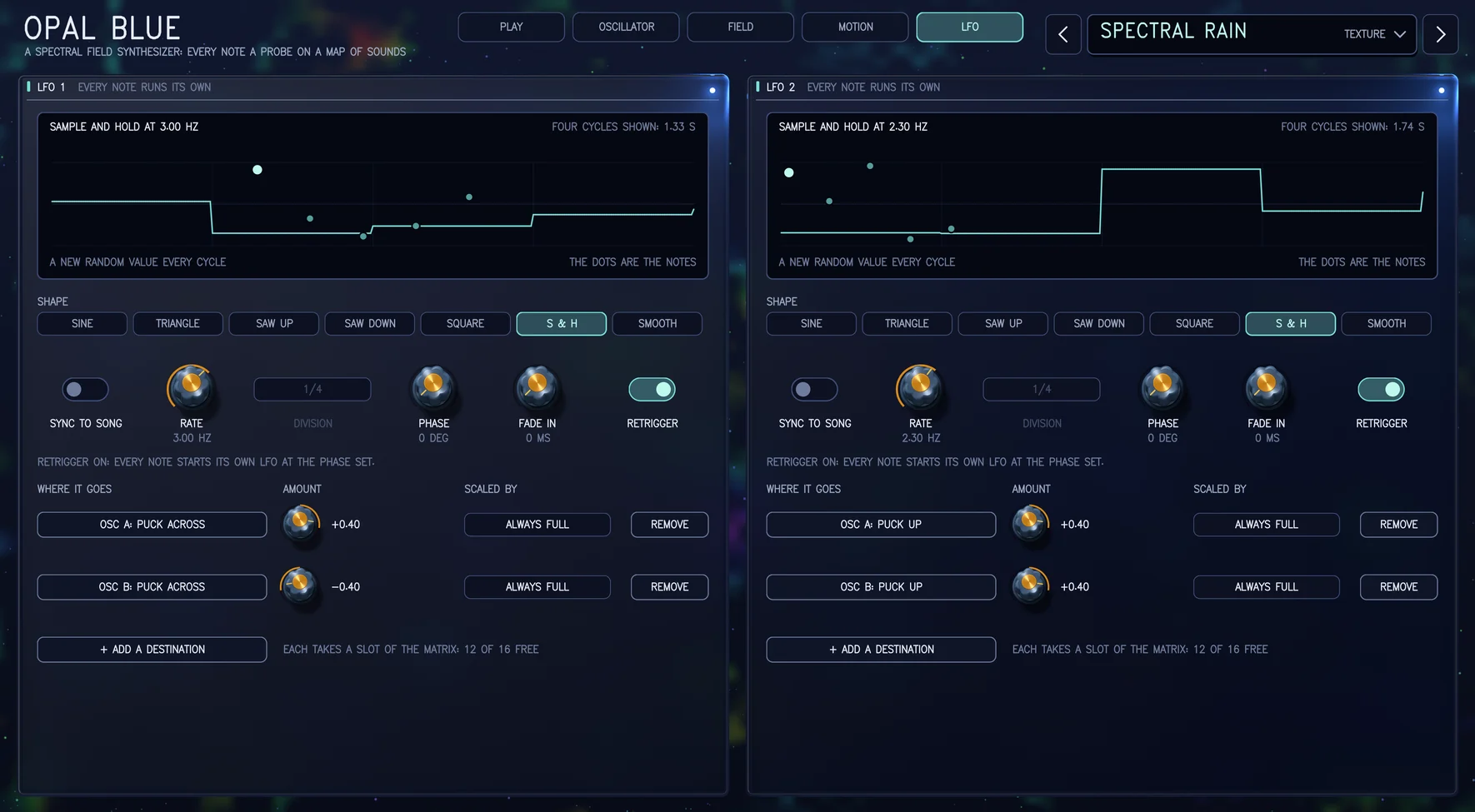
Two LFOs, each with seven shapes, free or locked to the song, with a fade in and a retrigger, and as many as four destinations each. Every note runs its own. A destination is a slot of the sixteen-slot matrix, so what an LFO is doing is never hidden somewhere else, and the menu dims the destinations that would move nothing in the patch as it stands.
Everything the oscillators make goes through VELVET, the two-pole state-variable filter from Realgar Red, with LOW, BAND, HIGH and NOTCH, PUSH for how hard it is driven, and KEY TRACK. It runs at twice your session's sample rate, as it does there.
Fifty factory patches to start from, in seven kinds: leads, pads, basses, keys, plucks, voices and textures.
Demos
14 takes, recorded by us
Recorded in Phonon. On the way here the only thing changed is the level, matched to within two decibels so you can move between them without reaching for the volume.
The name
Color that depends on where you stand
The colors in a black opal are not pigment. They are light diffracted by the stone's structure, and which one you see depends on where you stand. Every note here stands somewhere, and sounds like what is there. Its filter is Realgar Red's, built on the Phonon engine; the map, the probes and everything they read are new, written for this instrument.
VST3 · Windows 64-bit - macOS VST3 and Audio Unit are not built yet. No activation, and the plugin never asks who you are.
At a glance
Opal Blue specifications
| Format | VST3 instrument · Windows 64-bit |
|---|---|
| Not built yet | macOS VST3 and Audio Unit |
| Voices | 8 · poly, mono or legato, with glide |
| Oscillators | 2 · up to 8 unison voices each, each reading its own place on the map |
| The map | Up to 4 points from 60 generated waveforms, or an atlas of 2,048 sounds |
| Motion | 2 orbits in 4 shapes, 2 drawn paths · free or locked to the song |
| Each oscillator | Spectral operations, an exact spectral filter, 5 warp slots, SPIN |
| Filter | VELVET, from Realgar Red · low, band, high, notch · twice the session's rate |
| Modulation | 2 LFOs on the panel, 7 shapes, up to 4 destinations each · a 16-slot matrix |
| Parameters | 361 published, all automatable, and the pitch bend |
| Presets | 50, in seven kinds |
| The panel | 1416 by 780 · five pages · smoked glass over black opal, a blue LED in every card |
| Validation | 47 of 47 validator tests · host-tested in Phonon |
| Activation | None. No license server, no phone-home |